
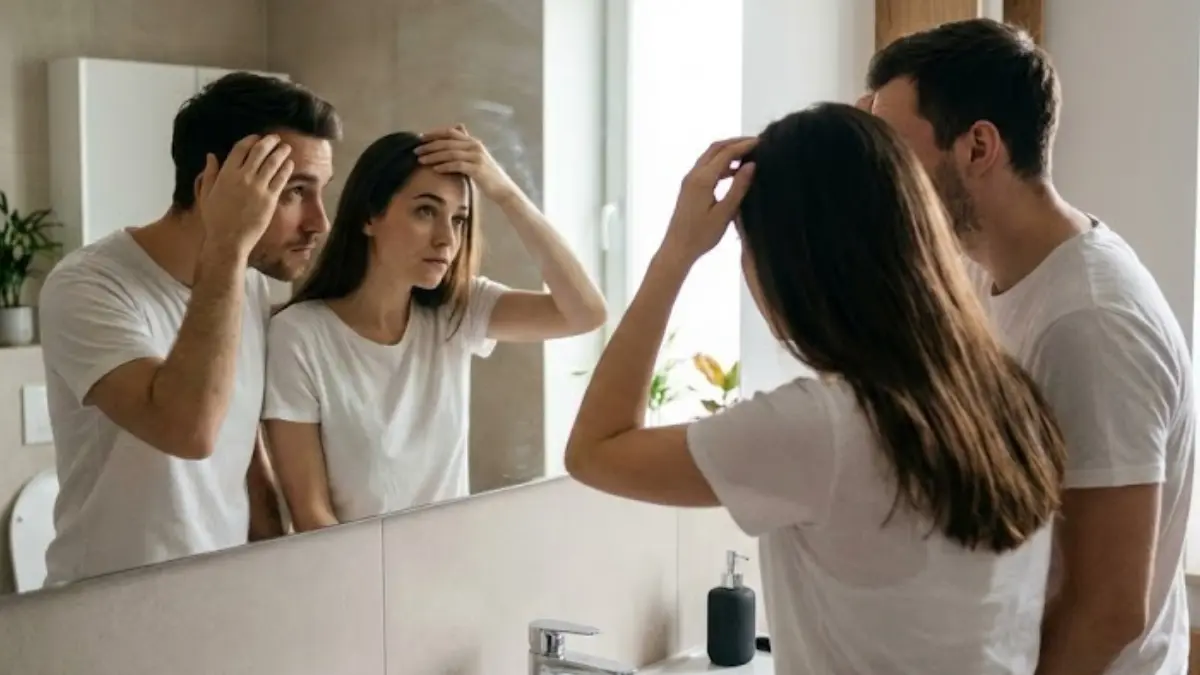
You notice more hair on your pillow, in the shower drain, and on your comb every single day. At first, you ignore it. But one morning, you catch your reflection in the mirror — and something feels different. Your hair looks thinner, your hairline seems to be moving back, and suddenly a quiet fear sets in: “Am I really losing my hair?”
Hair fall is no longer just a middle-age problem. Today, people in their early 20s are dealing with thinning hair, receding hairlines, and visible scalp. What makes it worse is the confusion. Everyone has a different theory — stress, genetics, hormones, shampoo, water, diet, pollution, lifestyle. You try one oil, one supplement, one remedy after another, but the shedding continues.
The problem is not lack of effort. The problem is lack of understanding. Most people jump straight into products without understanding what kind of hair fall they actually have. Real hair fall treatment does not start with oil or shampoo. It starts with identifying the root cause and building a system around it.
Table of Contents
TL;DR – Quick Summary
- Hair fall treatment works only when you control the root cause, not just apply products.
- Most hair loss is driven by hormones, nutrient deficiencies, stress, and scalp health.
- Real results come from combining internal correction with growth support and proper care.
- There is no single oil, pill, or shampoo that can fix hair loss on its own.
Audio version of this article: Short on time? Listen to the full audio version of this Hair Fall Treatment guide.
How Hair Actually Grows (And Why It Stops Growing)
Before talking about hair fall treatment, you need to understand one simple truth:
Hair does not fall randomly. It follows a biological cycle.
The Hair Growth Cycle (Simplified)
Every hair follicle goes through three phases:
1. Anagen (Growth Phase)
This is the active growth phase. Hair grows continuously for 2–6 years.
2. Catagen (Transition Phase)
A short phase where growth slows down and the follicle shrinks.
3. Telogen (Resting Phase)
Hair stops growing and eventually falls out to make space for new hair.
In healthy conditions, about 85–90% of your hair is always in the anagen phase. That’s why normal shedding (50–100 hairs per day) is natural.
Hair fall becomes a problem when:
- Too many follicles enter the telogen phase together
- Growth phase becomes shorter
- New hair becomes thinner than old hair
- Follicles fail to regenerate properly
This is where real hair loss begins — not when hair falls, but when regrowth fails.
The hair growth cycle is well documented in medical literature and consists of anagen, catagen, and telogen phases.
Different Types of Hair Fall (Not Everyone Loses Hair the Same Way)
One of the biggest mistakes people make is assuming all hair fall is the same. It is not. The hair fall treatment for a 25-year-old man with genetic baldness is completely different from a 30-year-old woman with iron deficiency.
Hair Fall in Men
Male hair fall usually follows a pattern:
- Receding hairline
- Thinning crown
- Gradual miniaturization of hair
This is mostly driven by genetic sensitivity to DHT (dihydrotestosterone). Over time, DHT shrinks hair follicles, reduces growth phase, and produces thinner, weaker hair until follicles become inactive.
This is called androgenetic alopecia — the most common form of hair loss in men.
DHT plays a central role in androgenetic alopecia, which has been confirmed in multiple clinical studies.
Hair Fall in Women
Female hair fall is usually diffuse, not patterned.
Instead of bald patches, women notice:
- Overall thinning
- Wider parting
- Reduced volume
- Excess shedding during washing
Common triggers include:
- Hormonal imbalance
- Iron and ferritin deficiency
- Thyroid disorders
- PCOS
- Post-pregnancy hair loss
- Chronic stress
One of the most overlooked causes of hair fall in women is hormonal imbalance. Conditions like PCOS, thyroid disorders, and menopause silently damage hair from the inside. Read our detailed guide on hormonal hair loss in women to understand exactly how hormones affect your hair — and how to fix it naturally.
This is why most female hair fall treatments fail — because they focus on external products while the problem is internal.
Iron deficiency is one of the most common causes of diffuse hair loss in women.
Seasonal Hair Fall
Seasonal shedding is real and backed by data.
You may notice increased hair fall during:
- Monsoon (humidity + scalp inflammation)
- Winter (dry scalp + poor circulation)
- Summer (UV damage + sweating)
Seasonal hair fall is usually temporary, but if your follicles are already weak, it can accelerate long-term hair loss.
This is where preventive hair fall treatment becomes important — not to panic, but to strengthen the system before damage accumulates.
Seasonal shedding is common, especially during monsoon. Here’s why hair falls in the rainy season and how to stop it naturally.
The Real Root Causes of Hair Fall

Hair fall is not caused by one single factor. It is a multi-layered biological problem.
Internal Causes (Most Important)
These directly affect follicle health from inside:
- Hormonal imbalance (DHT, thyroid, cortisol)
- Iron and ferritin deficiency
- Vitamin D and B12 deficiency
- Protein deficiency
- Insulin resistance
- Chronic stress
If these are not corrected, no external hair fall treatment will work long-term.
External Causes (Accelerators)
These don’t create hair loss, but they speed it up:
- Hard water damage
- Air pollution
- Chemical shampoos
- Heat styling
- Tight hairstyles
- Frequent hair coloring
External factors weaken the scalp environment, making follicles more vulnerable to internal damage.
The Hair Fall Treatment Framework
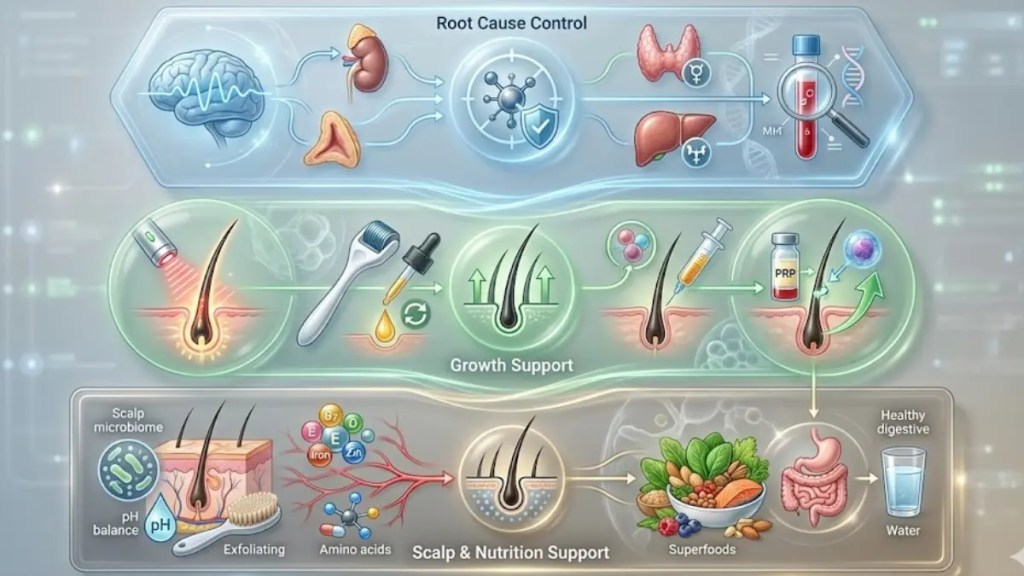
(Root Cause Control + Growth Support + Scalp Health)
This is the mental model that actually works.
Real hair fall treatment has three layers:
1. Root Cause Control
Stop what is damaging follicles internally
(DHT, deficiencies, hormones, stress)
2. Growth Support
Stimulate weak follicles
(Minoxidil, caffeine, redensyl, rosemary)
3. Scalp & Nutrition Support
Create a healthy environment
(Diet, herbs, oils, gentle products)
Most people only do Layer 2 and ignore Layer 1.
That’s why results are temporary.
Growth without cause control is like filling water in a leaking bucket.
Hormonal Hair Fall: When Your Own Body Works Against Your Hair
Hormonal imbalance is one of the most underestimated causes of chronic hair loss. Most people think hormones only matter in extreme cases, but the truth is simple: hair follicles are highly sensitive to hormonal signals.
DHT and Hair Loss (The Male Pattern Trigger)
DHT (dihydrotestosterone) is a byproduct of testosterone. In people who are genetically sensitive, DHT slowly damages hair follicles by:
- Shrinking follicle size
- Reducing growth phase
- Producing thinner hair every cycle
Over time, this process leads to miniaturization, where thick terminal hair becomes thin, invisible hair.
This is why male pattern baldness is progressive. It does not stop on its own. Without proper hair fall treatment, DHT-driven hair loss always continues in the background.
For a deeper breakdown of how DHT works and how to block it naturally, read our complete DHT Blocker Guide.
Thyroid and Female Hair Loss
Thyroid disorders affect both men and women, but women are far more vulnerable.
When thyroid hormones are imbalanced:
- Hair growth slows down
- More follicles enter resting phase
- Shedding increases across the entire scalp
The dangerous part is that thyroid-related hair loss looks “normal” from outside. There are no bald patches, just constant thinning.
No oil or shampoo can fix this. Only medical diagnosis + internal correction works here.
PCOS and Hormonal Hair Fall in Women
PCOS (Polycystic Ovary Syndrome) creates a hormonal environment where:
- Androgen levels increase
- Insulin resistance develops
- Scalp follicles weaken
- Facial hair may increase while scalp hair falls
This is one of the most emotionally frustrating types of hair loss because women feel like their body is doing the opposite of what it should.
PCOS-related hair fall treatment must focus on:
- Hormone balance
- Insulin control
- Nutrition
- Stress regulation
External products alone are useless in this case.
Even lifestyle supplements like creatine may increase DHT levels in some individuals, which can indirectly affect hair loss.
Nutritional Hair Fall: When Your Body Lacks Building Material
Hair is a non-essential tissue for the body.
When nutrients are limited, the body prioritizes organs, not hair.
That’s why nutritional deficiencies hit hair first.
Iron and Ferritin Deficiency
This is the number one cause of hair loss in women globally.
Low iron leads to:
- Reduced oxygen delivery to follicles
- Shorter growth phase
- Weak, thin regrowth
Most people check hemoglobin, but the real marker is ferritin (iron storage).
Ferritin below 40 = hair growth will struggle.
Ferritin below 20 = shedding becomes aggressive.
No external hair fall treatment works until iron is corrected.
Vitamin D and B12 Deficiency
Vitamin D affects:
- Follicle activation
- Immune regulation
- Inflammation control
Low vitamin D is linked with:
- Telogen effluvium
- Alopecia areata
- Chronic shedding
Vitamin B12 deficiency leads to:
- Poor cell division
- Weak hair shaft
- Fatigue and slow regrowth
These deficiencies silently destroy hair growth potential from inside.
Protein Deficiency
Hair is made of keratin, which is protein.
Low protein intake leads to:
- Thin hair
- Slow growth
- Excess shedding
- Poor recovery after hair fall
Most people underestimate this because they eat “enough food” but not enough protein.
Hair fall treatment without adequate protein is biologically impossible.
Stress and Lifestyle Hair Fall (The Silent Killer)
Chronic stress increases cortisol. Cortisol pushes hair follicles into resting phase.
This condition is called telogen effluvium.
Common triggers:
- Emotional trauma
- Job stress
- Poor sleep
- Overtraining
- Crash dieting
Stress-related hair fall is deceptive because:
- It starts 2–3 months after stress
- People forget the original trigger
- They blame products instead
If stress is not controlled, any hair fall treatment becomes temporary.
Growth Stimulators: Supporting Regrowth (Not Root Cause)
This is where most people start — and also where most people get stuck.
Growth stimulators do not fix the cause.
They only push follicles to perform better.
Minoxidil (The Most Popular)
Minoxidil works by:
- Increasing blood flow
- Extending growth phase
- Activating weak follicles
It does not block DHT.
It does not correct deficiencies.
It does not fix hormones.
Minoxidil is a support tool, not a cure.
This is why people experience:
- Good results while using
- Heavy shedding after stopping
I have also shared my personal experience on how I naturally stopped Minoxidil and maintained hair growth without chemicals.
Natural Growth Stimulators
These improve scalp environment and circulation:
- Caffeine
- Rosemary oil
- Peppermint oil
- Redensyl / Procapil
They are weaker than minoxidil, but:
- Safer long-term
- No dependency
- Good for early-stage hair fall
Natural growth stimulators work best when:
- Root causes are controlled
- Nutrition is adequate
- Stress is managed
Otherwise, results remain limited.
The Core Truth About Hair Fall Treatment (So Far)
At this point, one thing should be clear:
Hair fall is not a surface problem.
It is a systemic biological imbalance.
Real hair fall treatment requires:
- Hormonal stability
- Nutritional sufficiency
- Stress regulation
- Scalp support
- Consistency for months
Anything that ignores these layers becomes a temporary cosmetic fix, not a real solution.
Herbal & Ayurvedic Hair Fall Treatment (The Scalp Healing Layer)
Modern hair fall treatment cannot rely only on chemicals and drugs. Traditional systems like Ayurveda understood something very early:
hair does not grow on a damaged scalp.
Herbal treatment focuses on:
- Reducing scalp inflammation
- Improving blood circulation
- Strengthening follicles naturally
- Creating a healthy growth environment
Herbs do not act like instant medicines. They work slowly, but they work at the root level.
Most Effective Herbs for Hair Fall
Bhringraj
Often called the “king of herbs for hair”. It improves circulation to hair follicles and supports regrowth in weak areas.
Amla
Rich in antioxidants and vitamin C. It protects follicles from oxidative damage and indirectly supports DHT control.
Brahmi
Highly effective for stress-related hair fall. It calms the nervous system and reduces cortisol impact.
Neem
Best for dandruff, fungal infections, itching, and scalp inflammation.
Hibiscus
Strengthens hair shaft and reduces breakage.
Aloe Vera
Hydrates the scalp, reduces irritation, and improves follicle environment.
Herbs do not create miracles.
They repair the environment where natural growth becomes possible.
Hair Fall Products: What Actually Works (And What Is Just Marketing)
This is where most people get trapped.
Every brand claims:
“clinically proven”, “dermatologist approved”, “100% natural”.
The reality:
Most products are support tools, not solutions.
Shampoos for Hair Fall
A good shampoo should:
- Keep scalp clean
- Reduce inflammation
- Avoid harsh chemicals
A shampoo cannot regrow hair.
Its job is to prevent further damage.
Avoid:
- SLS
- Parabens
- Harsh fragrances
Many popular shampoos contain harmful ingredients. Here’s why SLS and parabens in shampoo may damage your scalp long-term.
Oils for Hair Growth
Oils help with:
- Scalp massage
- Blood circulation
- Stress reduction
Best oils:
- Onion oil
- Castor oil
- Coconut oil
- Bhringraj oil
Oil does not grow new follicles.
Oil creates a healthy scalp environment.
Healthy environment = better chance of regrowth.
Supplements for Hair Fall
Supplements only work when:
- A real deficiency exists
- Blood tests confirm it
Useful supplements:
- Iron (if ferritin is low)
- Vitamin D
- Vitamin B12
- Zinc
- Biotin (supportive only)
Blind supplementation is not hair fall treatment.
It is expensive guessing.
Hair Fall Treatment Comparison Table (Decision Framework)
| Hair Fall Type | Root Cause | Best Treatment Approach |
|---|---|---|
| Male pattern baldness | DHT sensitivity | DHT blockers + growth stimulators |
| Female diffuse thinning | Iron / hormones | Blood correction + nutrition |
| Stress hair fall | Cortisol | Stress control + sleep + diet |
| Seasonal shedding | Scalp inflammation | Herbal care + gentle routine |
| Product damage | Chemicals | Clean products + scalp healing |
| PCOS hair fall | Hormonal imbalance | Medical support + lifestyle |
One core truth from this table:
There is no single hair fall treatment that works for everyone.
Advanced Medical Treatments (When Natural Is Not Enough)
Some cases genuinely need medical support.
PRP (Platelet-Rich Plasma)
Your own blood plasma injected into scalp to stimulate follicles.
GFC (Growth Factor Concentrate)
A more concentrated and advanced form of PRP.
Mesotherapy
Nutrient injections directly into the scalp.
Hair Transplant
Used when follicles are permanently dead.
Medical procedures are not shortcuts.
They work best after internal issues are fixed.
Otherwise, results fade.
New treatments like Breezula for hair loss are also being studied for their role in blocking androgen receptors at the follicle level.
Hair Loss Myths That Destroy Progress
“Oil grows hair”
Oil improves scalp. Growth depends on follicles.
“Shaving makes hair thicker”
Shaving changes appearance, not biology.
“Grey hair causes baldness”
Greying and baldness are separate processes.
“Daily washing causes hair fall”
Hair that falls was already in resting phase.
When You Should Stop Self-Treating and See a Doctor
Consult a professional if:
- Bald patches appear
- Sudden heavy shedding
- Itching, pain, redness
- Hair fall with fatigue or weight loss
- No improvement after 3–4 months
Self-treatment has limits.
Ignoring medical signs makes damage permanent.
The Real Hair Fall Treatment Formula (Final Truth)
Hair fall is not a product problem.
Hair fall is a system problem.
Real hair fall treatment works only when:
- Root causes are controlled
- Hormones are balanced
- Deficiencies are corrected
- Stress is managed
- Scalp is healthy
- Growth is supported
- And consistency is maintained for months
There is no oil, no pill, no shampoo that can replace this system.
Hair regrowth is slow.
But hair loss is also slow.
The people who win are not the ones who try everything.
They are the ones who understand the system and stick to it.
FAQ:
These are the most common questions people ask about hair fall treatment, based on real user searches and medical research.
What is the most effective hair fall treatment?
The most effective hair fall treatment is not a single product, but a complete system. It includes controlling the root cause (such as DHT, hormonal imbalance, or nutrient deficiency), supporting regrowth with proven stimulators, and maintaining scalp health through proper care and lifestyle changes. Without fixing internal causes, no external treatment works long-term.
Can hair fall be stopped permanently?
Hair fall can be controlled and significantly reduced in most cases, but “permanent stopping” depends on the cause. Genetic and hormonal hair loss requires long-term management, while nutritional and stress-related hair fall can often be fully reversed once the underlying issue is corrected.
Is natural hair fall treatment better than medical treatment?
Natural hair fall treatment is safer for long-term scalp health and mild hair loss, but medical treatment is necessary for advanced genetic or hormonal hair loss. The best results come from combining both — using medical solutions to control damage and natural methods to support scalp and follicle health.
Can lost hair grow back?
Yes, hair can grow back if the follicles are still alive. Hair regrowth is possible in early and moderate stages of hair loss when root causes like DHT, iron deficiency, stress, or inflammation are controlled. If follicles are permanently damaged, regrowth becomes unlikely without medical procedures.
How long does hair fall treatment take to show results?
Hair fall treatment usually takes 3 to 6 months to show visible improvement. Hair growth is a slow biological process, and real results depend on consistency. Quick results are often temporary, while sustainable regrowth requires long-term commitment to the treatment system.
This article is for educational purposes only. Hair fall can have medical, hormonal, and genetic causes that require professional diagnosis. Always consult a qualified healthcare professional before starting any medical or supplement-based hair fall treatment.


14 thoughts on “Hair Fall Treatment: The Ultimate Guide to Why You’re Losing Hair and How to Actually Fix It”