
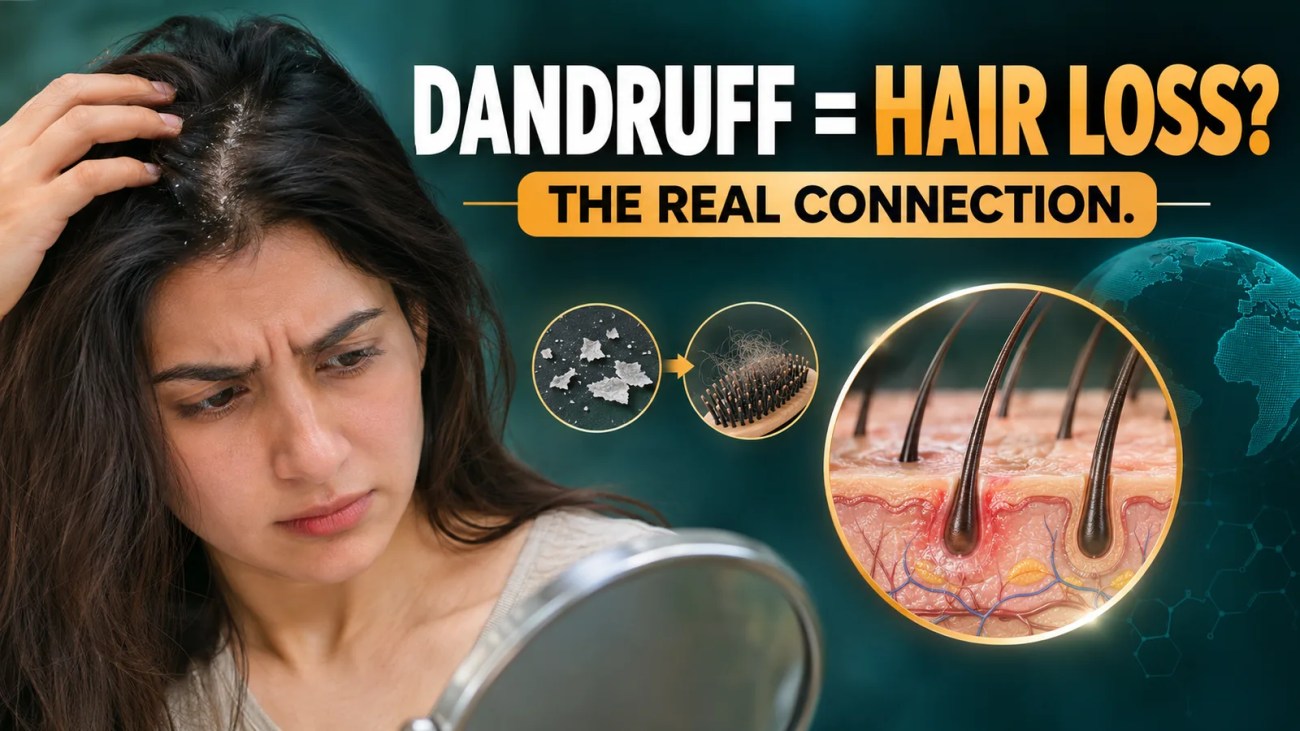
Seeing flakes on your shoulders is frustrating, but finding more hair in your shower drain can turn that frustration into real fear.
Does dandruff cause hair loss, or are the flakes and excessive shedding two separate problems?
This article uncovers the real connection, explains when hair can grow back after treatment, and shows you how to identify the scalp conditions that need more than an ordinary anti-dandruff shampoo.
Does dandruff cause hair loss? The answer is more complicated than most people think. Ordinary dandruff does not usually cause permanent baldness or destroy hair follicles. However, persistent itching, repeated scratching, scalp irritation, and certain conditions that look like dandruff can contribute to hair breakage or temporary hair shedding. The key is understanding what is happening beneath those flakes.
Does Dandruff Really Cause Hair Loss?
Dandruff is a common scalp condition that causes small white or yellowish flakes to appear on the scalp and hair. It can also cause itching and irritation.
The Mayo Clinic describes dandruff as a mild form of seborrheic dermatitis, with possible contributing factors including oily or irritated skin, dry skin, Malassezia yeast, sensitivity to hair-care products, and other skin conditions such as psoriasis and eczema.
The important distinction is that dandruff itself does not normally cause permanent hair loss. Hair follicles generally continue their normal growth cycle even when the scalp produces visible flakes.
However, the problem becomes more complicated when dandruff is persistent or accompanied by intense itching.
How can dandruff contribute to hair fall?
There are three important ways scalp problems can affect the appearance and condition of your hair.
1. Repeated scratching can damage hair
An itchy scalp creates a strong urge to scratch. Repeated scratching with fingernails can irritate the skin, weaken already fragile hair shafts, and pull out hairs that are ready to shed.
Aggressive scratching does not automatically destroy hair follicles, but it can worsen irritation and make existing shedding more noticeable.
2. Scalp irritation can make the problem worse
Seborrheic dermatitis causes redness, itching, and scaling. When symptoms remain uncontrolled, the urge to scratch and remove scales increases.
This creates a cycle of irritation and mechanical damage. Treating the underlying scalp condition helps break that cycle.
3. Dandruff and another hair-loss condition can happen together
This is something many people overlook.
A person can have dandruff and genetic hair loss at the same time. Similarly, stress-related shedding, nutritional deficiencies, and hormonal changes can occur alongside an itchy, flaky scalp.
In these situations, treating dandruff may improve scalp health without solving the separate cause of hair loss.
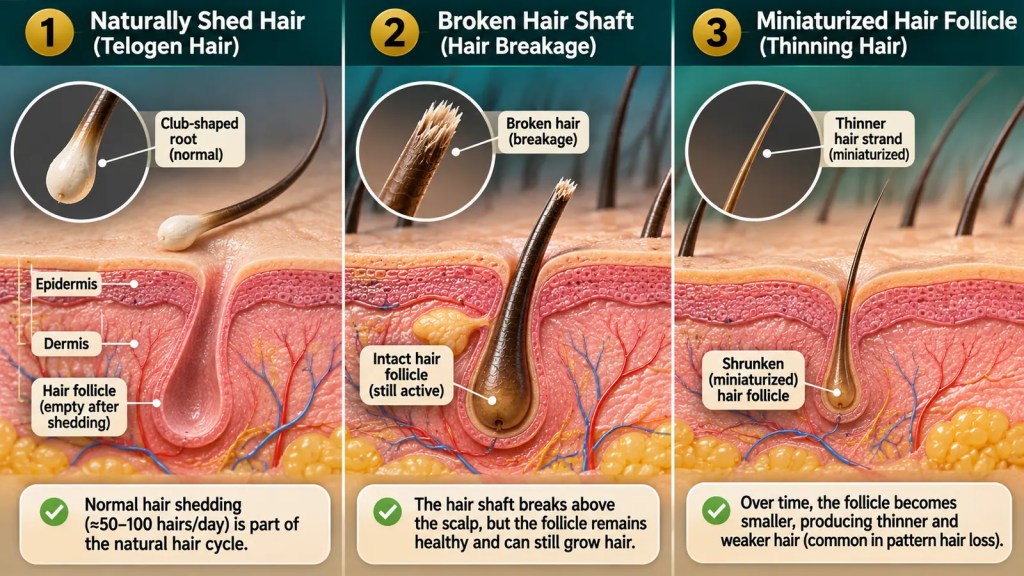
Hair Shedding vs Hair Breakage vs Actual Hair Loss
Before assuming that dandruff is making you bald, understand what is actually happening to your hair.
These three problems look similar when you notice hair on your pillow, comb, or shower floor, but their causes are different.
Hair shedding
Hair shedding happens when a hair completes its natural growth cycle and falls out from the follicle.
It is normal to lose some hair every day. However, excessive shedding can occur after physical illness, emotional stress, rapid weight loss, nutritional problems, and other triggers.
Hair breakage
Hair breakage occurs when the hair shaft snaps before reaching the end of its natural growth cycle.
The broken strands are often shorter than your normal hair and may have uneven or frayed ends. Scratching, rough brushing, chemical damage, and excessive heat can contribute to breakage.
Actual hair loss
Actual hair loss involves reduced hair density, visible thinning, receding hairlines, or bald patches. It can result from genetic, hormonal, inflammatory, infectious, or autoimmune conditions.
Recognising these differences matters because hair shedding, hair breakage, and permanent hair loss do not require the same treatment.
Dandruff vs Dry Scalp vs Seborrheic Dermatitis
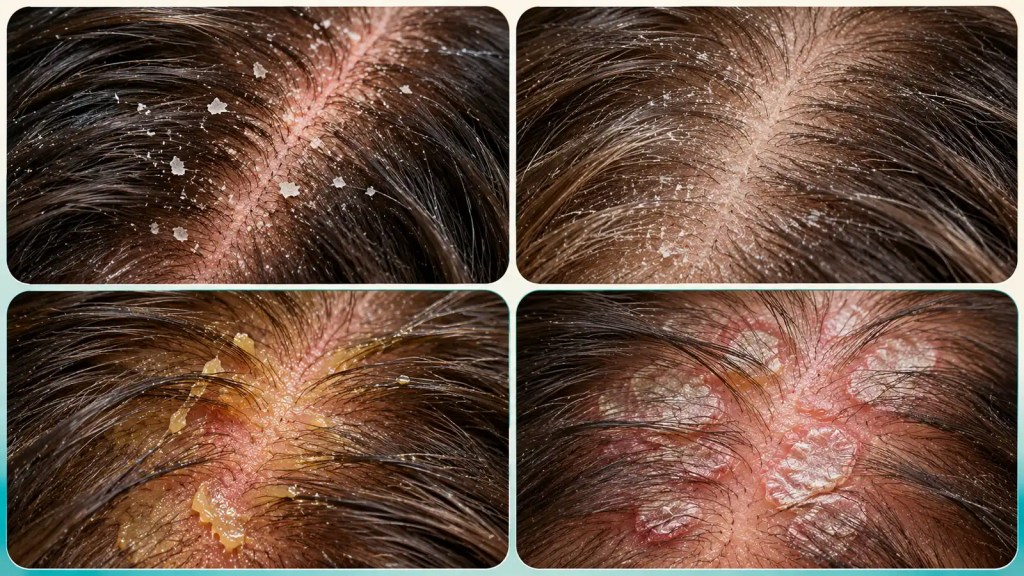
Not every flaky scalp has the same underlying cause. Using the wrong treatment can leave the real problem unresolved.
| Condition | Common signs | Possible hair-related effects |
|---|---|---|
| Dandruff | White flakes and itching | Scratching-related breakage or noticeable shedding |
| Dry scalp | Fine flakes, tightness, dryness | Breakage if hair becomes dry and fragile |
| Seborrheic dermatitis | Greasy scales, redness, itching | Temporary shedding or breakage associated with irritation |
| Scalp psoriasis | Thick scales, defined patches, redness | Temporary hair loss from scratching or forcefully removing scales |
| Tinea capitis | Scaly patches, broken hairs, black dots | Patchy hair loss and possible scarring if treatment is delayed |
The appearance of flakes alone cannot confirm which condition you have. Persistent symptoms, painful areas, or visible patches of hair loss deserve a proper scalp examination.
Other Scalp Conditions That Can Cause Hair Loss
Sometimes what looks like ordinary dandruff is actually another scalp disorder. These conditions need different treatments, and delaying the correct diagnosis can affect recovery.
1. Seborrheic dermatitis
Seborrheic dermatitis is a common inflammatory skin condition that causes flaky, greasy scales and itching.
It is associated with Malassezia yeast, natural skin oils, and an individual inflammatory response. It is not simply a sign of poor hygiene.
Mild cases may respond to medicated anti-dandruff shampoos, but recurring or severe symptoms can require additional treatment.
2. Scalp psoriasis
Scalp psoriasis is an immune-mediated condition that causes thick, raised patches covered with dry, often silvery scales.
Unlike ordinary dandruff, these patches can become very itchy, sore, or cracked. Scratching and forcefully removing scales can pull out hair.
The good news is that hair usually regrows after scalp psoriasis clears, provided the hair follicles have not been permanently damaged. The American Academy of Dermatology explains how scalp psoriasis and repeated scratching can contribute to temporary hair loss and why forcefully removing scales should be avoided.
3. Tinea capitis or scalp ringworm
Tinea capitis is a fungal infection of the scalp that can resemble severe dandruff.
However, it can also cause circular scaly patches, broken hairs, black dots, swollen areas, and sometimes pus-filled sores.
This condition requires medical diagnosis and prescription oral antifungal medication. MedlinePlus explains that scalp ringworm can cause permanent hair loss and scarring, and that medicated shampoo alone cannot cure the infection. Early diagnosis and appropriate antifungal treatment are essential to prevent complications.
Delayed treatment can lead to scarring and permanent hair loss.
4. Contact dermatitis
Sometimes the scalp reacts to ingredients in shampoos, hair dyes, fragrances, styling products, or other hair-care products.
The result can be itching, redness, burning, flaking, and irritation. Continuing to use the triggering product can make symptoms worse.
If irritation repeatedly appears after using a particular product, stop using it and seek medical advice if symptoms persist.
Will Hair Grow Back After Treating Dandruff?
This is probably the most important question for anyone experiencing both dandruff and hair fall.
In most cases, ordinary dandruff does not permanently damage hair follicles. Therefore, if increased hair shedding is related to scratching or temporary scalp irritation, the hair can recover once the underlying problem is controlled.
However, hair regrowth depends on the actual cause of hair loss, not simply on whether the flakes disappear.
Here is how different conditions affect recovery.
When hair loss is related to ordinary dandruff
If the main issue is repeated scratching and hair breakage, stopping the irritation and handling your hair gently can allow healthier growth.
Hair that has fallen out naturally will follow its normal growth cycle. Hair shafts that have broken need time to grow out.
When hair loss is related to seborrheic dermatitis
Controlling inflammation, itching, and scaling can improve scalp health.
Hair shedding associated with irritation can improve once the condition is under control. However, persistent thinning needs further evaluation because another hair-loss condition may be present.
When hair loss is related to scalp psoriasis
The American Academy of Dermatology explains that hair usually regrows after scalp psoriasis clears.
Avoid picking scales or scraping the scalp because this can remove hair along with the scales and worsen the condition.
When hair loss is caused by scalp ringworm
Hair often regrows after the infection is successfully treated, but delayed treatment can cause scarring and permanent hair loss.
This is why unexplained bald patches, broken hairs, and painful or swollen scalp areas should never be treated as ordinary dandruff.
When dandruff and genetic hair loss occur together
Treating dandruff will not reverse androgenetic alopecia, commonly called male or female pattern hair loss.
This condition involves genetic susceptibility and sensitivity of hair follicles to androgens. In affected individuals, follicles gradually become smaller, producing thinner and shorter hairs.
Understanding the role of DHT and genetic hair loss is important when thinning continues even after scalp symptoms improve.
Likewise, widespread shedding caused by stress, illness, or other physical triggers can indicate telogen effluvium, which is a different condition from dandruff-related irritation.
How to Treat Dandruff Without Worsening Hair Fall
The right treatment depends on the cause and severity of your scalp condition. For uncomplicated dandruff, medicated shampoos are often the first treatment option. The American Academy of Dermatology’s recommendations for choosing and using dandruff shampoo explain which active ingredients to look for, how to apply the shampoo, and why usage instructions matter.
Best active ingredients in anti-dandruff shampoos
| Active ingredient | Main function |
|---|---|
| Ketoconazole | Antifungal action against Malassezia |
| Selenium sulfide | Helps control yeast and scalp flaking |
| Zinc pyrithione | Antimicrobial and antifungal activity |
| Salicylic acid | Helps loosen and remove accumulated scales |
| Coal tar | Helps slow excessive skin-cell turnover |
| Sulfur | Helps manage scaling and flaking |
These ingredients do not work in exactly the same way. Your choice should depend on the scalp condition, product formulation, local availability, and professional advice.
For example, ketoconazole is commonly used in medicated shampoos for dandruff associated with yeast. Understanding the formulation and correct use of a ketoconazole shampoo is more useful than choosing a product simply because it promises fast results.
How to use anti-dandruff shampoo correctly
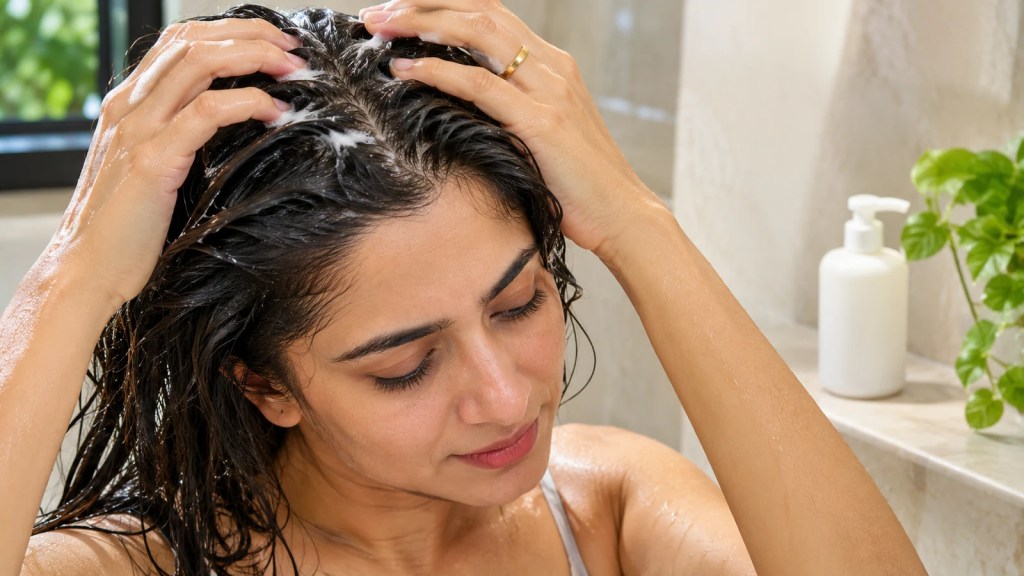
Even an effective shampoo can produce disappointing results when used incorrectly.
Follow these practices:
- Apply it to the scalp: The active ingredient needs to reach the affected scalp rather than simply coat the hair.
- Follow the contact time: Some medicated shampoos need to remain on the scalp for several minutes before rinsing. Follow the product instructions.
- Use the recommended frequency: Different ingredients and formulations have different instructions. Daily use is not necessary for every medicated shampoo.
- Avoid aggressive rubbing: Massage gently with your fingertips instead of scratching with your nails.
- Rinse properly: Remove shampoo residue without using excessively hot water.
- Monitor irritation: Stop using a product that causes significant burning, worsening redness, or a reaction, and seek medical advice.
The American Academy of Dermatology recommends choosing a shampoo according to your scalp and hair type and following its instructions carefully.
Common mistakes that can worsen scalp problems
Some habits make an irritated scalp harder to manage.
Scraping flakes with fingernails: Pulling off scales can damage the scalp and hair.
Using several medicated shampoos randomly: Switching products too frequently makes it difficult to understand what is helping or causing irritation.
Applying irritating home remedies: Lemon juice, strong essential oils, and undiluted acidic mixtures can irritate sensitive skin.
Ignoring persistent symptoms: Continued itching, redness, or patchy hair loss should not be dismissed as stubborn dandruff.
Expecting shampoo to cure every scalp condition: A dandruff shampoo cannot replace prescription treatment for psoriasis or scalp fungal infections.
Why Is Your Hair Still Falling After Dandruff Treatment?
Suppose your dandruff has improved. The flakes are reduced, your scalp feels less itchy, and your shampoo is working.
But your hair is still falling.
This is an important clue that the underlying hair loss may have another cause.
Stress-related hair shedding
Significant emotional stress, fever, illness, surgery, or rapid weight loss can trigger telogen effluvium.
In this condition, more hair follicles enter the resting phase and shed later. The shedding often becomes noticeable after the original trigger, which is why people do not always connect the two events.
Nutritional deficiencies
Iron deficiency and certain other nutritional deficiencies can contribute to hair shedding in some people.
However, hair loss alone cannot tell you which nutrient is deficient. Randomly taking supplements is not a reliable solution.
The correct approach is to identify the underlying problem and correct a confirmed deficiency. The relationship between vitamin deficiencies and hair loss is not identical for every nutrient.
Genetic and hormonal hair loss
Gradual thinning around the temples, hairline, or crown can indicate pattern hair loss.
Unlike temporary shedding, androgenetic alopecia can progress if left untreated. It requires a separate assessment and treatment plan.
The role of DHT in male and female pattern hair loss is particularly relevant when scalp symptoms improve but hair density continues to decline.
A comprehensive evaluation of different hair fall causes and treatment approaches can help distinguish these problems.
When Should You See a Dermatologist?
Occasional flakes and mild itching are common, but persistent or severe symptoms should not be ignored. The NHS recommends seeking medical advice when dandruff does not improve after at least four weeks of anti-dandruff shampoo use, particularly when the scalp is very itchy, red, or swollen.
Do not keep experimenting with shampoos when you notice:
- Hair loss in distinct patches.
- Broken hairs or black dots on the scalp.
- Severe itching, redness, or swelling.
- Painful areas, pus, or crusted sores.
- Thick scales that bleed when disturbed.
- Flaking that also affects your face or other body areas.
- Dandruff that does not improve after at least four weeks of anti-dandruff shampoo use.
- Hair thinning that continues despite successful dandruff treatment.
A dermatologist can examine the scalp, identify the pattern of hair loss, and decide whether additional tests or treatments are necessary.
Depending on the symptoms, evaluation may involve scalp examination, dermoscopy, fungal testing, or selected blood tests. Not everyone needs the same investigations.
Early diagnosis is particularly important when a fungal infection or a scarring scalp condition is suspected.
Frequently Asked Questions
1. Can dandruff cause permanent hair loss?
Ordinary dandruff does not usually cause permanent hair loss. Repeated scratching can contribute to temporary shedding or breakage. However, certain conditions that resemble dandruff, including severe scalp infections, can cause lasting damage if treatment is delayed.
2. Will hair grow back after treating dandruff?
Yes, hair can grow back when shedding is related to temporary scalp irritation or scratching and the follicles remain healthy. However, recovery depends on the underlying cause. Genetic hair loss will not reverse simply by treating dandruff.
3. Does scratching dandruff cause hair loss?
Repeated scratching can irritate the scalp, break fragile hair, and pull out hairs. It can also worsen inflammatory scalp conditions. Avoid using fingernails or sharp tools to remove flakes.
4. Can severe dandruff cause hair thinning?
Severe or persistent scalp irritation can make hair breakage and shedding more noticeable. However, visible thinning should be investigated because genetic hair loss, infections, and other scalp conditions may exist alongside dandruff.
5. Does ketoconazole shampoo cause hair loss?
Ketoconazole shampoo is an antifungal treatment commonly used for dandruff and seborrheic dermatitis. It does not normally cause permanent hair loss. Some users experience irritation or dryness, so follow product directions and seek advice if symptoms worsen.
6. Does washing hair increase hair fall?
Washing does not normally cause hair follicles to release healthy hair prematurely. It often makes already-shed hairs more visible because loose strands collect during shampooing and rinsing. Gentle washing is preferable to avoiding shampoo out of fear.
7. Can seborrheic dermatitis cause hair loss?
Seborrheic dermatitis mainly causes inflammation, itching, and scaling. Persistent irritation and scratching can contribute to temporary hair shedding or breakage. Continued hair loss after symptoms improve deserves a separate evaluation.
8. How long does hair take to grow back after dandruff treatment?
There is no universal recovery timeline. Hair growth depends on whether the problem involved breakage, temporary shedding, infection, or another hair-loss condition. Visible improvement can take several months, and persistent shedding requires reassessment.
9. Can dandruff shampoo stop hair fall?
Anti-dandruff shampoo can help control the scalp condition responsible for flakes and itching. It can reduce scratching-related damage, but it is not a universal hair-growth treatment and cannot reverse genetic or hormonal hair loss.
10. When should I worry about dandruff and hair loss?
Seek medical advice when dandruff comes with patchy hair loss, broken hairs, swelling, pain, pus, severe inflammation, or persistent symptoms despite appropriate treatment. These signs can indicate conditions that need specific medical care.
Conclusion
Dandruff and hair loss can occur together, but that does not mean one always causes the other.
Ordinary dandruff does not generally destroy hair follicles or cause permanent baldness. However, repeated scratching, scalp irritation, and untreated conditions that resemble dandruff can contribute to hair shedding or breakage.
The most important step is identifying the real cause. Treating dandruff can improve scalp health, but persistent thinning may require a separate diagnosis for genetic hair loss, telogen effluvium, nutritional deficiencies, or other medical conditions.
Stop treating every fallen hair as a dandruff problem. Treat the scalp condition, identify the real cause, and give your hair the right conditions to recover.
Medical Disclaimer: This article is intended for educational and informational purposes only. It does not replace professional medical advice, diagnosis, or treatment. Consult a qualified dermatologist for persistent dandruff, unexplained hair loss, scalp inflammation, or suspected infection. Never start prescription medication or high-dose supplements without appropriate medical guidance.


