
You spend your hard-earned money on protein supplements because you want better nutrition and real results, not promises that leave you questioning what you actually bought.
But what happens when India’s food safety regulator raises concerns about the claims used to promote a protein-related product?
The recent FSSAI misleading protein claims controversy reveals why understanding the difference between a marketing promise, a nutritional fact, and proven product quality matters more than ever.
What Did FSSAI Actually Flag?
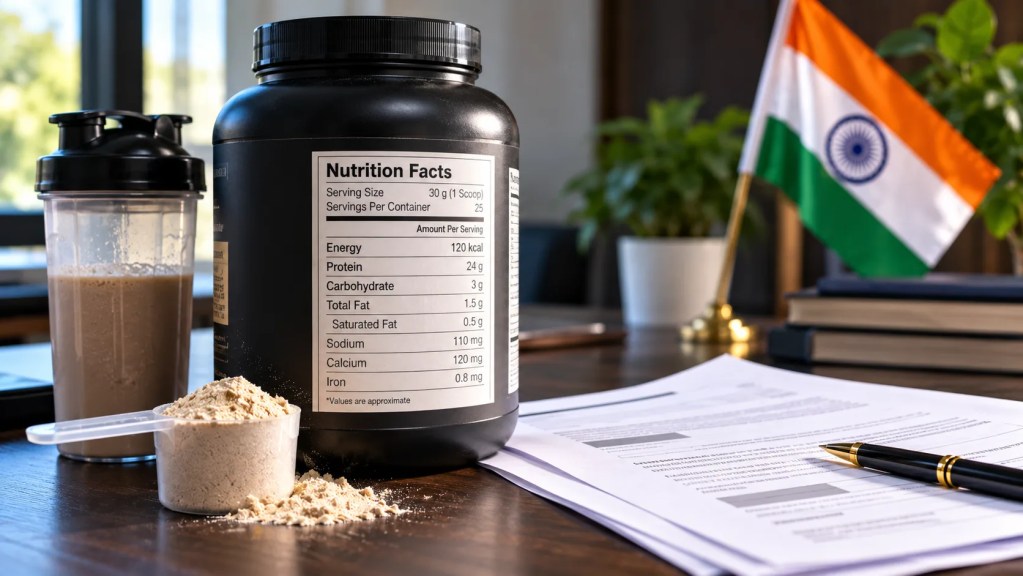
On October 8, 2026, the Food Safety and Standards Authority of India (FSSAI) issued notices to Dr. Reddy’s, Nestlé Health Science, Tirupati Wellness, Amazon, Flipkart, and Netmeds over allegedly misleading advertising and claims associated with a product called Celevida GLP+.
According to reports by The Economic Times, the regulator questioned how the product’s claims were presented and whether they could mislead consumers about its health benefits.
One of the claims described the product as offering “High Protein Support for Lean Muscle Preservation during GLP-1/GIP Therapies.”
The concerns also involved claims relating to muscle strength, immunity support, and energy metabolism. The regulator questioned the association between the product and GLP-1/GIP therapies, as well as the way its benefits were represented to consumers.
GLP-1 and GIP are hormones involved in the body’s regulation of appetite, digestion, and glucose metabolism. Medicines acting on these pathways are used for specific medical purposes. Claims about maintaining muscle during therapies involving these pathways therefore require appropriate context and supporting evidence.
The notice also raised concerns about the representation “imported from Europe for purity.”
These details matter because the issue was not simply whether protein appeared in a product’s nutrition information. It also concerned what consumers could reasonably understand from the product’s name, packaging, and promotional claims.
What Was the Regulator Asking Companies to Explain?
The companies concerned were asked to show cause why regulatory action should not be initiated over the claims.
A show-cause notice gives the concerned business an opportunity to respond. It should not automatically be interpreted as a final determination of every allegation or as proof that the product failed a laboratory protein-content test.
According to Moneycontrol’s report on the FSSAI action, Amazon said the product was no longer available on its marketplace following the regulatory direction.
That response relates to the reported listing and should not be interpreted as a blanket ban on protein supplements sold through e-commerce platforms.
For readers, the important question is what this regulatory action establishes—and what it does not.
Does This Mean All Protein Powders in India Are Misleading?
No. The reported action does not establish that all whey protein powders contain less protein than their labels declare, nor does it prove that every protein supplement sold in India is unsafe.
This distinction is essential.
A company can face questions about how it advertises a product’s health benefits without the regulator having established that the product contains less protein than stated. Similarly, a product can display a nutritional declaration without that declaration independently proving the composition of every batch.
These are different issues that require different evidence.
Consider three situations.
- A product claims to support a particular health outcome. The question is whether the claim is properly supported and permitted under the applicable regulations.
- A product declares a specific amount of protein per serving. The question is whether the actual composition matches the declaration.
- A product claims to meet specific quality or purity standards. The question is whether appropriate evidence supports those representations.
A finding about one issue does not automatically settle the others.
FSSAI’s warning should encourage informed scrutiny, not create the impression that every protein powder is fake.
Why This Distinction Matters to Buyers
Supplement marketing often combines nutrition information with claims about performance, recovery, digestion, immunity, or other health outcomes.
A buyer may see a prominent protein claim beside a promise about muscle preservation and reasonably assume that both have the same level of supporting evidence.
They do not necessarily do so.
The declared protein quantity is a nutritional figure. A claim about the product’s effect on muscle preservation is a separate representation about a potential physiological benefit.
A responsible buying decision considers each claim on its own terms.
Why Food Labels and Health Claims Need Scientific Support
India’s food advertising rules are not limited to television advertisements or social media promotions. Labels, packaging, websites, and other marketing communications can also make claims about a food’s characteristics.
The Food Safety and Standards (Advertising and Claims) Regulations, 2018 set out requirements for food-related claims. Their general principles require claims to be truthful, unambiguous, meaningful, and not misleading.
This is particularly relevant when a product is promoted using language about specific health benefits.
A company should not assume that adding protein to a formulation automatically substantiates every claim about muscle preservation, immunity, or another physiological outcome.
Likewise, evidence supporting an ingredient’s general nutritional properties does not automatically establish that a finished product delivers every benefit suggested by its marketing.
The exact wording, product formulation, intended consumer, scientific evidence, and applicable regulatory requirements all matter.
Why Words Like “Supports,” “Helps,” and “Promotes” Still Matter
Health-related marketing can sound cautious without necessarily becoming self-explanatory.
For example, a phrase such as “supports muscle health” may sound less absolute than “builds muscle.” However, the softer wording does not remove the need to consider whether the claim is meaningful, appropriate, and substantiated.
The same applies to statements involving digestibility, immunity, or preservation of lean body mass.
Consumers should not automatically treat every such statement as false. Equally, they should not treat a claim on a package as proof that the promised benefit has been independently demonstrated for that particular product.
This is the core lesson of the FSSAI warning. A claim needs to be evaluated according to what it actually promises, not just how convincing it sounds.
Nutrition Facts, Health Claims, and Product Quality Are Different
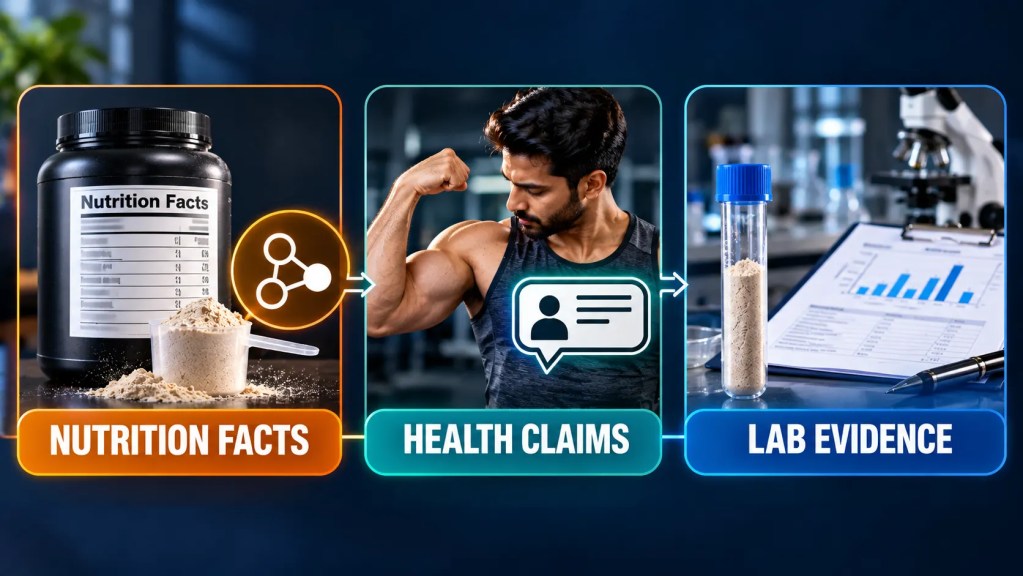
A useful way to understand this issue is to separate the information printed on a package from the evidence needed to verify it.
| Information or claim | What it communicates | What it does not automatically prove |
|---|---|---|
| Protein grams per serving | Declared protein quantity | Actual protein content of every batch |
| High-protein claim | A nutritional characteristic | Every possible health benefit of the product |
| Muscle-preservation claim | A claimed physiological benefit | That the specific product has demonstrated that benefit for every user |
| Purity or origin statement | A representation about the product | Compliance with every relevant quality parameter |
| FSSAI licence details | Food-business regulatory identification | Independent verification of every batch and quality parameter |
| Laboratory test report | Findings for specified parameters in a tested sample | Every aspect of safety or the quality of all future batches |
The key is to match each claim with the right kind of evidence. This distinction helps consumers interpret regulatory news without confusing marketing scrutiny with laboratory findings.
What Should You Look for When a Supplement Makes Health Claims?
The FSSAI development offers a practical opportunity to examine how brands communicate with buyers.
Instead of accepting a promotional statement at face value, consider the following questions.
1. What Exactly Is the Product Claiming?
Read the complete statement rather than focusing on one attractive phrase.
A product may prominently display its protein content while making a separate statement about immunity, recovery, or muscle preservation elsewhere on the packaging.
These statements communicate different things.
The first may describe a measurable nutritional characteristic. The second may imply a particular health or physiological benefit.
The distinction becomes especially important when products are marketed to people undergoing particular medical treatments or experiencing specific health conditions.
2. Does the Claim Apply to the Product and Its Intended Users?
Evidence must be relevant to the claim being made.
For instance, evidence about a nutrient’s general role in the body does not automatically establish the effectiveness of a specific formulation for people undergoing a particular treatment.
Similarly, the fact that protein contributes to normal physiological functions does not prove that every protein-containing product prevents muscle loss.
Consumers should be cautious when a marketing statement connects an ordinary food or supplement with the outcomes of a specific medical therapy without clearly explaining the basis for that association.
3. Is There Credible Evidence Behind the Promise?
If a brand makes a specific health-benefit claim, look for accessible explanations of the evidence supporting it.
Where relevant, useful evidence may include appropriately designed clinical research, product-specific data, and documentation that directly addresses the claim.
A general article about protein, an influencer’s recommendation, or a study involving an entirely different formulation does not automatically verify a product-specific benefit.
The absence of a published study on a product does not, by itself, establish wrongdoing. However, consumers should not confuse confident promotional language with proof.
4. Does the Marketing Create an Impression That Goes Beyond the Evidence?
Sometimes the concern is not one isolated word but the overall presentation.
A product name, imagery, headline, and surrounding claims can combine to create an impression that the product has a particular medical or physiological role.
This was an important aspect of the concern reported in the Celevida GLP+ matter, where the regulator questioned the association between the product and GLP-1/GIP therapies.
When evaluating any supplement, read the overall message rather than interpreting each phrase in isolation.
A Separate FSSAI Notice You Should Not Confuse With the Protein Supplement Case
On October 21, 2026, FSSAI issued a separate notice concerning claims associated with Nestlé India’s Lactogen Pro 1 infant nutrition product.
According to IANS reporting, the regulator sought scientific evidence supporting a claim that the product contained whey protein that was easy to digest.
The reported development also involved claims concerning other infant nutrition products, including NAN Excella Pro Stage 1.
This is a separate regulatory matter involving infant nutrition products, not a finding that ordinary gym whey protein powders are misleading.
Why mention it here? Because it illustrates a broader principle relevant to food marketing: claims about digestibility, immunity, or other benefits need to be considered in their specific product and regulatory context.
It would be inaccurate to combine these notices into a claim that FSSAI has declared all protein products misleading.
What Can Laboratory Testing Actually Tell You?

Regulatory scrutiny of a health claim and independent laboratory testing serve different purposes.
A laboratory test can provide evidence about specified characteristics of a sample. Depending on the methods used, testing may examine protein content, selected contaminants, microbiological parameters, or other measurable properties.
However, a report’s value depends on what was tested, how the test was performed, and which sample was examined.
A report measuring protein content does not necessarily establish that every health-benefit claim is valid. Conversely, a regulator questioning an advertising statement does not automatically show that the product failed a protein-content test.
If you want to understand how product-specific declared information and reported testing evidence are assessed, our Jan Aushadhi Whey Protein review provides an example of examining a particular product rather than making assumptions about the entire supplement market.
For more detailed guidance on reading nutrition panels, identifying label inconsistencies, and comparing products, see our guide to protein powder label red flags.
The two articles serve different purposes. This article explains the regulatory warning; the buying guide covers the practical process of assessing a product’s label.
Does an FSSAI Licence Guarantee Every Aspect of Quality?
No. Licence verification and product-quality testing answer different questions.
A valid licence provides regulatory information about a food business. It does not automatically demonstrate that every batch has been independently tested for every possible quality or safety concern.
Similarly, a QR code may direct consumers to product details, but its mere presence does not establish that all those details are accurate.
Buyers should verify information through appropriate sources and examine any available laboratory report in context.
A report should identify the relevant product and sample, the parameters tested, and the testing date. A result from one batch should not automatically be applied to every future batch.
The objective is to assess the evidence available rather than assume that a logo, a number, or a promotional certificate settles every question.
What Should Indian Supplement Buyers Do Now?
The FSSAI warning does not require consumers to panic or immediately reject all protein supplements. It provides a reason to be more careful about how products are evaluated.
Before buying a supplement, take these practical steps.
- Separate nutrition from marketing. Understand the difference between declared protein content and claims about health benefits.
- Read the complete packaging. Check the ingredient list, nutrition information, manufacturer details, batch identification, and applicable date declarations.
- Verify relevant regulatory information. Use appropriate official sources instead of treating a printed licence number or QR code as a complete quality guarantee.
- Evaluate the evidence. Look for credible, relevant support when a product makes specific health-benefit or purity claims.
- Interpret laboratory reports carefully. Check the tested product, batch, parameters, and date rather than relying solely on a brand’s summary of the result.
These steps can help you ask better questions and make more informed decisions without assuming that every unfamiliar ingredient or ambitious claim proves a product is unsafe.
The most useful response to misleading-marketing concerns is informed scrutiny, not fear-driven buying.
Frequently Asked Questions
What did FSSAI flag in October 2026?
On October 8, 2026, FSSAI issued notices to companies and e-commerce platforms over allegedly misleading advertising and claims associated with Celevida GLP+. The reported concerns involved claims related to protein support, lean muscle preservation during GLP-1/GIP therapies, and other health benefits.
Has FSSAI banned all protein powders in India?
No. The reported action does not establish a blanket ban on whey protein or other protein supplements. It concerned specific product claims and their presentation to consumers.
Does an FSSAI notice prove that a product contains less protein than declared?
No. A notice concerning advertising or health claims is not automatically a laboratory finding about protein content. Actual composition needs to be assessed using appropriate evidence for the product or sample concerned.
What is a misleading protein claim?
A misleading protein-related claim is a statement or presentation that gives consumers an inaccurate or unsupported impression about a product’s nutritional properties, health benefits, or other characteristics. Whether a particular claim violates applicable requirements depends on its wording, context, supporting evidence, and relevant regulations.
Does an FSSAI licence guarantee protein powder quality?
A licence provides regulatory identification and licensing information. It does not automatically demonstrate that every batch has been independently tested for protein accuracy, contaminants, or every other quality parameter.
How can I decide whether a supplement’s claims are trustworthy?
Start by separating its nutrition declarations from its health-benefit claims. Check the manufacturer’s information, assess the wording of the claims, review relevant evidence, and examine any available laboratory report carefully. No single label element or promotional certificate should be treated as proof of every quality characteristic.
Conclusion
The FSSAI warning is a reminder that what a supplement promises and what evidence establishes are not the same thing.
The October 2026 action concerns specific product claims and their presentation. It should not be misrepresented as proof that all Indian protein powders are fake, nor should the absence of a final finding be used to dismiss legitimate questions about marketing claims.
Consumers deserve clear nutritional information, meaningful product claims, and evidence that can withstand scrutiny.
Read beyond the headline on the package. Understand the difference between a declared nutrient and a promised health benefit. Check the available evidence before trusting a claim.
Your supplement choice should be driven by facts, not fear, branding, or promises alone.
Disclaimer: This article is for general educational and informational purposes and is not medical advice. It does not establish that any product is unsafe or that a particular health claim is false beyond the facts reported by the cited sources. Consult a qualified healthcare professional or registered dietitian for advice about supplement suitability and individual nutritional needs.


4 thoughts on “Is Your Protein Powder Label Misleading? What India’s FSSAI Warning Means”