

Seeing more hair in your comb, shower drain, or pillow after the rainy season can be frightening, especially when you fear that your hair may never grow back.
But is it ordinary seasonal shedding, or could it be an early sign of a more serious hair-loss problem?
This guide explains the possible causes, practical hair-care steps, shampoo comparisons, supplements that may help, and the warning signs you should never ignore.
Why Does Hair Fall Increase After Monsoon?
The rainy season brings humidity, sweaty scalps, changes in hair-care habits, and sometimes scalp irritation. When the weather changes, many people start noticing more hair on their combs and bathroom floors.
However, hair fall after monsoon does not automatically mean that rainwater or humidity has damaged your hair roots. Seasonal timing is only one clue. Recent illness, nutritional deficiencies, stress, dandruff, hair breakage, and hereditary hair loss can also explain the problem.
1. Telogen Effluvium: Hair Shedding That Starts Months Later
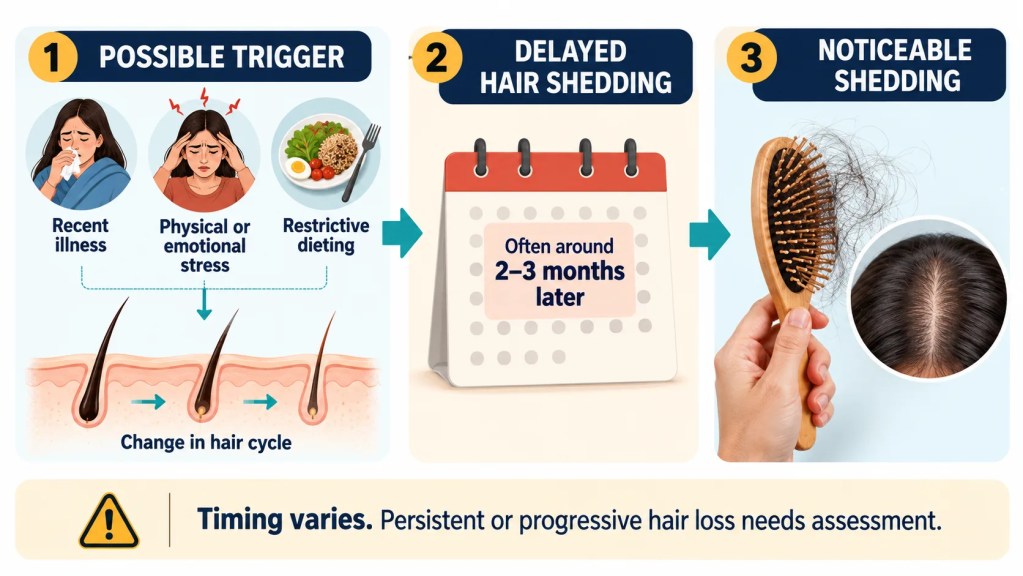
One possible explanation is telogen effluvium, a form of temporary excessive hair shedding.
Normally, hair follicles move through growth, transition, and resting phases. After a significant physical or emotional stressor, more follicles may enter the resting phase and shed hair than usual.
Common triggers include:
- High fever or a significant illness.
- Surgery or major physical stress.
- Severe emotional stress.
- Rapid weight loss or restrictive dieting.
- Inadequate protein intake or certain nutritional deficiencies.
- Hormonal changes, including those following childbirth.
The important detail is the timing. Telogen effluvium often becomes noticeable around two to three months after a trigger. Someone who experienced an illness during the rainy season may notice heavier shedding after the weather has changed.
Read our guide to telogen effluvium and stress-related hair shedding to understand this process in greater detail.
2. Dandruff and Scalp Irritation
A sweaty, uncomfortable scalp can make hair care difficult during humid weather. Some people also experience more noticeable dandruff, itching, or flaking.
Dandruff itself does not explain every case of hair loss. However, inflammation, persistent scratching, and certain scalp conditions can contribute to hair problems or breakage.
If you experience persistent itching, redness, thick scales, pain, or unusual scalp changes, do not rely entirely on home remedies. A dermatologist can help identify the underlying condition.
3. Nutritional Deficiencies and Restrictive Diets
Your hair needs adequate nutrition to grow normally. Iron deficiency, insufficient protein intake, and some other nutritional problems can contribute to hair shedding.
The risk increases when someone follows a highly restrictive diet, skips meals, loses weight rapidly, or relies on a limited range of foods.
Indian diets can provide plenty of hair-supporting nutrients through dal, beans, soy, eggs, dairy products, nuts, seeds, vegetables, and other protein-rich foods. The key is a balanced, consistent diet rather than one supposed hair-growth food.
People concerned about low iron levels can read our guide to iron deficiency and hair loss for more information.
4. Hair Breakage Can Look Like Hair Loss
Not every strand you find on your comb has fallen out from the root. Damaged hair can snap along its length, making your hair appear thinner.
Rough towel drying, aggressive brushing, tight hairstyles, frequent heat styling, and harsh chemical treatments can contribute to breakage.
Look at the pattern rather than relying on one sign. Short, broken strands may suggest breakage, while full-length shed hairs may reflect normal shedding or a hair-loss condition. Neither observation alone confirms a diagnosis.
Seasonal Shedding vs Permanent Hair Loss: How Can You Tell?
This is the most important distinction to understand when evaluating hair fall after monsoon.
Temporary shedding and progressive hair loss can look similar initially, but their patterns, causes, and management may differ. The following comparison can help you decide what to observe and when to seek professional advice.
| Feature | Temporary seasonal or stress-related shedding | Progressive or persistent hair loss |
|---|---|---|
| Onset | Often noticeable after a trigger or stressful event | Often develops gradually, although some conditions begin suddenly |
| Hair pattern | Shedding across much of the scalp | May include a widening part, receding hairline, or defined patches |
| Common clues | Recent illness, major stress, rapid weight loss, or nutritional problems | Family history, ongoing thinning, medical conditions, or inflammatory scalp disorders |
| Scalp appearance | Often looks relatively normal | May look normal or show redness, scaling, or other changes |
| Recovery | Often improves when the trigger resolves | May require cause-specific treatment |
| Next step | Monitor the pattern and address identified triggers | Seek assessment if thinning persists, progresses, or appears in patches |
These are clues, not a self-diagnosis tool. A person can experience temporary shedding and hereditary hair loss at the same time.

The American Academy of Dermatology explains the distinction in its guide to hair shedding versus hair loss.
What Does Normal Hair Regrowth Look Like?
With temporary shedding, new growth may become noticeable as short hairs along the scalp or hairline. However, regrowth takes time, and visible fullness returns more slowly than shedding begins.
Hair that continues to become progressively thinner, a widening central part, a receding hairline, or distinct bald patches deserves closer attention.
Do not assume that every case of hair fall after monsoon will resolve without treatment. The actual cause determines the likely recovery and the need for medical care.
How to Reduce Hair Fall After Monsoon Naturally
A sensible hair-care routine can protect your hair from avoidable damage. It cannot cure every underlying cause of hair loss, but it can support scalp health and reduce breakage.
1. Wash Your Hair According to Your Scalp Needs
There is no universal shampoo schedule that suits everyone.
If your scalp becomes oily or sweaty quickly, regular washing can help remove excess oil, sweat, and product buildup. If your scalp is dry or sensitive, choose a gentle shampoo and adjust the frequency to your needs.
Use lukewarm rather than very hot water. Apply shampoo primarily to the scalp, and avoid aggressive rubbing.
Hair washing does not usually create hair loss from the follicle. It can simply release hairs that were already ready to shed, which makes hair fall appear more dramatic in the shower.
2. Dry and Detangle Gently
Wet hair can be more vulnerable to mechanical damage. Instead of rubbing it vigorously with a towel, squeeze out excess water using a soft towel or cotton T-shirt.
Use a wide-toothed comb where appropriate, start detangling from the ends, and work upward gently. Avoid pulling through stubborn knots.
Do not keep hair bundled tightly for long periods while it remains wet. Focus on comfort, scalp cleanliness, and reducing friction rather than assuming that every wet-hair exposure damages hair follicles.
3. Treat Dandruff Instead of Masking It
If dandruff is contributing to discomfort, an appropriate anti-dandruff shampoo may help manage the scalp condition.
Follow the product directions, including how long the shampoo should remain on your scalp if specified. Persistent or severe symptoms require professional assessment rather than repeated experimentation with multiple products.
Oil alone does not reliably treat every cause of dandruff, and heavy scalp applications may not suit everyone.
4. Eat Enough Protein and Essential Nutrients
Hair growth depends on consistent nutrition, not a single superfood.
Include protein sources such as dal, chana, rajma, soy, paneer, curd, eggs, fish, or other foods suited to your diet. Add vegetables, fruits, whole grains, nuts, and seeds for dietary variety.
Avoid crash diets. Rapid weight loss and inadequate calorie or protein intake can trigger shedding. If you are losing weight, aim for a sustainable eating plan rather than aggressively cutting food groups.

Best Shampoo for Hair Fall After Monsoon: What Should You Choose?
Many shampoos advertise hair-fall control, but different products serve different purposes. A cosmetic shampoo may improve hair feel and reduce breakage without treating an underlying follicle disorder.
Instead of choosing a shampoo solely because its label says “anti-hair fall,” match it to your actual scalp and hair needs.
| Shampoo type | Best suited for | Important limitation |
|---|---|---|
| Gentle everyday shampoo | Routine cleansing and reducing irritation from unsuitable products | Does not treat every cause of hair loss |
| Anti-dandruff shampoo | Dandruff and related scalp symptoms, depending on its active ingredient | May not address hereditary or nutritional hair loss |
| Conditioning or moisturising shampoo | Dry, rough, or easily tangled hair | Can improve manageability but cannot guarantee new hair growth |
| Cosmetic anti-hair-fall shampoo | Hair that breaks easily or needs better manageability | Marketing claims do not prove treatment of follicle-level hair loss |
The right shampoo is the one that meets your scalp’s needs. No single shampoo works for every person or every hair-loss condition.
Should You Choose a Shampoo With Ketoconazole?
Ketoconazole shampoo is an option for certain dandruff-related conditions when appropriate. It is not a universal treatment for seasonal shedding, iron deficiency, or hereditary hair loss.
Use it according to the product instructions or a healthcare professional’s advice. If dandruff persists, your scalp becomes painful, or hair loss continues despite appropriate care, seek a diagnosis instead of repeatedly switching products.
Also, avoid assuming that sulphate-free, herbal, or expensive shampoos are automatically superior. Ingredients, scalp compatibility, the actual condition being treated, and the quality of evidence matter more than marketing language.
Which Supplements May Help Hair Fall?
Searches for which vitamin deficiency causes hair fall often lead people to biotin, iron, vitamin D, zinc, and multivitamins.
These nutrients do not work as interchangeable hair-growth treatments. Supplementation is most useful when a deficiency or another specific nutritional need has been identified.
Biotin: Is It Good for Hair Fall?
Biotin is a B vitamin involved in normal metabolic processes. Biotin deficiency can cause hair thinning, but deficiency is uncommon, and evidence supporting biotin supplements for people without a deficiency is limited.
Before buying a high-dose product, read our guide to biotin supplements for hair fall.
There is another important safety issue: high-dose biotin can interfere with certain laboratory tests and produce misleading results. Tell your healthcare professional about any biotin supplement you take before undergoing blood tests.
Iron and Vitamin D
Iron deficiency can contribute to hair shedding, particularly when iron stores are low. However, iron supplements should not be taken routinely without a reason to use them.
Vitamin D is also involved in normal body functions, and low levels have been associated with certain hair-loss conditions. An association does not establish that vitamin D supplements will improve every person’s hair growth.
Excess supplementation can cause harm. The safer approach is to assess the likely cause, review your diet and medical history, and use testing when clinically appropriate.
What Blood Tests May Be Needed?
Not everyone experiencing hair fall needs the same blood tests. A dermatologist may recommend tests based on your symptoms, examination, diet, medical history, and suspected cause.
Depending on the case, evaluation may include a complete blood count, iron studies or ferritin, thyroid testing, or selected vitamin tests.
Our guide to blood tests that may help identify the cause of hair fall explains this topic in more detail.
Avoid ordering a large panel of tests or taking several supplements simply because hair fall has increased. Targeted evaluation is more useful than guesswork.
When Should You See a Dermatologist?
Do not wait for a home remedy or shampoo to work if your symptoms suggest a more significant problem.
Arrange a medical assessment if you notice:
- Sudden or severe hair shedding.
- Distinct bald patches or rapid changes in hair density.
- A progressively widening part or receding hairline.
- Scalp pain, marked itching, redness, scaling, or burning.
- Loss of eyebrows or other body hair alongside scalp hair loss.
- Shedding that persists or worsens over several months.
- Hair loss accompanied by other unexplained symptoms.
A dermatologist can examine the scalp, review possible triggers, and decide whether blood tests or other investigations are needed. Some conditions benefit from early treatment.
For more information on diagnosis and treatment options, refer to the American Academy of Dermatology’s hair-loss guide.
Frequently Asked Questions
1. Is hair fall after monsoon normal?
Some people notice changes in shedding around seasonal transitions, but hair fall after monsoon is not automatically harmless or caused by the weather. Recent illness, stress, dietary changes, scalp conditions, and hereditary hair loss are possible explanations.
2. How long does seasonal hair fall last?
Temporary telogen effluvium often improves over several months once its trigger has resolved. The timing varies, and visible fullness can take longer to return. Persistent or worsening shedding needs assessment.
3. How can I reduce hair fall after monsoon naturally?
Use gentle hair-care practices, avoid tight hairstyles and excessive heat, maintain adequate protein and calorie intake, and treat dandruff appropriately. These steps can reduce avoidable damage, but they cannot replace treatment for an underlying medical condition.
4. Which shampoo is best for hair fall after monsoon?
Choose according to the cause. A gentle shampoo suits routine cleansing, while an appropriate anti-dandruff product may help when dandruff is present. Shampoo alone cannot treat every cause of hair loss.
5. Which vitamin deficiency causes hair fall?
Iron deficiency and certain other nutritional deficiencies can contribute to hair shedding. Biotin deficiency can also cause hair thinning, but it is uncommon. Testing and clinical assessment help determine which deficiencies, if any, need treatment.
6. Should I take biotin for seasonal hair fall?
Not automatically. Evidence for biotin supplementation in people without a deficiency is limited. High doses can interfere with certain laboratory tests, so consult a healthcare professional before starting a supplement.
7. Does washing hair daily increase hair fall?
Not necessarily. Washing can release hairs that were already in the shedding phase. Washing frequency should suit your scalp and hair type, and gentle handling helps reduce breakage.
8. Can permanent hair loss start after monsoon?
Yes, hair loss that becomes noticeable after monsoon can have causes unrelated to the season, including hereditary hair loss. Gradual thinning, a widening part, or a receding hairline deserves assessment rather than being dismissed as seasonal shedding.
Conclusion: Understand the Cause Before Treating the Hair
Hair fall after monsoon can be worrying, but the right response is not to panic, buy every advertised supplement, or switch shampoos repeatedly.
Pay attention to the timing, pattern, scalp symptoms, diet, and recent health changes. Gentle hair care and balanced nutrition can reduce avoidable damage, while persistent or progressive hair loss deserves a proper assessment.
Your best hair-care decision starts with identifying the cause—not guessing at the treatment.
Disclaimer: This article is for general educational purposes only and is not a substitute for professional medical advice, diagnosis, or treatment. Hair loss has several possible causes. Consult a qualified dermatologist or healthcare professional for persistent, severe, sudden, or unexplained hair loss, and do not start high-dose supplements or prescribed treatments without appropriate guidance.


