
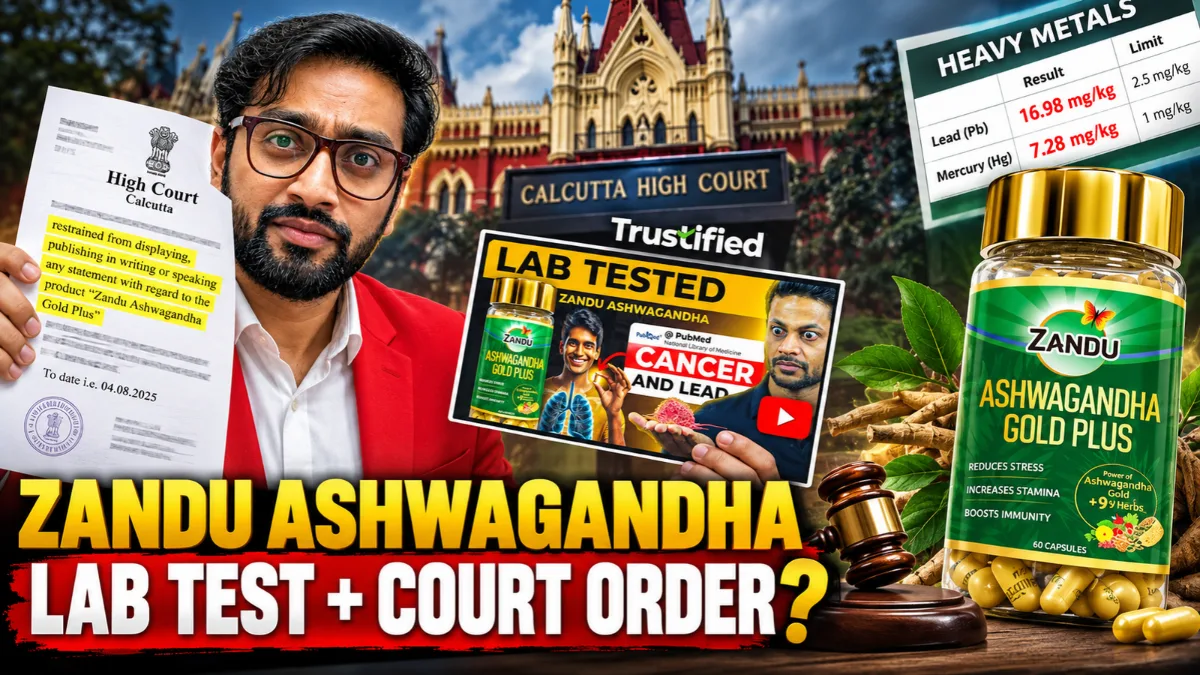
What if a popular Ayurvedic product becomes the centre of a dispute over lead and mercury levels? A Zandu Ashwagandha Gold Plus Lab Test has now become part of a major legal battle between Emami and the people behind Trustified. But what did the laboratory reports actually say, what did Zandu argue, and what did the Calcutta High Court decide in September 2026?
This article breaks down the Zandu Ashwagandha Gold Plus Lab Test, the reported heavy-metal findings, Zandu’s response, and the latest High Court order in simple English.
Why Is Zandu Ashwagandha Gold Plus in the News?
The High Court judgment records that the product was tested by Eurofins Analytical Services India Pvt. Ltd. for two broad areas: Withanolide content and heavy metals. The judgment describes Eurofins as an FSSAI-notified, NABL and IAS accredited laboratory.
The first level of testing examined the Withanolide content. The judgment records that the report showed 0.60 grams of Withanolide per 100 grams of the product. The appellants in the case argued that this was significantly below the level expected in a standard Ashwagandha product.
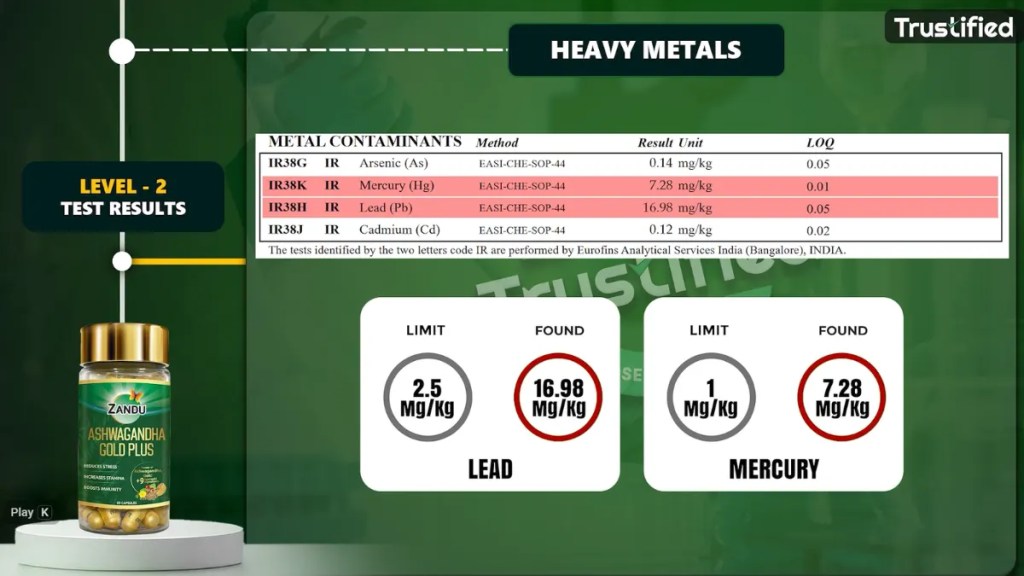
The second level focused on heavy metals.
According to the laboratory reports discussed in the judgment, the first test reported lead at 16.98 mg/kg and mercury at 7.28 mg/kg. The judgment compares these figures with the API formulation limits of 10 mg/kg for lead and 1 mg/kg for mercury.
The same sample was also re-tested for heavy metals. The judgment records that the second report reaffirmed the earlier findings, with the reported figures exceeding the cited API limits by 45% for lead and 745% for mercury.
These reported results became one of the central issues in the legal dispute.
Why Are Lead and Mercury Important?
Lead and mercury are heavy metals, and excessive exposure can create serious health concerns. But a health-product article should make an important distinction here.
The mere detection of a metal does not, by itself, answer every safety question. The relevant issues include the concentration, the applicable standard, the testing method and the nature of the formulation.
That distinction matters in the Zandu case.
According to the High Court judgment, Zandu argued that its product is an Ayurvedic proprietary medicine and a herbo-metallic preparation. The company relied on ingredients including Swarna Bhasma and Yashad Bhasma and argued that the testing side had applied the wrong standards to the product.
So the core question was not simply whether lead and mercury were detected. The legal dispute also concerned which limits should apply to the finished product.
What Did Zandu Say About the Test Results?
Zandu challenged the way the product had been assessed and questioned the applicability of the limits relied upon by the testing side.
The company argued that some of the testing categories were connected to food or nutritional-supplement standards and did not correctly reflect the regulatory framework applicable to an Ayurvedic proprietary drug.
Zandu also relied on its valid drug licence and expert opinions concerning the product’s formulation. Its position, as recorded in the judgment, was that metallic elements could arise from ingredients such as Swarna Bhasma and Yashad Bhasma that formed part of the product.
This is why it would be inaccurate to reduce the case to a simple claim that one side released a report and the other side had no explanation.
There are two separate parts of the story: what the laboratory reports recorded and how those findings should legally and scientifically be interpreted for this particular formulation.
What Did the Calcutta High Court Say About the API Limits?
This is one of the most important parts of the 2026 order.
The Calcutta High Court examined Part-II of the Ayurvedic Pharmacopoeia of India, which deals with formulations. The judgment says the applicable upper limits discussed in the case were 10 PPM for lead and 1 PPM for mercury.
The court also dealt with the argument that the product was a herbo-metallic preparation covered by another part of the API.
Its reasoning was that the categories were not necessarily mutually exclusive. A product could fall within more than one category, and where there was an overlap, the stricter applicable limit for the finished formulation could not simply be ignored.
The court therefore noted that both the requirements for individual ingredients and the limits applicable to the finished formulation had to be considered.
This distinction is critical when reading any Zandu Ashwagandha Gold Plus Test Report. A product’s licence and the laboratory result are not automatically the same legal question.
Did the High Court Declare Zandu Ashwagandha Gold Plus Unsafe?
No final finding of that kind was made in this appeal.
The High Court was primarily considering whether the earlier ex parte injunction should continue while the main dispute proceeded.
The court examined the material placed before it and found that the defendants had enough material to raise a defence of truth at this stage. It also noted that the plaintiff’s expert reports did not deny the quantities of lead and mercury recorded in the laboratory reports; instead, they sought to explain the presence of the metals through the product’s ingredients.
That is an important distinction.
The judgment does not amount to a final ruling that consumers should treat Zandu Ashwagandha Gold Plus as medically unsafe. The underlying legal dispute remains subject to further proceedings.
The court itself framed its findings in the context of the interim injunction and the applicable test for stopping publication before a full trial.
Why Was the Original Video Taken Down?
The dispute began after the laboratory-testing video was published in 2025.
According to the High Court judgment, the testing model used by the appellants involved anonymously purchasing products, documenting the process and sending samples to accredited laboratories. The product was selected for testing after consumer requests, and the test involved both Withanolide content and heavy metals.
After publication, Emami challenged the video and the statements about its product.
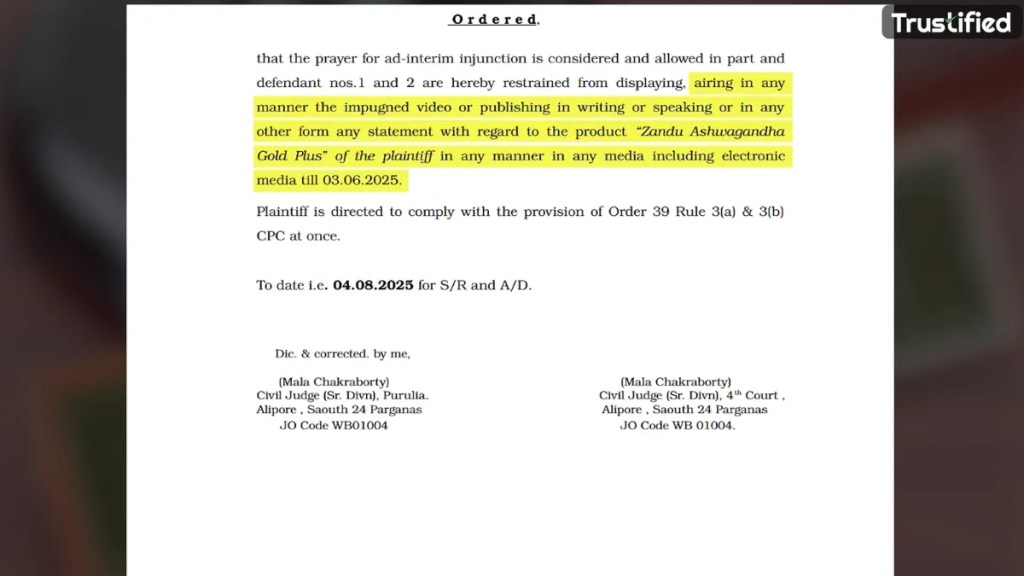
On 3 May 2025, the trial court granted an ex parte ad interim injunction restraining publication or airing of the disputed video and also restraining statements about the product in media. The defendants appealed that order before the Calcutta High Court.
On 22 September 2026, the Division Bench set aside that injunction.
The significance of the order is therefore not that the High Court conducted a fresh product approval or certification process. Its significance lies in the fact that the court found the earlier restraint on publication could not stand under the legal standard it applied.
What Is the Bonnard Principle?
One of the biggest legal issues in this case was the Bonnard principle.
In simple terms, this principle requires courts to be extremely careful before stopping allegedly defamatory material from being published, particularly when the publisher raises truth as a defence.
The Calcutta High Court referred to earlier Supreme Court jurisprudence and held that the principle is applicable in India. The judgment said that for an injunction of this kind, it is not enough for the plaintiff to show a prima facie case; the material must make it clear that the defence of truth is certain to fail at trial.
In this case, the court concluded that there was sufficient substance in the defence of truth for the earlier ex parte injunction not to continue.
That is the legal reason the Trustified video could return to public view. It does not mean the underlying litigation has ended.
What About “Poison in a Bottle” and “Cancerous”?
The language used in the original video was another major part of the dispute.
Zandu objected to descriptions such as “Poison in a bottle” and “Cancerous.”
The High Court examined the surrounding context rather than looking at the words in isolation. It noted that “Poison in a bottle” was followed by question marks and viewed the wording as inviting viewers to consider the possible effects of excessive lead and mercury exposure.
The court also considered the use of “Cancerous” in the context of the potential carcinogenic risk associated with excessive lead and mercury exposure.
That does not mean the court found that Zandu Ashwagandha Gold Plus causes cancer.
The court was assessing whether the language used in the disputed video could be restrained at the interim stage. That legal context is essential.
What Does the 2026 Order Mean for Consumers?
For consumers, the biggest lesson from the Zandu Ashwagandha Gold Plus Lab Test is the importance of looking at evidence rather than relying only on marketing claims.
When evaluating a health supplement or Ayurvedic product, readers should look at the product’s ingredients, testing method, batch details, laboratory credentials and the standard against which the result has been measured.
The same principle applies to other health products. NaturalAdda has also covered the importance of independent testing in its detailed article on the Patanjali honey purity test and lab results.
At the same time, readers should avoid drawing a medical conclusion from a headline alone.
A laboratory report can raise an important question. A court order can explain how those findings are being treated legally. A final scientific or medical conclusion requires the full evidence and the appropriate expert interpretation.
Zandu Ashwagandha Gold Plus Lab Test: Final Takeaway
The Zandu Ashwagandha Gold Plus Lab Test became the centre of a major dispute because laboratory reports discussed in the Calcutta High Court recorded lead and mercury levels above the API formulation limits considered in the case.
The court also found sufficient prima facie substance in the defence of truth to set aside the earlier ex parte injunction. It held that the Bonnard principle applies and that the material before it did not establish that the defence of truth was certain to fail.
But this is not a final judgment on the overall safety of the product.
The main dispute still has to be dealt with in the appropriate proceedings, and the High Court expressly treated its observations in this appeal as part of its interim assessment.
For consumers, the practical lesson is straightforward: when a health product becomes controversial, do not rely on either marketing claims or social-media headlines alone. Look at the actual test, the applicable standard, the company’s response and the court record.
The strongest protection for a consumer is not a viral claim—it is evidence, context and the habit of checking the facts before making a health decision.
Disclaimer
This article is intended for general information and consumer awareness only. It summarises laboratory findings and legal observations recorded in publicly available material, including the Calcutta High Court’s 22 September 2026 judgment. It is not a medical diagnosis, safety certification or recommendation to use or avoid any product. The High Court’s observations were made in the context of the appeal against an interim injunction and do not constitute a final determination of the underlying product dispute. Readers with medical concerns should consult a qualified healthcare professional before using any Ayurvedic medicine or dietary supplement.


