
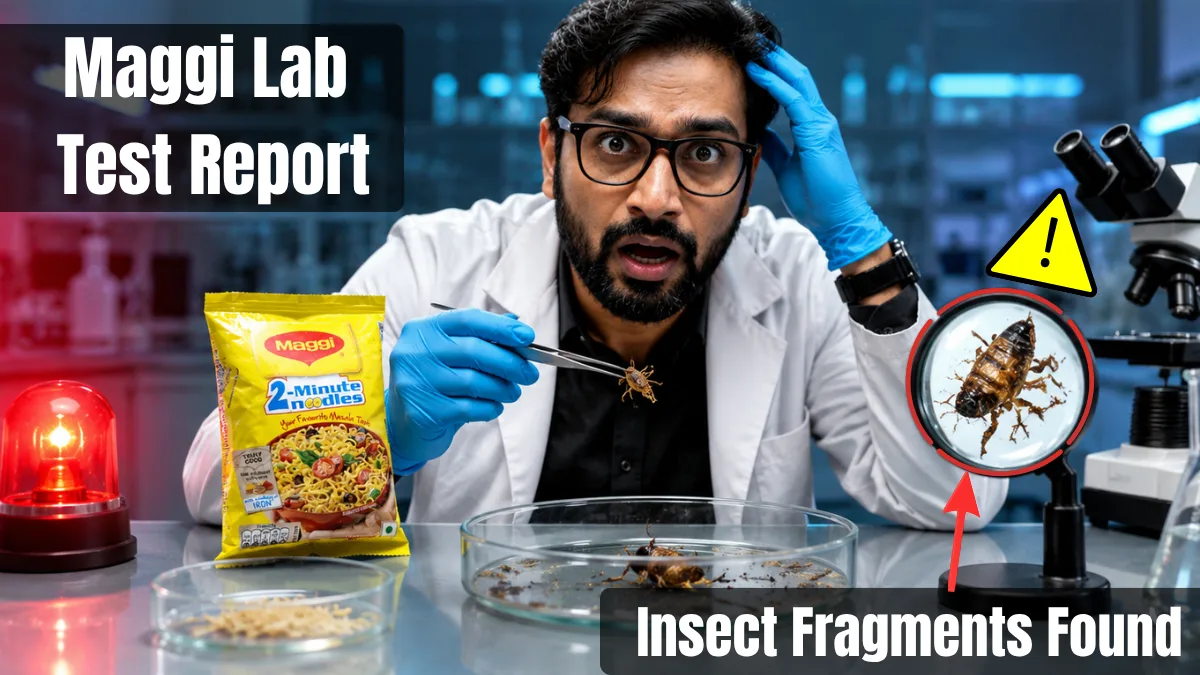
Maggi isn’t food for most Indians — it’s a memory. It’s the taste of hostel nights, rainy evenings, and a mother’s quick fix when a child comes home hungry. So when a Maggi lab test report claims something is hiding inside every packet, you don’t just read it — you feel it. Here’s the full truth, backed by real lab data, not rumours.
What Is This Maggi Lab Test All About?
India’s first 100% blind testing platform, Trustified, decided to do what nobody else had done seriously — test Maggi noodles for contamination, not nutrition. Everyone already knows Maggi isn’t a health food. Nobody eats it for protein. That’s not the debate here.
The real debate is cleanliness. Is what you’re eating contaminated? That’s a different question entirely, and it’s the one this investigation was built to answer.
Why Trustified Decided to Test Maggi Noodles
Trustified had earlier tested Maggi Magic Masala, the taste-maker many people add to home-cooked meals. Maggi noodles itself was skipped — until viewers, mostly students and mothers, pushed back. They said the same thing millions of Indians think: “I still eat it sometimes. Isn’t that worth checking?”
That single comment changed everything. Trustified picked up a sealed 600-gram Maggi pack and sent it for independent laboratory testing.
The History Behind India’s Most Trusted Instant Noodles Brand
Maggi belongs to Nestlé, the Swiss food giant founded in 1866. Nestlé launched Maggi in India in 1983, and within a decade, it became more than a product — it became the category itself. Say “instant noodles” in India, and most people still say “Maggi” instead.
That kind of trust took forty years to build. This Maggi lab test questions whether that trust still holds up under a microscope.
What Was Actually Tested — And Why It Matters
This wasn’t a nutrition test. Trustified was clear: testing calories or protein in Maggi makes no sense, because nobody expects nutrition from it in the first place. What they tested instead was filth analysis — a specialized process that detects what your eyes never could.
Filth analysis checks for:
- Insect fragments
- Hair particles
- Foreign impurities
- Manufacturing hygiene gaps
Why Nutrition Wasn’t the Focus
Being unhealthy and being contaminated are not the same problem. You can choose to eat unhealthy food knowingly. But nobody chooses to eat contaminated food knowingly. This distinction is exactly why the test ignored macros completely and went straight for hygiene.
The Shocking Results of the Maggi Lab Test
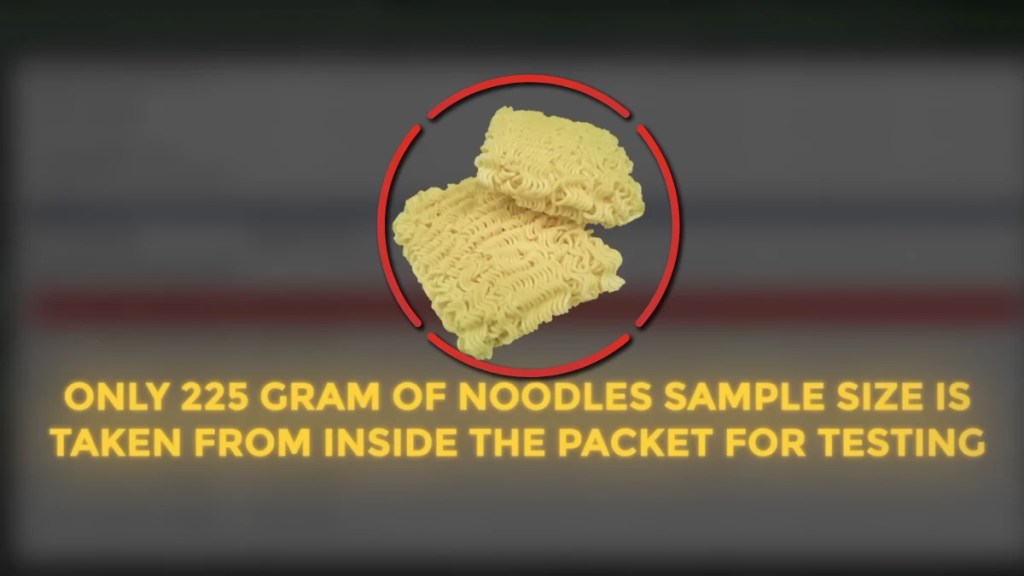
A sealed 600-gram Maggi pack was sent to a specialized lab in the USA, because this level of light filth analysis wasn’t available in India. Only 225 grams of noodles were tested — the masala sachet was excluded.
The result: 49 insect fragments were found in that single sample.
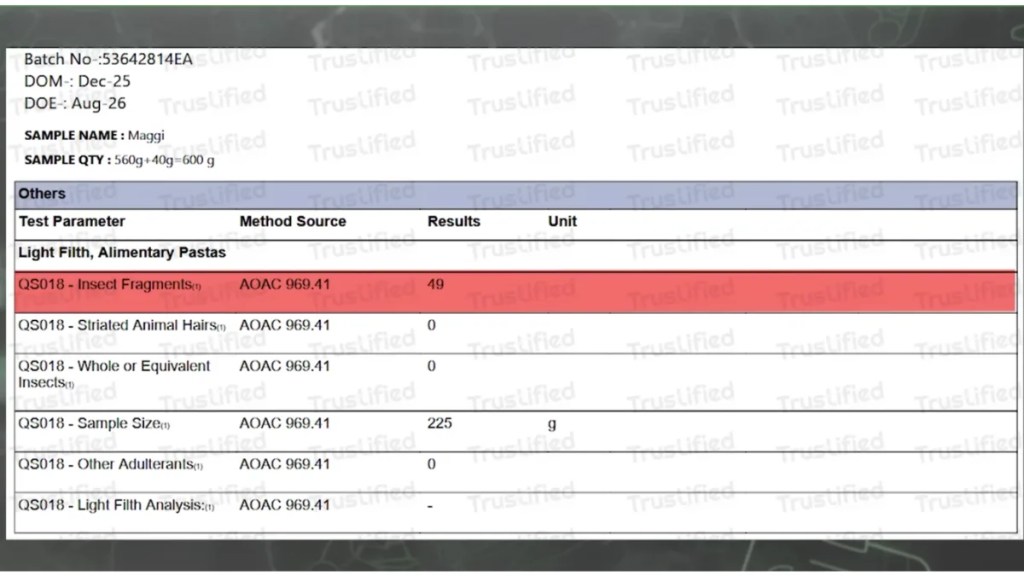
This number was confirmed directly with the testing lab. No assumptions, no guesswork — just a documented lab report.
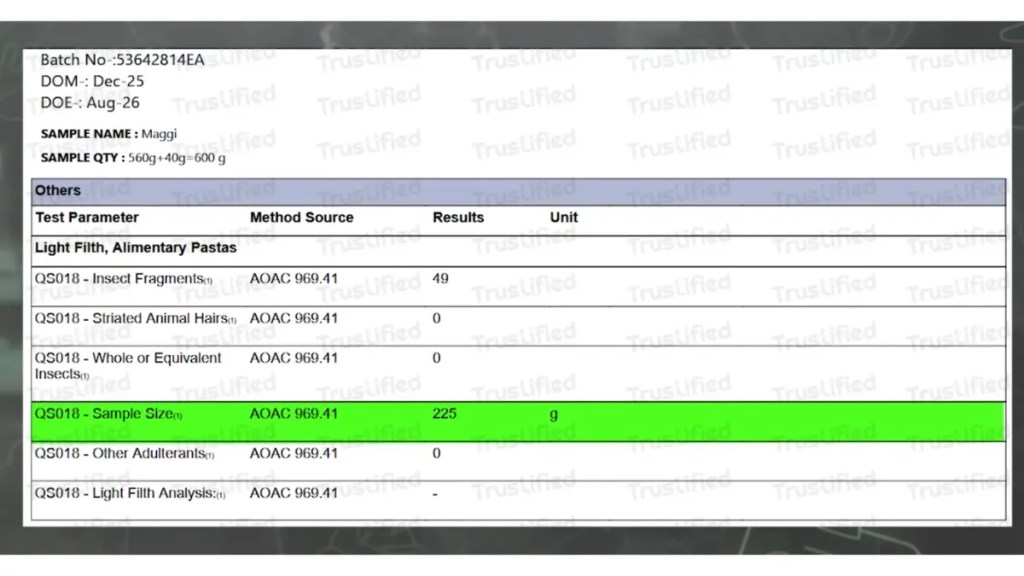
Here’s a quick snapshot of what this investigation actually covered:
| Test Parameter | Details |
|---|---|
| Product Tested | Maggi Noodles (600g sealed pack) |
| Sample Size Tested | 225 grams (noodles only) |
| Test Type | Filth Analysis (Light Filth Extraction) |
| Lab Location | USA |
| Insect Fragments Found | 49 |
| Masala Sachet Included? | No |
| FSSAI Food Category | Cereal-based product |
| Nan Pro (Nestlé Baby Food) Result | Passed |
Numbers like these don’t lie — but they do demand context, which is exactly what the rest of this article gives you.
How Filth Analysis Actually Works
Filth analysis isn’t a basic visual check. It’s a microscopic, lab-grade process that separates food particles from contaminants that the human eye simply cannot catch. Technicians use extraction methods to isolate insect fragments, hair strands, and foreign debris from a food sample, then examine each particle under magnification.
This is exactly why the Maggi lab test was sent abroad — this level of light filth extraction wasn’t available domestically at the time. It’s not a casual swab test. It’s the same rigorous standard used by international food safety regulators to certify whether a product is fit for consumption.
Understanding this process matters, because it tells you the 49 insect fragments weren’t a guess or an exaggeration. They were isolated, counted, and documented under lab conditions.
Maggi’s 2015 Controversy vs. Today’s Maggi Lab Test
This isn’t Maggi’s first brush with controversy. Back in 2015, Maggi noodles were pulled off shelves nationwide after lead and MSG concerns triggered a massive ban. Courts eventually cleared the product, and it returned to shelves within months.
But here’s the difference: 2015 was about chemical composition. This new investigation is about physical contamination — insect fragments and filth, not lead levels. Two completely different issues, a decade apart, both circling back to the same core question: how closely is quality actually monitored inside the manufacturing process?
If a brand can bounce back from one controversy, it can bounce back from another too — but only if it treats every lab report as a chance to improve, not just a PR problem to survive.
What FSSAI Rules Say About This
Under the FSSAI compendium, instant noodles fall under the cereal-based food category. FSSAI regulations clearly state that food in this category must be free of filth like dirt, insect fragments, and extraneous matter.

That means this Maggi lab test result directly touches an area FSSAI itself considers non-negotiable. It’s not an opinion. It’s a documented regulatory standard being tested against real data.
If this pattern feels familiar, it’s because it isn’t isolated. Our earlier investigation into the bacteria contamination found in D-Mart’s packaged masala showed a similar gap between what’s promised on the label and what the lab actually finds.
What About Nestlé’s Other Products?
Here’s where the story gets balanced instead of one-sided. Trustified also tested Nan Pro, Nestlé’s infant nutrition product — arguably a far more sensitive category since it’s meant for babies.
Nan Pro passed the test.
This matters because it proves the investigation wasn’t a blanket attack on Nestlé. It was product-specific, evidence-based, and limited strictly to what the lab found in that one product line.
Why This Isn’t the First Wake-Up Call
If you think one contaminated food product is an isolated case, think again. Blind lab testing across India has repeatedly exposed the same pattern — trusted brands, ordinary-looking packaging, and lab reports that tell a different story. Our report on Dabur Hajmola’s lab test findings revealed exactly this kind of gap in a product millions consume daily for digestion.
Even something as routine as airline food isn’t safe from scrutiny — the lab test results of IndiGo’s flight sandwiches surprised a lot of frequent flyers too.
What This Means for Parents and Students
Two groups eat Maggi more than anyone else — students living away from home, and parents feeding hungry kids on a busy evening. Both trust it because it’s fast, familiar, and forgiving on a tight budget.
That’s exactly why this report matters most to them. A student pulling an all-nighter isn’t checking filth analysis reports. A mother handing her child a quick bowl isn’t thinking about insect fragments. Convenience has always been Maggi’s biggest strength — but convenience should never come at the cost of hygiene.
This isn’t about guilt-tripping anyone for eating Maggi. It’s about making sure the next bowl you cook comes from a batch that meets the standard it’s supposed to.
What Should You Do With This Information?
Stop panicking. Start reading labels, lab reports, and real data instead of social media noise. This report isn’t asking you to boycott anything — it’s asking you to be aware.
A few practical steps:
- Don’t rely on Maggi as a regular meal for children.
- Cook noodles thoroughly at high heat — it reduces (not eliminates) contamination risk.
- Follow verified lab reports, not viral WhatsApp forwards.
- Support brands that respond to quality concerns with transparency, not denial.
Even everyday dairy isn’t beyond question — our Amul dahi cup vs pouch lab test comparison shows packaging itself can affect product safety.
Trustified’s Real Intent Behind This Test
Trustified made their purpose clear — this wasn’t about targeting Nestlé or attacking a legacy brand. It was about pushing for better manufacturing standards through independent, lab-backed evidence. If a company as large as Nestlé has room to improve hygiene standards, that improvement benefits every consumer, including you.
Choose Safe. Be Safe. That’s the entire philosophy behind this investigation.
Final Word: Is Maggi Safe to Eat?
Here’s the direct answer: Maggi was never a health food, and it still isn’t. But this Maggi lab test proves something more urgent — contamination, not nutrition, is the real conversation India needs to have about its most-loved packaged food.
Forty years of trust doesn’t disappear overnight. But it also doesn’t survive silence. The only way brands improve is when consumers stop accepting “trust us” as an answer and start asking for proof.
Read the label. Read the lab report. Make your own choice — but make it an informed one.
Disclaimer: This article is based on an independent lab test conducted by Trustified and is intended solely for consumer awareness. It does not aim to defame any brand or company, and readers are encouraged to refer to official FSSAI guidelines and brand statements for complete context.
References & Source
This Maggi lab test article is based on the original independent blind lab testing video published by Trustified, India’s 100% blind testing certification platform.
- 1
Maggi Lab Test: The Results Shocked Us! — Independent blind filth analysis lab test of Maggi noodles, revealing 49 insect fragments in a 225g sample.


