

(Amul dahi) Amul is one of the most trusted dairy brands in India, with a presence not only across the country but also in several international markets. For decades, Amul has been a household name, associated with quality, consistency, and consumer confidence. Compared to many mass-market food brands, Amul products generally receive very few serious quality-related complaints. That is exactly why recent findings from an independent blind testing platform have attracted widespread attention.
A consumer awareness YouTube platform called Trustified recently conducted blind lab tests on two variants of Amul Masti Dahi – the cup-packaged variant and the pouch-packaged variant. According to Trustified, while the cup variant met hygiene parameters, the pouch variant showed concerning microbiological results. This article is written purely from a consumer awareness and educational perspective, based on publicly available information, lab data shared by Trustified, and Amul’s official clarification.
Update 2026: Trustified Re-tests Amul Dahi – Pouch Variant Fails Again
In February 2026, Trustified conducted another independent blind lab test on Amul Masti Dahi, focusing once again on the pouch variant. This re-test was performed after the earlier report gained significant attention and after Amul issued its public clarification.
According to Trustified’s latest lab data, the microbiological parameters of the pouch variant again showed concerning results. Similar to the previous test, elevated levels of Coliforms and Yeast & Mould were detected, exceeding FSSAI safety limits. The cup variant, however, continued to meet hygiene standards.
Trustified stated that this second test strengthens their earlier findings and suggests that the issue may not be limited to a single batch, but could be related to packaging, storage, or handling processes in the pouch format.
Amul has not yet released a detailed technical report for this second test at the time of writing.
Updated in February 2026 based on the latest Trustified re-test findings.
Why Trustified’s Blind Testing Matters

Trustified claims to run India’s first 100% blind testing certification program, where products are sent directly to NABL-accredited laboratories without revealing brand names. The idea is simple – eliminate brand influence and let the lab results speak for themselves. According to Trustified, they invest significant time and money into lab testing so that consumers can make safer and more informed choices.
In one of their recent investigations, Trustified tested curd – a product consumed daily in millions of Indian households. Curd is widely known for its probiotics, digestive benefits, and as a natural source of protein and calcium. It is also commonly used by fitness enthusiasts and families, making its quality and hygiene extremely important.
For this test, Trustified selected Amul Masti Dahi, one of the most popular curd brands in India.
Two Variants, Same Ingredients – Then Why Test Both?
Amul Masti Dahi is available in two main variants:
- Pouch Variant – 400 grams at around ₹35
- Cup Variant – 400 grams at around ₹50
Both variants list the same ingredients on the packaging. However, the cup variant is approximately 40% more expensive. Because of this price difference, Trustified decided to test both variants separately instead of assuming identical quality.
According to Trustified, this decision turned out to be crucial.
How the Samples Were Collected and Tested
As curd is a perishable product, the samples were collected by the laboratory itself. The lab report mentions:
- Sample collected by the lab
- Temperature maintained during collection
- Date of collection and “use before” date recorded
This process is important because handling and storage can significantly impact microbiological results in live products like curd.
Macro (Nutritional) Accuracy – No Major Issues
Trustified first checked whether the nutritional values claimed on the label matched the lab results.
For both pouch and cup variants, parameters like:
- Protein
- Carbohydrates
- Fat
- Saturated fat
were found to be broadly in line with the declared values. Minor variations were within acceptable range.
From a nutritional labeling perspective, both variants appeared compliant.
SNF, Heavy Metals, Aflatoxins & Pesticides – Within Limits
In the pouch variant, Trustified also tested:
- SNF (Solids-Not-Fat) – Found well above the FSSAI minimum requirement
- Heavy Metals – Below LOQ
- Aflatoxins – Below LOQ
- Pesticides – Not detected or below LOQ
Up to this point, the pouch variant did not show any alarming red flags.
The Key Concern – Microbiological Findings in the Pouch Variant
The major issue emerged during microbiological testing.
In curd, the presence of APC (Aerobic Plate Count) is normal because curd contains beneficial bacteria. However, two parameters raised concern in the pouch variant:
- Coliforms
- Yeast & Mould
According to Trustified’s report:
- Yeast & Mould were found to be around 60 times higher than the FSSAI prescribed safe limit.
- Coliform levels were found to be approximately 2100 times higher than the FSSAI permissible limit.
Trustified clearly highlighted these values visually in their report, showing the FSSAI safe limit in a circle and the detected levels far exceeding it. Such high levels of Coliform and Yeast & Mould are typically associated with poor hygiene, contamination, or lapses in process control during manufacturing, packaging, or storage.
Trustified clarified that these are not “good bacteria” and their presence at high levels raises questions about hygiene practices.
Cup Variant – A Different Result
For the cup variant, Trustified tested macro accuracy and microbiological parameters.
While APC was detected (which is normal in curd), all other microbiological parameters including Coliforms, Yeast and Mould were below LOQ.
In simple terms, the cup variant did not show the hygiene-related issues that were observed in the pouch variant.
Amul’s Official Response
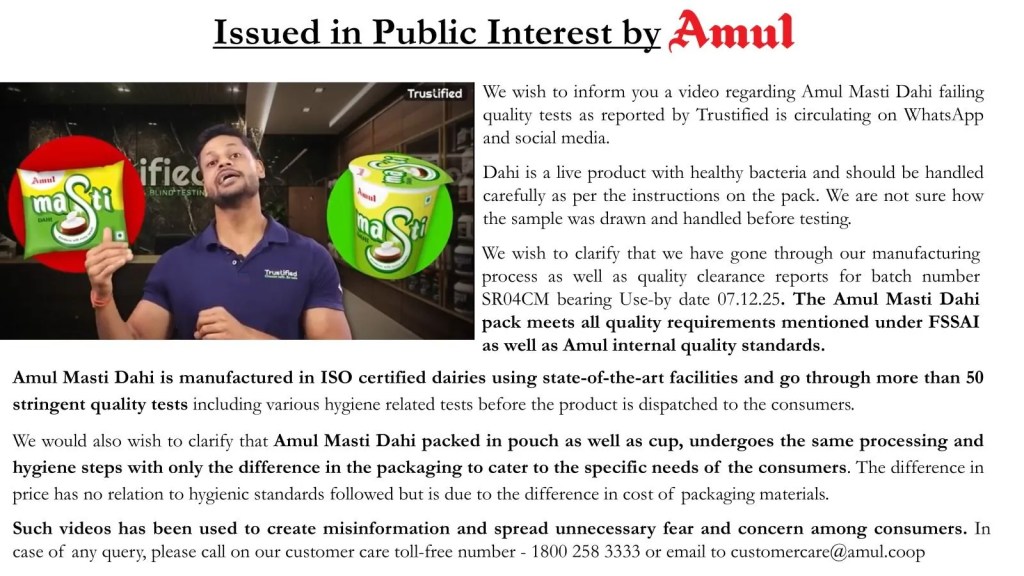
After Trustified’s video began circulating on social media and WhatsApp, Amul issued an official clarification in public interest.
Amul stated that:
- Dahi is a live product containing healthy bacteria and must be handled carefully
- The company is not certain how the sample was drawn, stored, or handled before testing
- The specific batch in question was reviewed internally and meets all FSSAI and Amul quality standards
- Amul Masti Dahi is manufactured in ISO-certified dairies and undergoes more than 50 quality and hygiene-related tests
- Both pouch and cup variants follow the same processing and hygiene standards, and the price difference is due to packaging material cost, not quality difference
Amul also expressed concern that such videos may create misinformation and unnecessary fear among consumers.
A Balanced Perspective on the Amul–Trustified Debate
At this stage, it would be unfair to label Trustified as completely right or Amul as completely wrong based only on one report. Amul is a well-established cooperative brand, and many of its products have previously passed blind testing without any issue. However, certain questions raised by Trustified cannot be ignored – especially how a detailed internal audit and back-testing could be completed within just 24 hours, why no supporting test data was shared publicly, and why there is a ₹15 price difference between the cup and pouch variants if hygiene standards are truly the same.
It is also noticeable that Amul remained silent when its products passed tests or when issues like ghee adulteration were raised earlier, but responded immediately when a negative report surfaced. This raises concerns about transparency. It is possible that this issue was limited to a specific batch or a lapse in quality control at the operational level, but ultimately, such incidents affect brand trust.
The Bigger Question: Whom Can Consumers Trust?
Today, even well-known brands can face quality inconsistencies. Tomorrow, someone may say Mother Dairy is safe, and later another report may question it. Consumers are left confused. Local dairies cannot always be trusted either. Ideally, making curd at home is the safest option, but that is not practical for everyone, especially those living away from home.
In such a situation, the responsibility lies heavily on large brands to be:
- more transparent
- more consistent
- and stricter in their internal quality control
Because ultimately, it is their reputation that is at stake.
Final Takeaway
I, Abhishek Chauhan, am sharing this analysis purely from a consumer education and awareness perspective. The intention is not to defame any brand or create fear, but to encourage transparency, accountability, and informed decision-making.
If you are at home, making curd at home is always the best option. If you are dependent on packaged curd, then brands must ensure the highest level of hygiene across all variants – not just premium ones. Consumers deserve consistency, not confusion.
FAQs
Did Amul Dahi really fail the lab test?
The issue came from an independent blind testing report by Trustified, where the pouch variant showed hygiene-related concerns, while the cup variant passed microbiological parameters. This does not mean all Amul Dahi is unsafe, but it does highlight the importance of handling, storage, and packaging conditions.
Are both Amul Dahi variants made with the same ingredients?
Yes, both the cup and pouch variants list the same ingredients on the label. However, packaging type and external handling conditions can influence product safety, especially in perishable dairy items like curd.
Why is the cup variant more expensive than the pouch?
According to Amul, the price difference is mainly due to packaging and logistics costs, not because of any difference in quality standards. Cup packaging offers better protection during transportation and storage, which can reduce contamination risk.
Has Amul officially responded to the lab test findings?
Yes, Amul released an official clarification stating that their products meet FSSAI regulations and internal quality benchmarks. The company emphasized that their manufacturing process follows strict hygiene and safety protocols.
Should consumers stop buying Amul Dahi after this report?
Not necessarily. Instead of panic, consumers should stay informed, check packaging condition, verify storage hygiene at the shop, and prefer better-protected variants. Awareness is more important than fear when it comes to food safety.
Did Trustified buy the Amul Dahi directly from an official Amul booth this time?
Yes. In the latest 2026 re-test, Trustified stated that the Amul Masti Dahi pouch was purchased directly from an official Amul booth rather than a random retailer. They also shared photographs of the purchase, temperature readings, and storage conditions to ensure that the sample was handled under proper and controlled conditions before being sent to the NABL-accredited laboratory.
Were temperature and storage conditions properly maintained during the re-test?
According to Trustified, the product temperature was checked and documented at the time of purchase and during sample handover. Visual proof of the temperature readings and packaging condition was also shared publicly. This reduces the possibility that the microbiological results were caused by external mishandling or improper storage after purchase.
Disclaimer
The information provided in this article is for educational purposes only. It is not intended to be a substitute for professional medical or nutritional advice. Please consult your doctor, healthcare provider, or certified nutrition expert before making any changes to your diet or lifestyle.
Amul Lassi Review: Ingredients, Sugar & Health Truth – Is It Really Healthy?


4 thoughts on “Amul Dahi Quality Exposed: Cup vs Pouch Lab Test Report (Re-Test 2026 Update)”