

You’ve been spending hundreds of rupees on probiotic capsules from Amazon — when the same solution sits in a Jan Aushadhi store for just ₹5. Nobody talks about this because nobody wants you to know. This article breaks down exactly what the Jan Aushadhi Probiotic Capsule contains, how it stacks up against expensive online alternatives, and whether the ₹5 price tag means cheaper quality — or just smarter spending.
The ₹5 Question Nobody Is Asking
Walk into any Jan Aushadhi Kendra and you’ll find the Jan Aushadhi Probiotic Capsule priced at around ₹5 per strip. Now open Amazon or Flipkart — the same category of probiotic supplement costs anywhere between ₹300 to ₹1,500 for a month’s supply.
Same bacteria. Same function. Drastically different price.
So what’s really going on here?
Before we answer that, you need to understand what a probiotic actually is — because most people taking it don’t fully know, and most people who should be taking it don’t even know it exists.
What Is a Probiotic — And Why Does Your Gut Need It?
Your gut is not just a food-processing tube. Inside your small and large intestine live trillions of microorganisms — bacteria, both good and bad. The good ones are called probiotics. Their job is to manage your entire digestive environment — breaking down food efficiently, keeping harmful bacteria in check, and strengthening your immune system from the inside.
Your Gut Is a Factory. Probiotics Are the Manager.

Think of your intestine as a manufacturing plant. The workers on the floor — the ones assembling parts — are your digestive enzymes. They physically break food down into nutrients your body can absorb.
But every factory needs a manager.
Probiotics are that manager. They oversee the entire operation — making sure the workers (enzymes) are doing their job, bad elements are removed, and the overall environment stays productive. Without a good manager, even the hardest-working team falls apart.
This is exactly why people who take antibiotics end up with digestive issues. Antibiotics don’t discriminate — they kill both bad and good bacteria. The moment your probiotic population drops, your gut’s “management” disappears. The result? Loose motions, bloating, poor digestion, and a sluggish gut.
What Is a Prebiotic — And How Is It Different?
Here’s where most people get confused.
- Probiotic = the good bacteria themselves
- Prebiotic = the food that feeds those good bacteria
Prebiotics are dietary fibres found in everyday foods — whole wheat, oats, bananas, onions, garlic, and most vegetables. When you eat fibre, it reaches your intestine undigested, and the good bacteria feed on it to multiply and stay strong.
This is why doctors tell constipation patients to “eat more fibre.” Fibre doesn’t just add bulk — it actively nourishes your gut bacteria, which then regulate your bowel movements naturally.
The Jan Aushadhi Probiotic Capsule is a synbiotic — it contains both prebiotic fibre and probiotic bacteria in a single capsule. That’s the full package.
What’s Actually Inside the Jan Aushadhi Probiotic Capsule?
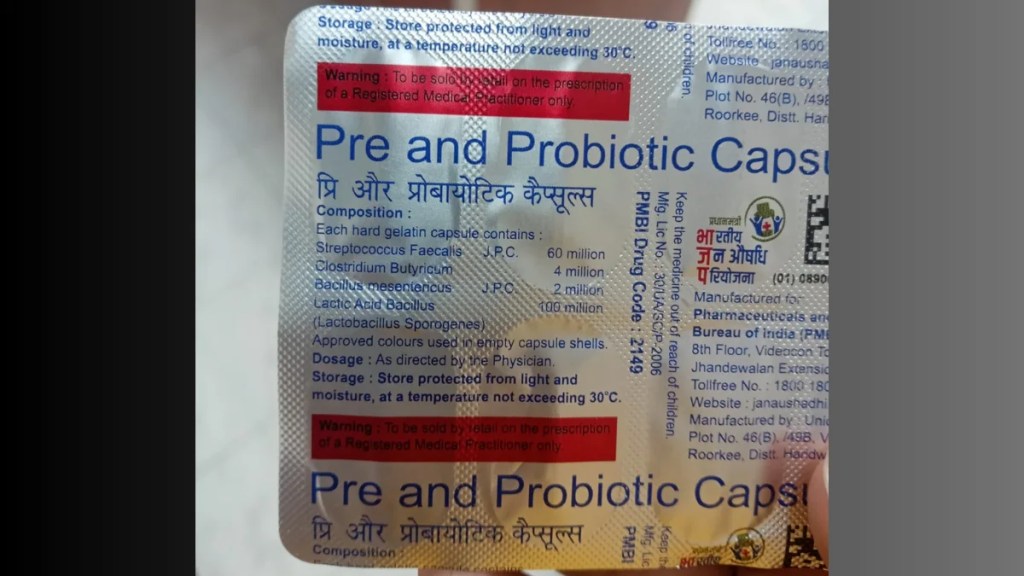
This is where it gets interesting. The Jan Aushadhi Probiotic Capsule contains four specific bacterial strains, each assigned a distinct job inside your gut:
| Bacterial Strain | Quantity | Primary Function |
|---|---|---|
| Streptococcus Faecalis | 60 Million CFU | Fights bad bacteria, controls diarrhea and loose motions |
| Clostridium Butyricum | 4 Million CFU | Repairs intestinal wall lining, reduces gut inflammation, manages gas |
| Bacillus Mesentericus | 2 Million CFU | Works with digestive enzymes to break food down, reduces bloating and heaviness |
| Lactobacillus Sporogenes | 100 Million CFU | Balances gut pH, manages gas/diarrhea/loose motions, overall gut environment manager |
The standout here is Lactobacillus Sporogenes at 100 Million CFU — this is the same bacteria found in curd (dahi) and buttermilk (chhach). It’s the most well-researched probiotic strain in the world, and it’s doing the heaviest lifting inside this capsule.
When your doctor gives you a lactic acid sachet after a bout of loose motions — that’s Lactobacillus doing its job. The Jan Aushadhi Probiotic Capsule delivers the same strain in a stable, pharmaceutical-grade capsule form.

Who Actually Needs This Capsule?
Not everyone needs a probiotic supplement — and that’s an honest answer. If your digestion is smooth, your gut is fine, and you’re not facing any of the issues below, natural probiotic foods like curd and buttermilk are more than enough.
But if you tick any of these boxes, the Jan Aushadhi Probiotic Capsule is worth serious attention:
For Gym-Goers and High-Protein Dieters
If you’re hitting the gym hard and loading up on whey protein, casein, or high-carb bulking meals — your digestive system takes a serious hit. Heavy protein intake increases gut workload significantly. The result is gas, bloating, heaviness after meals, and sometimes loose motions.
Probiotics improve protein digestion and amino acid absorption, meaning your body actually uses the protein you’re paying for — instead of just fermenting it in your gut and creating gas. If you’re already investing in a quality supplement like Jan Aushadhi Whey Protein, pairing it with a probiotic makes that investment work harder.
For People Who Just Finished Antibiotics
This is the most clinically supported use of probiotics. After a full antibiotic course, your gut flora is wiped out — good and bad both. Supplementing with the Jan Aushadhi Probiotic Capsule immediately after your antibiotic course helps rebuild the healthy microbiome faster and restores normal digestion.
For People With Chronic Gas, Bloating, or Irregular Bowels
If you’re dealing with persistent gas, a heavy feeling after meals, or alternating constipation and loose motions — your gut bacteria balance is likely off. A short course of probiotics can restore that balance naturally, without harsh laxatives or antacids.
For People Who Want to Boost Immunity Naturally
Nearly 70% of your immune system lives in your gut. A healthy gut microbiome directly translates to stronger immunity. If you’re also taking a Jan Aushadhi Multivitamin with Ginseng for overall health support, adding probiotics creates a solid foundational stack — gut health and micronutrient coverage together.
Jan Aushadhi vs Amazon Probiotic — The Real Difference
Now for the main question this article is built around.
Go on Amazon and search “probiotic capsule India.” You’ll find products from brands like Wellbeing Nutrition, Carbamide Forte, Himalaya, and dozens of others — priced between ₹300 and ₹1,500. Many of them contain Lactobacillus Acidophilus, Lactobacillus Rhamnosus, Bifidobacterium — names that sound very different from what’s in the Jan Aushadhi capsule.
So is it the same thing?
The short answer: same category, different regulatory path.
Why the Warning Label Exists on Jan Aushadhi Capsule
In India, supplements are regulated under two systems:
FSSAI (Food Safety and Standards Authority of India) governs nutraceuticals and food supplements. Products approved under FSSAI are sold freely — no prescription needed, no warning label required. Most Amazon probiotics fall into this category.
CDSCO (Central Drugs Standard Control Organisation) governs pharmaceutical-grade drugs. The Jan Aushadhi Probiotic Capsule is classified under CDSCO norms — which means it carries a prescription warning not because it’s dangerous, but because pharmaceutical-grade products in India are legally required to carry that label.
The bacteria inside both products do the same job. The difference is the standard of manufacturing and quality control applied. CDSCO norms are stricter — which is why the same bacteria in a Jan Aushadhi capsule can be called a pharmaceutical-grade supplement, while an Amazon product under FSSAI is classified as a food supplement.
The Jan Aushadhi Probiotic Capsule is not inferior. If anything, its regulatory classification signals higher manufacturing standards — at a fraction of the price.
Side Effects — The Honest Answer
The Jan Aushadhi Probiotic Capsule has no significant side effects for most healthy adults. It is not a steroid, not a hormone, not habit-forming, and carries zero addiction potential.
In the first 2–3 days of starting probiotics, some people experience:
- Mild gas or flatulence
- Slight bloating
This is temporary. It’s simply your gut adjusting to the new bacterial population. It passes on its own within a few days.
Who should consult a doctor first:
- Pregnant women
- Infants and young children
- People with severe or chronic gut conditions (IBD, Crohn’s disease)
- Immunocompromised individuals
For everyone else — diabetics, blood pressure patients, thyroid patients — probiotics are safe. Digestion requires good gut bacteria regardless of any other health condition.
How to Take It — Simple and Clear
- Dose: 1 capsule per day
- Best time: Empty stomach, morning
- Duration: 7–15 days for temporary issues (gas, bloating, post-antibiotic recovery). Longer if advised by a doctor.
- Price: ~₹5 per strip at Jan Aushadhi Kendra
No complicated routine. No stacking required. Just consistency.
Is the Jan Aushadhi Probiotic Capsule the same as what’s available on Amazon?
The bacterial strains serve the same purpose, but the Jan Aushadhi Probiotic Capsule is regulated under CDSCO pharmaceutical standards, while most Amazon probiotics fall under FSSAI food supplement norms. Same function, different regulatory classification and quality benchmark.
Can I take the Jan Aushadhi Probiotic Capsule without a doctor’s prescription?
Technically it is a Schedule H drug requiring a prescription. However, since it is a nutraceutical supplement with no known serious side effects, many pharmacists dispense it directly. For chronic gut conditions, always consult a doctor first.
How long does it take for the Jan Aushadhi Probiotic Capsule to show results?
For gas and bloating, most people notice improvement within 3–5 days. For post-antibiotic gut restoration, give it 10–15 days of consistent use. Results vary depending on the severity of the gut imbalance.
Can gym-goers take the Jan Aushadhi Probiotic Capsule with protein supplements?
Absolutely. High protein intake stresses the digestive system — probiotics improve protein breakdown and reduce bloating. Take the probiotic on an empty stomach in the morning and your protein supplement post-workout.
Are there any natural alternatives to the Jan Aushadhi Probiotic Capsule?
Yes. Curd (dahi), buttermilk (chhach), fermented foods like idli-dosa batter, and traditional kanji are all natural probiotic sources. For mild issues, these work well. When the problem is more acute — post-antibiotic, heavy gym training, persistent bloating — the capsule delivers a more concentrated, consistent dose.
Conclusion
The Jan Aushadhi Probiotic Capsule is not a compromise. It is a pharmaceutical-grade gut health supplement that does exactly what expensive branded alternatives promise — at ₹5 instead of ₹500.
Your gut manages everything — digestion, immunity, nutrient absorption, even energy levels. Ignoring it because “it’s just gas” is a mistake most people regret slowly, not suddenly.
If you’re a gym-goer not getting results from your protein, someone recovering from antibiotics, or simply someone tired of feeling heavy and bloated after every meal — this ₹5 capsule deserves a spot in your routine.
Stop overpaying for a label. Start investing in your gut.
Disclaimer: This article is for educational and informational purposes only. It is not a substitute for professional medical advice, diagnosis, or treatment. Always consult a qualified healthcare provider before starting any new supplement, especially if you are pregnant, nursing, or managing a chronic health condition.


