
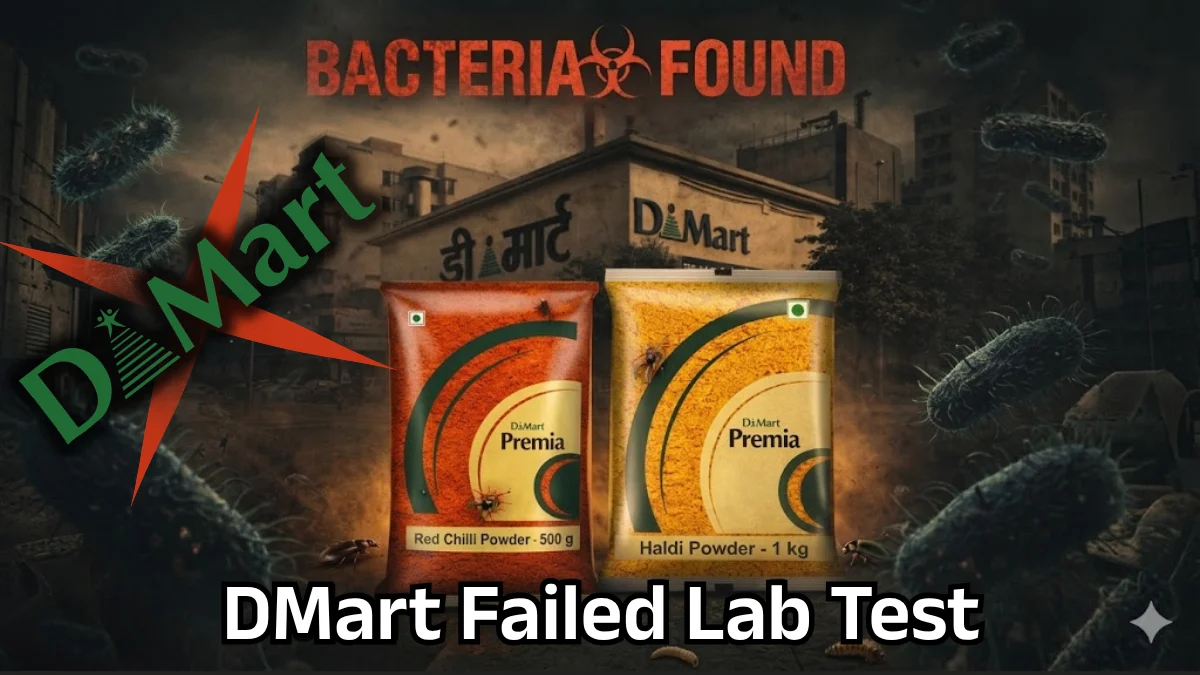
Millions of Indian families trust DMart with their daily groceries — and that trust just got a serious reality check.
What if the masala sitting in your kitchen right now is carrying bacteria levels 36 times higher than what India’s own food safety authority considers safe?
This article breaks down the full blind lab test results of DMart’s Haldi Powder and Red Chilli Powder — every number, every health risk, and what you need to do next. The DMart masala lab test results are out, and they demand your attention.
Why DMart Became India’s Most Trusted Grocery Destination
DMart doesn’t run big ad campaigns. It doesn’t need to. Its reputation was built on one simple idea — more value, less money. People drive past three other stores just to shop at DMart. The aisles aren’t fancy. The display isn’t premium. But the prices? Aggressive enough to make the trip worthwhile every single time.
Their private label products — including the popular DMart Premia masala range — are 20 to 30% cheaper than leading branded alternatives on the same shelf. That price difference is real, and for India’s middle-class households, it adds up over months and years.
But here’s the silent assumption baked into every DMart purchase: “It’s organized retail. It’s sealed and packaged. It must be safe.”
That assumption just got tested — blindly, in a lab — and the results are hard to ignore.
What Is Trustified and Why This Test Carries Weight
Trustified is India’s first 100% blind testing certification program. Blind here means exactly what it sounds like — no brand is aware their product is being tested. Products are purchased directly from retail stores, sealed pack, exactly as any consumer would buy them, and sent to a NABL-accredited laboratory without revealing the brand name.
No prior notice. No sponsored results. No brand influence.
The Blind Testing Model — No Room for Bias
Trustified’s model is built on one principle: test what the consumer actually buys, not what the brand submits for certification. Most quality tests in India happen internally (by the brand) or post-complaint. Trustified bypasses that entirely.
Their previous DMart masala lab test in the spices category had already flagged a pattern — Everest, India’s top spice brand, had 3 out of 4 products fail blind testing. That result shocked the food safety community. And now, DMart’s own private label is under the same lens.
DMart Masala Lab Test Results — The Numbers That Don’t Lie
The DMart masala lab test covered five levels of analysis for both products: heavy metals, aflatoxins, synthetic water-soluble dyes, pesticides, and microbiological contamination.
Levels 1 through 4? Mostly clean. Heavy metals, aflatoxins, dyes — within safe range. Pesticides — detected but within permissible Codex limits.
Level 5 — microbiological — is where both products collapsed completely.
DMart Haldi Powder Deluxe — Level 5 Microbiological Test
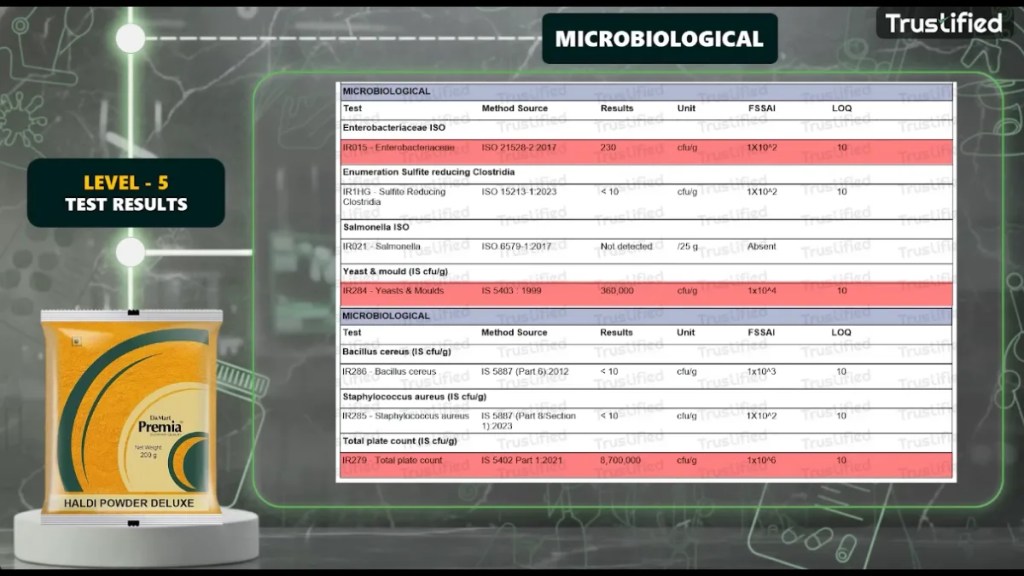
DMart’s Haldi Powder Deluxe (200g) sailed through the first four levels. But the microbiological report from Level 5 tells a completely different story.
- Enterobacteriaceae: 230 cfu/g — 2.3x above FSSAI safe limit
- Total Plate Count (TPC): 8,700,000 cfu/g — 8.7x above FSSAI safe limit
- Yeast & Molds: 360,000 cfu/g — 36x above FSSAI safe limit ❌
A 36x violation means the fungal contamination in this turmeric powder is thirty-six times beyond what India’s food regulator considers acceptable for human consumption.
DMart Red Chilli Powder — The Numbers Get Worse
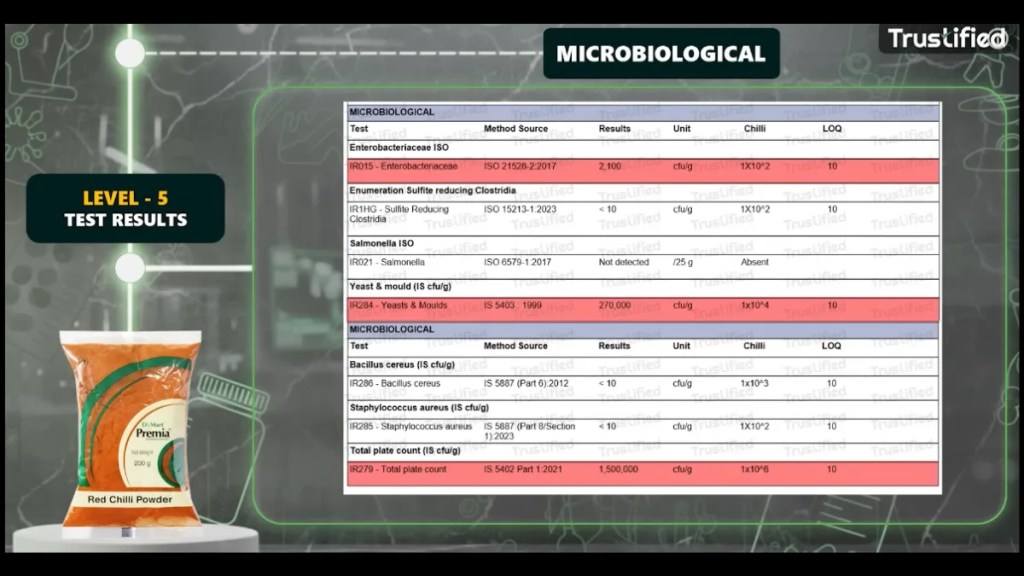
The DMart Red Chilli Powder (200g) results are equally alarming — and on Enterobacteriaceae, actually worse.
- Enterobacteriaceae: 2,100 cfu/g — 21x above FSSAI safe limit ❌
- Total Plate Count (TPC): 1,500,000 cfu/g — 1.5x above FSSAI safe limit
- Yeast & Molds: 270,000 cfu/g — 27x above FSSAI safe limit ❌
Salmonella was not detected. Bacillus cereus and Staphylococcus aureus were within limits. But Enterobacteriaceae at 21 times the permissible level is a serious public health flag that cannot be brushed aside.
Side-by-Side Lab Results — DMart Masala Microbiological Comparison
| Parameter | DMart Haldi Powder | FSSAI Limit | Breach Level |
|---|---|---|---|
| Enterobacteriaceae | 230 cfu/g | 100 cfu/g | 2.3x ⚠️ |
| Total Plate Count | 8,700,000 cfu/g | 1,000,000 cfu/g | 8.7x ⚠️ |
| Yeast & Molds | 360,000 cfu/g | 10,000 cfu/g | 36x ❌ |
| Salmonella | Not Detected | Absent | ✅ Pass |
| Parameter | DMart Red Chilli Powder | FSSAI Limit | Breach Level |
|---|---|---|---|
| Enterobacteriaceae | 2,100 cfu/g | 100 cfu/g | 21x ❌ |
| Total Plate Count | 1,500,000 cfu/g | 1,000,000 cfu/g | 1.5x ⚠️ |
| Yeast & Molds | 270,000 cfu/g | 10,000 cfu/g | 27x ❌ |
| Salmonella | Not Detected | Absent | ✅ Pass |
These aren’t numbers on a data sheet. They go into your dal, your sabzi, your curry — every single day.
What These Bacteria Are Actually Doing to Your Body
The Immediate Risks You Can Feel
Enterobacteriaceae is a bacterial family that includes dangerous pathogens responsible for gut infections. Elevated levels in food are a known indicator of fecal contamination — meaning somewhere in the processing, handling, or storage chain, hygiene broke down completely. Short-term exposure causes food poisoning: nausea, vomiting, diarrhea, and severe abdominal cramps.
Yeast & Molds at 36x the safe limit mean active fungal presence in the product. Mold in food produces mycotoxins — and critically, several mycotoxins are heat-stable, meaning cooking at normal temperatures does not destroy them. Your food looks fine. The toxin stays.
The Long-Term Damage That Builds Silently
Haldi and red chilli are not occasional-use condiments. They go into Indian meals daily, sometimes multiple times a day. Repeated exposure to contaminated masala — even at levels that don’t cause immediate illness — accumulates over time. Chronic gut inflammation, disrupted gut microbiome, weakened immune function, and in cases of sustained mycotoxin exposure, potential stress on the liver and kidneys.
Children, elderly individuals, and anyone with reduced immunity carry a significantly higher risk.
The Question Nobody Bothered to Ask DMart — Until Now
This is arguably the most important part of this entire story.
DMart’s private label products have never faced public lab scrutiny before. Their brand equity rides on pricing and convenience — not on published quality certifications. Consumers assumed organized retail equals safe food. Nobody tested that assumption.
It also raises a harder question: DMart sells a significant volume of open, loose products alongside packaged goods. If a factory-sealed, packaged masala is failing microbiological standards at this scale, what does that say about products with zero packaging protection?
The answer is uncomfortable — and it demands accountability from a brand that serves crores of Indian families every week.
Local Market vs DMart — Who Is Actually Worse?
Indian consumers consciously moved away from local kirana stores and open spice markets. The reasoning was sound — open masala bins, unhygienic storage, no traceability, no accountability. Organized retail was supposed to fix all of that.
The DMart masala lab test results say otherwise.
If a sealed, private-label product from one of India’s largest organized retailers carries bacterial contamination comparable to what you’d expect from the most unregulated local shop — the safety premium of organized retail simply doesn’t exist.
This doesn’t make local markets better. It confirms the problem is systemic — not isolated to one channel or one brand. The entire Indian spice supply chain, from farm to shelf, has a hygiene and handling problem that no one is actively policing.
FSSAI — A Regulator Built for Headlines, Not Safety
Here’s the part that should make every Indian food consumer angry.
The limits being violated in this DMart masala lab test are FSSAI’s own standards — which are already far more lenient than EU and US equivalents. The European Food Safety Authority applies significantly stricter microbial thresholds for ground spices. India’s limits give more room — and these products still exceeded them by 36x.
FSSAI’s enforcement model is reactive, not proactive. Surprise audits on private label products from major retailers are rare. Penalties for violations are minimal. Public disclosure of brand-specific violations is inconsistent at best. There is no mandatory real-time surveillance system. There is no proactive random sampling program for retail shelves.
The United States FDA operates mandatory recall protocols. EU food safety law requires traceability at every stage and rapid alert systems for cross-border contamination. India has a website and a complaint form.
When Patanjali Ghee was put through independent blind lab testing, quality concerns surfaced that no official regulatory action had flagged. When Amul Milk went under the blind testing lens, it triggered national debate about whether “trusted brand” actually means “safe product.” The pattern isn’t new — and it extends beyond food. Even Hajmola, a digestive tablet consumed daily by millions, wasn’t spared when subjected to independent blind lab testing. Every time independent testers step in, they find what FSSAI’s system consistently misses.
That’s not a coincidence. That’s a regulatory failure.
What You Should Do Right Now
Stop waiting for official action. The DMart masala lab test conducted by Trustified has done what FSSAI hasn’t — given you verified, evidence-based information. Here’s what actually works:
🚨 What You Should Do Now
- ❌ Discontinue use of DMart Premia Haldi Powder Deluxe and Red Chilli Powder from recent purchases until DMart issues a formal response.
- 🔍 Check Trustified’s website — their full pass/fail lab report goes live within 24 hours of video publication.
- 📢 File a complaint on FSSAI’s consumer portal at fssai.gov.in — volume of complaints creates pressure even when enforcement is slow.
- 🧪 Demand lab test proof before buying any private label masala, regardless of the retailer.
- 📤 Share this article — most DMart shoppers have no idea this test happened. That changes with you.
Conclusion — The Real Price of Cheap
DMart’s model is brilliant. Low margin, high volume, aggressive pricing — it works. It has transformed grocery retail for millions of Indian families. But cost-cutting in logistics and margins is very different from cost-cutting in food safety.
The DMart masala lab test conducted by Trustified is not an attack on a brand. It is a mirror held up to a system — retailer, regulator, and consumer — that has been operating on assumption instead of evidence for far too long.
Yeast & Molds at 36x above FSSAI limits. Enterobacteriaceae at 21x. These are not quality complaints. These are health warnings.
India’s middle class deserves better than having to choose between expensive branded masala that may also fail and cheap private label masala that clearly does. The answer is not blind loyalty to any brand — it is demanding verified, tested proof of safety from every brand, every time.
Choose tested. Stay safe.
This article is based on blind lab test results published by Trustified, an independent food testing certification organization. Tests were conducted on specific product batches of DMart Premia Haldi Powder Deluxe and Red Chilli Powder (200g), purchased from DMart retail stores. Results reflect those specific batches and may vary across batches, manufacturing dates, and store locations.
This article does not constitute medical or dietary advice. Readers experiencing health concerns are advised to consult a qualified healthcare professional. For the complete lab report, visit Trustified’s official website.


