
You’ve eaten it as a child. Your parents ate it after every big meal. Dabur Hajmola has been a part of every Indian household for decades — a tiny orange tablet carrying a mountain of nostalgia. But what if the very candy you’ve been eating all your life is hiding something your eyes can never see? A certified blind lab test has revealed findings that will make you think twice before popping that next tablet.
In a first-of-its-kind Dabur Hajmola lab test conducted by Trustified — India’s only 100% blind product testing program — a sample of Hajmola was sent to Eurofins, one of the world’s most trusted ISO 17025-accredited laboratories. The results were documented. The data is real. And the numbers are hard to ignore.
Why Was Dabur Hajmola Blind Tested?
Hajmola is not a protein bar or a nutritional supplement. It is not meant to deliver calories, vitamins, or macronutrients. So testing it for nutritional content would have been pointless. The real question with a product like this is simple: is it physically clean?
In the category of spice-based digestive tablets, the biggest and most realistic risk is physical contamination — foreign matter that sneaks into your food during harvesting, processing, grinding, storage, or packaging. This is why Trustified chose filth analysis as the testing method for this Dabur Hajmola lab test — the one test that directly measures hygiene at a microscopic level.
Heavy Filth vs Light Filth — What Does It Actually Mean?
Most people have never heard of filth analysis. Here’s what it means — and why it matters more than you think.
What Is Heavy Filth?
Heavy filth refers to larger, often visible foreign particles — sand, soil, stone, glass, or metal fragments. While they can sometimes be spotted by the naked eye, lab confirmation is essential for exact measurement. Think of it as the ‘obvious dirt’ category.
What Is Light Filth?
Light filth is where it gets unsettling. These are microscopic particles — insect fragments, broken body parts like wings, legs, and antennae, and animal hairs — that are completely invisible to the naked eye. A microscope is required to detect and count them. This is exactly why light filth testing had to be sent to an overseas Eurofins lab for this Dabur Hajmola lab test — the equipment required is not available everywhere in India.
How Was This Lab Test Conducted?
The sample tested was Hajmola Batch No. BM1227, manufactured in November 2025, with an expiry of October 2027. The sample was collected and sent directly by Eurofins — completely blind, with no brand involvement.
Testing was done using the AOAC 970.66 method — an internationally recognised protocol for microscopic filth determination, referenced in regulatory frameworks including the FDA. The lab holds ISO 17025 accreditation, which means every procedure follows validated international quality standards. The data presented here is 100% documented and official.
🚨 Dabur Hajmola Lab Test Results — The Numbers That Shocked Us
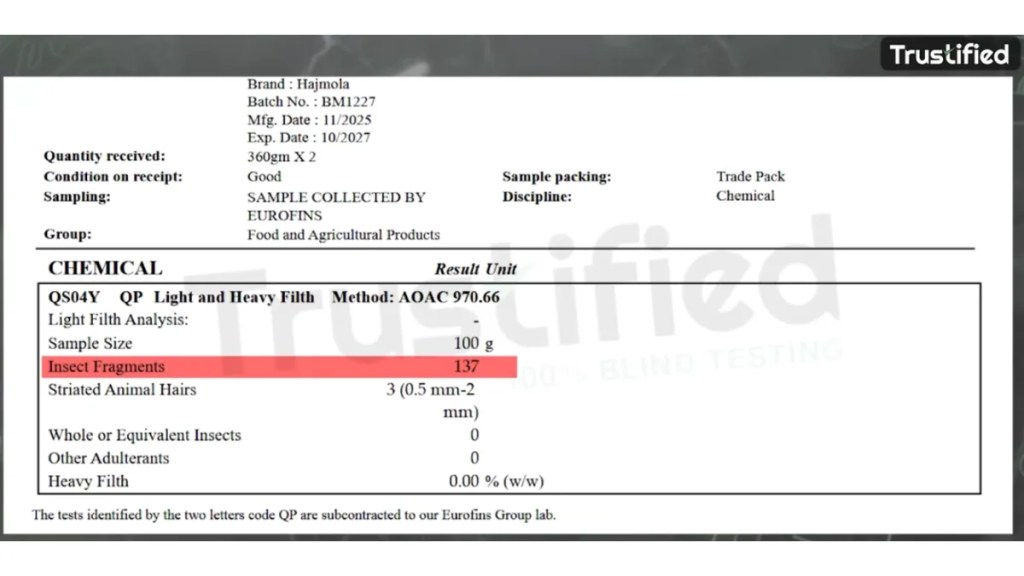
Here is the complete breakdown of what was found in 100 grams of Dabur Hajmola:
| Test Parameter | Result | Status |
| Heavy Filth (Sand, Soil, Glass, Metal) | 0.00% (w/w) | ✅ PASS |
| Light Filth — Insect Fragments | 137 counts / 100g | 🚨 CONCERNING |
| Striated Animal Hairs | 3 counts (0.5–2mm) | ⚠️ FLAGGED |
| Whole or Equivalent Insects | 0 | ✅ PASS |
| Other Adulterants | 0 | ✅ PASS |
📊 Key Takeaway: While heavy filth was completely absent — a clean pass — the light filth results from this Dabur Hajmola lab test revealed 137 insect fragments and 3 striated animal hairs per 100 grams of product, detected under microscope using the internationally validated AOAC 970.66 method.
Where Do These Insect Fragments Actually Come From?
Before you demand a government ban, it is important to understand the supply chain reality of spice-based products in India — because the problem starts long before the product reaches a factory.
Raw ingredients like ginger, black pepper, cumin, and long pepper are grown in open fields. After harvesting, they are typically sun-dried outdoors — not in sterile chambers. Insects are naturally present in this environment. During drying, storage in open gunny sacks, and months of warehousing (since dried herbs don’t spoil quickly), insect activity is almost inevitable.
When these ingredients reach the grinding and processing stage, insect bodies break down into microscopic fragments that blend invisibly into the final powder. You cannot wash dried spices the way you wash vegetables. You cannot filter what you cannot see. The honest truth is that eliminating light filth entirely from spice-based products is technically very difficult — even for large manufacturers. The real question is: are the numbers within a safe limit?
This is where regulatory bodies like FSSAI become critical. India’s food safety authority has defined limits for certain contaminants — but enforcement and transparency around light filth standards remain areas that need stronger public attention.
This is not the first time a popular Indian brand has faced scrutiny under blind lab testing. When Patanjali products were put through the same certified lab process, the findings raised equally important questions about quality control in the Ayurvedic and herbal product segment.
What Does the Dabur Hajmola Label Actually Claim?

The Hajmola label calls itself an ‘Ayurvedic Medicine’ and lists genuine herbal ingredients — Maricha (black pepper), Shunthi (ginger), Pippali (long pepper), Nimbu Saar (lemon extract), Shvetajiraka (cumin), along with Samudra Lavana, Sharkara, and Sauvarchala Lavana. Each 550mg tablet is a formulation rooted in traditional Ayurvedic science.
But two lines on that label deserve a closer look. First: “No Preservatives and Artificial Sweeteners Used.” Second: “Permitted Excipients: Q.S.” — Q.S. stands for Quantum Satis, meaning ‘as much as needed.’ This is a legal but deliberately vague declaration that does not tell the consumer what those excipients actually are. For a brand that markets itself as fully transparent and Ayurvedic, this lack of full disclosure is a conversation worth having.
Is FSSAI Doing Enough? The Accountability Question
Most Indians assume that if a product is on a supermarket shelf, someone has already tested it. But the reality is that FSSAI — the Food Safety and Standards Authority of India — simply does not have the infrastructure to independently test every product, from every batch, of every brand, every year. With thousands of food products in the market, complete coverage is a logistical impossibility.
This is exactly why independent blind testing organisations like Trustified matter. When the government cannot fill every gap, public accountability through transparent testing becomes the next line of defence. The data from this Dabur Hajmola lab test is not an attack on any brand — it is a demand for higher standards, better transparency, and stronger regulatory enforcement across the entire industry.
The problem is not limited to digestive tablets. Even daily essentials like milk have raised red flags — Amul milk was blind-tested in a certified lab and the results were equally eye-opening for millions of Indian consumers who never questioned what they were drinking every morning.
Should You Stop Eating Dabur Hajmola?
That is ultimately your decision — and it should be an informed one. The heavy filth results were clean. No sand, no glass, no metal. The light filth numbers — 137 insect fragments per 100g — are concerning, but it is important to note that different countries have different regulatory limits, and this report presents documented data without making regulatory judgments.
What this Dabur Hajmola lab test does tell us is this: we are living in 2026, in an age where certified lab data is available, where blind testing is possible, and where consumers have every right to make educated choices. If data exists, use it. You don’t have to stop eating Hajmola — but you deserve to know exactly what you’re eating.
Is Dabur Hajmola really 100% Ayurvedic?
Dabur classifies Hajmola as an Ayurvedic Medicine and lists herbal ingredients like Maricha, Shunthi, and Pippali. However, the label also states “Permitted Excipients: Q.S.” — a legal but vague declaration that does not disclose what those excipients actually are. For a brand claiming full Ayurvedic transparency, this remains an open question.
What did the Dabur Hajmola Lab Test reveal?
The Dabur Hajmola lab test conducted at Eurofins — an ISO 17025 accredited lab — using the internationally recognised AOAC 970.66 method found 137 insect fragments and 3 striated animal hairs per 100 grams of product. Heavy filth including sand, glass, and metal was completely absent.
What are excipients in Dabur Hajmola?
Excipients are inactive substances used as binders, fillers, or flow agents in tablet manufacturing. The term “Q.S.” (Quantum Satis) on the Hajmola label means “as much as needed” — but the actual excipients used are not named, making it impossible for consumers to know exactly what they are consuming beyond the listed herbal ingredients.
Is it safe to eat Hajmola daily?
Dabur recommends 1 to 2 tablets for adults after meals. The Dabur Hajmola lab test found 137 insect fragments per 100g — while different countries have different regulatory limits for such contaminants, this data is worth considering before making daily consumption a habit, especially for children.
Is Hajmola safe during pregnancy?
Pregnant women should always consult a doctor before consuming any Ayurvedic or herbal product. No specific peer-reviewed safety data for Hajmola during pregnancy is publicly available. Given the lab test findings, caution is advisable.
Where do insect fragments in food come from?
Insect fragments in spice-based products typically originate during harvesting, open-air drying, storage in gunny sacks, and grinding of raw ingredients like ginger, pepper, and cumin. Since dried herbs cannot be washed like vegetables, microscopic insect body parts often survive the entire manufacturing process. This is a supply chain reality across the spice industry — not limited to any single brand.
What is the AOAC 970.66 test method?
AOAC 970.66 is an internationally recognised standard method for microscopic determination of light and heavy filth in food products. It is referenced in regulatory frameworks including the US FDA and is performed only in ISO 17025 accredited laboratories to ensure validated, reproducible results.
How many insect fragments are allowed in food in India?
FSSAI has defined contamination limits for various food categories, but specific light filth thresholds for processed Ayurvedic tablets are not widely published. For reference, the US FDA Defect Levels Handbook permits up to 75 insect fragments per 50g in certain ground spices. The 137 fragments found per 100g in this Dabur Hajmola lab test translates to approximately 68.5 per 50g.
Conclusion — The Right to Know
A one-rupee candy. A lifetime of habit. And now, 137 insect fragments per 100 grams in a certified lab report.
This Dabur Hajmola lab test is not about fear — it is about awareness. We live in an era where certified testing is accessible, where data can be made public, and where consumers have more power than ever before. You no longer need to guess what’s in your food. You can know.
The findings presented here come from an ISO 17025 accredited lab using the AOAC 970.66 internationally recognised method. The data is documented. The report is real. What you do with this information is your choice — and that choice should always be informed.
📺 Watch the full Trustified blind test video: Dabur Hajmola Blind Test — YouTube
Choose Safe. Be Safe. — Trustified


