

You watched 200 strands circle the shower drain this morning — and your stomach dropped.
What if this shedding never stops, and one day you look in the mirror and barely recognize yourself?
This guide gives you the complete truth about telogen effluvium — why stress pushes your hair out, how long it actually lasts, and the exact steps to stop the shedding and regrow every strand naturally.
Hair loss is personal. It hits your confidence, your identity, and your mental peace — all at once. And when a doctor casually says “it’s just stress-related hair loss,” it does not feel just anything. It feels like your body is betraying you.
The medical term for this condition is telogen effluvium — and it is the most common form of stress-related hair loss affecting millions worldwide. The good news? It is almost always reversible. But only if you understand what is happening inside your scalp, what triggered it, and what to do next.
That is exactly what this article delivers.
Table of Contents
What Is Telogen Effluvium?
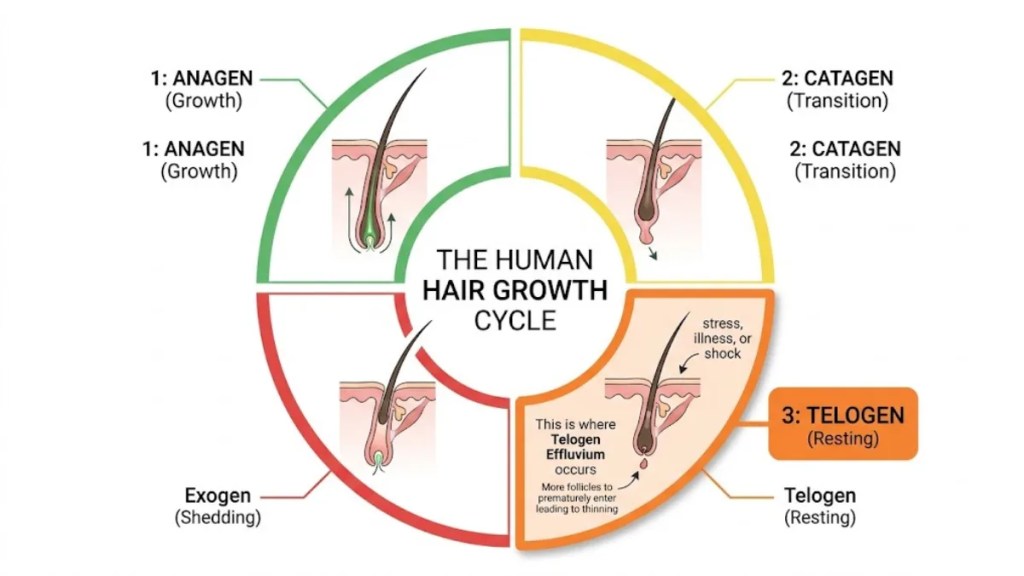
Telogen effluvium is a reactive hair loss condition where a large number of hair follicles are pushed prematurely into the resting (telogen) phase. Instead of growing, they sit idle for two to three months — and then fall out simultaneously.
The result? Sudden, diffuse hair shedding that shows up on your pillow, in the shower, on your comb, and across your bathroom floor.
This is not pattern baldness. This is not permanent. This is your body’s alarm system telling you something went wrong — physically, emotionally, or nutritionally — roughly three months ago.
How the Hair Growth Cycle Works
Your hair follows a predictable cycle with four phases:
- Anagen (Growth Phase): Lasts 2–7 years. About 85–90% of your hair is here at any given time.
- Catagen (Transition Phase): Lasts 2–3 weeks. The follicle shrinks and detaches.
- Telogen (Resting Phase): Lasts 2–3 months. Hair sits idle, waiting to shed.
- Exogen (Shedding Phase): Old hair falls out, new hair pushes through.
Normally, only 5–10% of your hair is in the telogen phase. During telogen effluvium, that number jumps to 30% or more — which is why you suddenly lose 200–300+ hairs per day instead of the normal 50–100.
Acute vs Chronic Telogen Effluvium
There are two types and the difference matters:
Acute telogen effluvium is triggered by a specific event — surgery, illness, emotional trauma, crash diet. It starts 2–3 months after the trigger and resolves within 6–9 months once the cause is removed.
Chronic telogen effluvium lasts longer than six months, sometimes years. It often has no single identifiable trigger and tends to affect women between 30 and 60. The shedding comes in waves — better some months, worse in others.
What Causes Stress-Related Hair Loss?
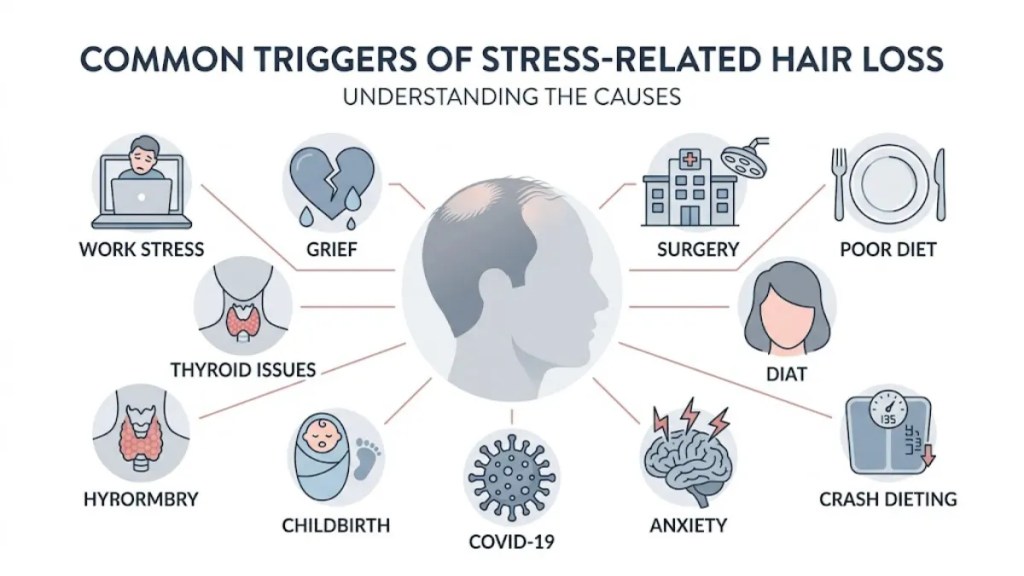
Telogen effluvium never appears randomly. There is always a trigger — even if you cannot immediately identify it. The tricky part is that the trigger happens 2–3 months before the shedding starts, so most people never connect the two.
Emotional and Psychological Triggers
Your body does not distinguish between a lion chasing you and a toxic work environment. Chronic emotional stress floods your system with cortisol, and elevated cortisol directly disrupts the hair growth cycle.
Common emotional triggers include:
- Death of a loved one or grief
- Divorce, breakup, or relationship trauma
- Job loss, financial stress, or work burnout
- Anxiety disorders and prolonged depression
- Caregiving stress
- Major life transitions (relocation, isolation)
Physical and Medical Triggers
Your body treats physical trauma the same way it treats emotional stress — as a survival threat. Hair growth is not a survival priority, so the body shuts it down.
- High fever or severe infection (including COVID-19)
- Major surgery or hospitalization
- Childbirth (postpartum hair loss is classic telogen effluvium)
- Stopping or starting birth control pills
- Thyroid disorders (hypothyroidism or hyperthyroidism)
- Autoimmune flare-ups
- Rapid weight loss or crash dieting
Nutritional Deficiencies That Trigger TE
This is the trigger most people overlook — and the easiest to fix.
- Iron deficiency (low ferritin is the #1 nutritional cause)
- Vitamin D deficiency
- Zinc deficiency
- Vitamin B12 deficiency
- Protein deficiency (common in restrictive diets)
- Extreme calorie restriction
Telogen Effluvium Symptoms You Should Not Ignore

Classic Signs
The hallmark of telogen effluvium is sudden, diffuse thinning — not bald patches, not receding hairlines. The shedding is spread across your entire scalp, though it often feels most noticeable at the temples and crown.
Watch for these signs:
- Handfuls of hair coming out in the shower or while brushing
- Hair on your pillow every morning
- Ponytail feeling noticeably thinner
- Visible scalp through your hair, especially in bright light
- Hair strands everywhere — on clothes, desk, car seat, food
How Much Hair Loss Is Normal vs Telogen Effluvium?
- Normal shedding: 50–100 hairs per day
- Telogen effluvium: 200–300+ hairs per day
- Severe cases: 400+ hairs per day
If you are consistently losing more than 150 hairs daily for several weeks, it is time to investigate.
The Home Pull Test
Grab a small section of about 40–60 hairs between your fingers near the scalp. Slide your fingers firmly along the full length of the hair.
- Normal result: 1–2 hairs come out
- Positive for TE: 6 or more hairs come out easily
Repeat in three different areas of your scalp — front, sides, and crown. If all areas show excessive shedding, telogen effluvium is likely.
Telogen Effluvium vs Other Hair Loss Types

This is where most people panic unnecessarily. They assume the worst — permanent baldness — when the reality is far more treatable. Understanding the differences saves you from months of anxiety.
| Feature | Telogen Effluvium | Androgenetic Alopecia | Alopecia Areata |
|---|---|---|---|
| Pattern | Diffuse, all-over thinning | Receding hairline / crown thinning | Circular bald patches |
| Onset | Sudden (2–3 months after trigger) | Gradual (months to years) | Sudden |
| Cause | Stress, illness, deficiency | Genetics + hormones (DHT) | Autoimmune attack |
| Hair Type Lost | Telogen (club) hairs with white bulb | Miniaturized thin hairs | Exclamation mark hairs |
| Reversible? | Almost always YES | Partially (with treatment) | Unpredictable |
| Scalp Appearance | Normal scalp | Visible miniaturization | Smooth, shiny patches |
| Pull Test | Strongly positive | Usually negative | Positive at patch edges |
| Treatment Duration | 6–12 months recovery | Lifelong maintenance | Variable |
The key difference: telogen effluvium sheds normal, healthy hairs that were prematurely pushed into rest. Androgenetic alopecia shrinks the follicle permanently. One is a temporary disruption. The other is a structural change. Know which one you are dealing with before you panic.
If you are unsure, a trichoscopy examination at a dermatologist’s office can distinguish between these conditions within minut
There is no magic pill for telogen effluvium. Recovery requires a combination of removing the trigger, supporting your body nutritionally, and giving your follicles the right environment to restart growth.
Medical Treatments
Minoxidil (2% or 5%): The only FDA-approved topical treatment that directly stimulates hair follicles. For telogen effluvium, it speeds up the transition from telogen back to anagen. Results appear within 3–4 months. It is not mandatory for TE recovery — but it accelerates the timeline.
PRP Therapy (Platelet-Rich Plasma): Your own blood is drawn, concentrated, and injected into the scalp. PRP delivers growth factors directly to dormant follicles. Studies show measurable improvement in hair density within 3–6 sessions.
Low-Level Laser Therapy (LLLT): Red light devices stimulate cellular energy in hair follicles. Effective as a supporting treatment alongside other approaches.
Natural Remedies That Actually Work
- Scalp massage (5 minutes daily): Research published in Dermatology and Therapy confirmed that standardized scalp massage increases hair thickness by improving blood flow to follicles. Use your fingertips — circular motions, medium pressure.
- Rosemary oil: A 2015 study showed rosemary oil performed comparably to 2% minoxidil over six months. Mix 3–5 drops with a carrier oil (coconut or jojoba) and massage into the scalp.
- Pumpkin seed oil: Blocks mild DHT activity and supports follicle health.
- Ashwagandha: An adaptogen that directly lowers cortisol levels. If your stress-related hair loss is driven by chronic stress, this herb addresses the root cause.
Supplements for Hair Regrowth — With Dosages
Do not blindly take supplements. Get a blood test first. Supplementing without confirmed deficiency is wasteful — and in some cases, harmful (excess Vitamin A and zinc actually cause hair loss).
Once your levels are tested, here is what works:
| Supplement | Recommended Dosage | Why It Helps | Important Note |
|---|---|---|---|
| Iron (Ferritin) | 30–60 mg/day | Ferritin below 40 ng/mL linked to TE | Take with Vitamin C for absorption. Avoid with tea/coffee |
| Vitamin D3 | 2000–4000 IU/day | Deficiency directly disrupts hair cycle | Get levels tested — target 40–60 ng/mL |
| Zinc | 15–30 mg/day | Supports follicle structure and repair | Excess zinc causes copper deficiency — do not exceed 40 mg |
| Biotin | 2500–5000 mcg/day | Strengthens hair keratin | Stop 72 hours before any blood test — biotin skews results |
| Omega-3 | 1000–2000 mg/day | Reduces scalp inflammation | Fish oil or algae-based for vegetarians |
| Vitamin B12 | 1000 mcg/day | Essential for cell division in follicles | Critical for vegetarians and vegans |
| Vitamin C | 500–1000 mg/day | Boosts iron absorption + collagen synthesis | Take alongside iron supplement |
These supplements support hair recovery — they do not replace addressing the actual trigger. Fix the root cause AND supplement. That is the formula.
Best Diet for Telogen Effluvium Recovery
Your hair follicles are among the fastest-dividing cells in your body. They demand constant nutritional fuel. Starve them, and they shut down. Feed them right, and they come back stronger.
Top Foods That Fight Hair Loss
- Eggs: Complete protein + biotin + zinc in one food
- Spinach and lentils: Iron + folate powerhouse
- Salmon and sardines: Omega-3 + Vitamin D + protein
- Sweet potatoes: Beta-carotene converts to Vitamin A for scalp sebum production
- Nuts and seeds: Zinc, selenium, Vitamin E
- Greek yogurt: Protein + B5 (pantothenic acid)
- Bell peppers: Vitamin C for iron absorption and collagen
- Oysters: The single richest food source of zinc
Foods to Avoid During Recovery
- Excess sugar: Spikes insulin, increases inflammation, worsens shedding
- Highly processed foods: Nutrient-empty calories that displace real nutrition
- Excess alcohol: Depletes zinc, B vitamins, and dehydrates the scalp
- Raw egg whites in excess: Avidin in raw whites binds biotin and blocks absorption
- Mercury-heavy fish (swordfish, king mackerel): Mercury toxicity triggers hair loss
Telogen Effluvium Recovery — Month by Month
This is the section you have been looking for. Here is the honest, realistic timeline — what actually happens at each stage of telogen effluvium recovery.
This is the hardest phase emotionally. Hair comes out in alarming quantities — 200 to 500 strands per day. The shower drain fills up. Your brush collects clumps. Your anxiety spikes — which ironically worsens the shedding. The trigger has already passed. Breathe. This phase is temporary.
You start noticing fewer hairs on your pillow. The drain is not as full. The pull test begins to normalize. You are not imagining it — the worst is genuinely passing. Daily counts drop noticeably week on week.
Tiny baby hairs appear along your hairline and part line. They stick up at awkward angles and feel fine and soft. These short new strands are your proof that follicles have exited telogen and re-entered the anagen growth phase. This is the most reassuring visible sign of confirmed recovery.
New hairs gain length and thickness. Your ponytail starts to feel fuller. Density returns gradually — not overnight, but steadily and consistently. Most cases of acute telogen effluvium resolve fully around this milestone.
Most people recover 90–100% of their original hair density within a year. Some notice slight texture changes during regrowth — this is normal and temporary. Chronic TE cases take longer but full recovery is still achievable once the root trigger is addressed.
Pro Tip: Take monthly photos of your part line in the same lighting and angle. Progress is too slow to notice daily — but comparing month 1 to month 6 photos shows clear, undeniable improvement. Stop counting hairs. Start tracking baby hairs instead.
Signs Your Telogen Effluvium Is Ending
Stop counting hairs. Start looking for these signs instead:
- Shower drain collects fewer hairs than last month
- Short baby hairs visible at the hairline and temples
- Pull test yields 1–2 hairs instead of 6+
- Pillow is cleaner in the morning
- Hair feels slightly thicker when you run your hands through it
- Your hairdresser notices new growth
Mistakes That Make Telogen Effluvium Worse
❌ Obsessively counting hairs: Increases anxiety, which increases cortisol, which increases shedding. A vicious cycle.
❌ Crash dieting during recovery: Your follicles need calories and nutrients to rebuild. Restricting food NOW is the worst timing possible.
❌ Skipping meals or protein: Hair is protein. No protein intake = no hair production. Simple biology.
❌ Over-supplementing without blood tests: Excess zinc causes copper deficiency. Excess Vitamin A causes MORE hair loss. Test first, supplement second.
❌ Using harsh shampoos and heat styling: Already-weakened hair breaks easier. Switch to gentle, sulfate-free products during recovery.
❌ Googling hair loss at 2 AM: You will convince yourself you are going bald. You are not. Step away from the search bar and sleep — your hair needs rest more than research.
Stress Management for Hair Recovery
Exercise, Yoga, and Sleep — The Underrated Hair Growth Tools
Exercise: 30 minutes of moderate cardio, four times a week, measurably reduces cortisol levels. Walking, swimming, cycling — anything that gets your heart rate up without overtraining. Excessive intense exercise (marathon training, extreme CrossFit) can worsen telogen effluvium through physical stress overload.
Yoga: Specific inversions like downward dog, headstand, and forward folds increase blood circulation to the scalp. Pair with deep breathing (pranayama) for a double cortisol-lowering effect.
Sleep: Your body repairs hair follicles during deep sleep. Growth hormone — essential for cell regeneration including hair cells — peaks during sleep stages 3 and 4. Aim for 7–8 hours minimum. Non-negotiable.
Mental Health and Hair Loss — The Conversation Nobody Has
Here is what nobody tells you: hair loss causes stress, and stress causes hair loss. It is a brutal feedback loop.
Many people experiencing telogen effluvium develop secondary anxiety, social withdrawal, and depression — not because of the hair itself, but because of what it represents. Identity. Youth. Control.
If your hair loss is consuming your thoughts, disrupting your work, or making you avoid social situations — that is not vanity. That is a mental health signal. Talk to a therapist. Join a support community. Tell someone you trust how you feel.
Your emotional recovery matters as much as your hair recovery. Often, they are the same thing.
For deeper strategies on managing the anxiety-stress cycle, read our comprehensive guide on how chronic stress affects your body and how to break the cycle.
When to See a Doctor
🔴 Hair loss continues beyond 12 months with no improvement
🔴 You notice distinct bald patches (not diffuse thinning)
🔴 Scalp is red, itchy, scaly, or painful
🔴 Hair loss started after a new medication
🔴 You are also experiencing unexplained weight changes, fatigue, or irregular periods
🔴 Family history of autoimmune conditions
🔴 Hair loss is accompanied by nail changes (brittle, ridged)
Can telogen effluvium be permanent?
Acute telogen effluvium is not permanent. Once the trigger is removed and nutritional gaps are addressed, hair regrows within 6–12 months. Chronic TE lasts longer but still responds to proper management.
How many hairs falling per day is telogen effluvium?
Normal shedding is 50–100 hairs daily. Telogen effluvium typically causes 200–300+ hairs to fall per day. In severe cases, it exceeds 400.
Does telogen effluvium cause bald spots?
No. Telogen effluvium causes diffuse, all-over thinning — not localized bald patches. If you see distinct bald spots, that suggests alopecia areata, which is a different condition entirely.
Will my hair thickness return to normal after telogen effluvium?
In most cases, full density returns within 12–18 months. Some people notice slight texture changes during regrowth (finer or wavier than before), but this usually normalizes over time.
Can telogen effluvium happen more than once?
Absolutely. If you encounter a new major stressor, illness, or nutritional deficiency, TE can recur. The good news is that knowing what it is the second time reduces the anxiety significantly — and faster intervention means faster recovery.
Does minoxidil work for telogen effluvium?
Minoxidil is not necessary for TE recovery — the hair regrows on its own once the trigger is resolved. However, minoxidil accelerates the regrowth timeline and is useful if you want faster visible results or if shedding is severe.
Can anxiety alone cause telogen effluvium?
Yes. Chronic anxiety elevates cortisol and norepinephrine levels continuously, which directly disrupts the hair growth cycle and pushes follicles into the telogen phase.
Is telogen effluvium genetic?
There is no direct genetic marker for TE. However, your genetic predisposition to stress response, nutritional absorption, and hormonal sensitivity can influence your susceptibility.
Can lack of sleep cause telogen effluvium?
Chronic sleep deprivation raises cortisol, impairs growth hormone production, and creates systemic inflammation — all of which contribute to hair shedding. Sleep is not optional for hair health.
Does exercise help telogen effluvium?
Moderate exercise reduces cortisol, improves blood circulation to the scalp, and enhances nutrient delivery to follicles. It helps — but overtraining (extreme endurance exercise) can worsen TE by putting additional physical stress on the body.
Can diet alone cure telogen effluvium?
If the trigger was a nutritional deficiency, then correcting the diet can resolve TE entirely. If the trigger was emotional trauma, surgery, or medication — diet supports recovery but does not replace addressing the root cause.
Should I cut my hair short during telogen effluvium?
A shorter cut reduces the visual impact of thinning and makes shedding less noticeable psychologically. It does not affect the biological recovery process either way — this is purely a personal comfort decision.
Final Takeaway: Your Hair Will Grow Back
Telogen effluvium is frightening. Watching your hair fall out in clumps while feeling powerless is one of the most distressing experiences anyone can go through.
But here is what the science, the data, and thousands of recovery stories confirm: stress-related hair loss is temporary, treatable, and reversible.
Your job is simple:
- Identify and remove the trigger — emotional, physical, or nutritional
- Feed your body — protein, iron, Vitamin D, zinc, and whole foods
- Manage your stress — exercise, sleep, breathe, and talk to someone
- Be patient — follicles recover on their own timeline, not yours
- Stop panicking — anxiety about hair loss causes more hair loss
Six months from now, you will run your fingers through new growth and wonder why you ever doubted your body’s ability to heal.
Trust the process. Your hair is already on its way back.
References & Scientific Sources
This article is based on peer-reviewed research and clinical evidence from trusted medical and scientific sources.
- 1
The diagnosis and treatment of iron deficiency and its potential relationship to hair loss.
- 2
Telogen Effluvium — a comprehensive clinical review covering pathophysiology, diagnosis, and management.
- 3
Standardized scalp massage results in increased hair thickness by inducing stretching forces to dermal papilla cells in the subcutaneous tissue.
- 4
Rosemary oil vs minoxidil 2% for the treatment of androgenetic alopecia: a randomized comparative trial.


One thought on “Telogen Effluvium: How to Stop Stress Hair Loss and Regrow Hair Naturally”