
You clean your hairbrush and feel your stomach drop — that’s too much hair. Again. You’ve tried different shampoos. You’ve taken biotin. Nothing works.
Your doctor ran a blood test, told you everything looks ‘normal’ — but your iron deficiency hair loss keeps getting worse. The problem? Most doctors only check hemoglobin. They completely miss the one number that explains your hair fall.
This guide gives you the exact blood tests to ask for, the ferritin targets that matter, and a treatment plan backed by clinical research — not guesswork.
Key Takeaways — Iron Deficiency Hair Loss
- Ferritin is the real marker — not hemoglobin. You can have normal hemoglobin and still lose hair. Ask your doctor specifically for a serum ferritin test. Target range for hair growth: 70–100 ng/mL.
- Four blood tests — not one. Serum Ferritin, Serum Iron, TIBC, and Transferrin Saturation together give the complete picture. A basic CBC alone is not enough to diagnose iron deficiency hair loss.
- This type of hair loss is fully reversible. Follicles are dormant — not dead. With consistent iron treatment, most people see visible regrowth by Month 6 and full recovery by Month 12.
- Pair iron with Vitamin C — always. Eating iron-rich foods alongside Vitamin C sources (amla, lemon, guava) boosts absorption by up to 67%. Avoid tea and coffee 1 hour before and after iron intake.
Table of Contents
What Is Iron Deficiency — And Why Your Hair Pays the Price
Iron is not just about energy. Inside your body, iron plays a direct role in building hemoglobin — the protein that carries oxygen to every single cell, including the cells inside your hair follicles.
When iron levels drop, the body makes a brutal survival decision: it cuts off oxygen supply to non-essential areas first. Hair follicles are at the top of that cut list.
Global scale: The World Health Organization estimates that iron deficiency affects over 2 billion people worldwide. In India, more than 50% of women of reproductive age are iron deficient — making this the single most common nutritional cause of hair loss in the country.
Iron Deficiency vs Iron Deficiency Anemia — Know the Difference
This is the mistake most doctors make, and it costs patients months of unnecessary hair loss.
- Iron deficiency anemia means your hemoglobin is low — your blood test looks abnormal.
- Iron deficiency without anemia means your hemoglobin is technically ‘normal’ — but your ferritin (iron storage) is depleted.
- Hair loss can happen in BOTH cases — but most doctors only test hemoglobin and stop there.
Normal hemoglobin does not rule out iron deficiency hair loss. Ferritin is the test that tells the truth.
How Iron Deficiency Actually Destroys Your Hair
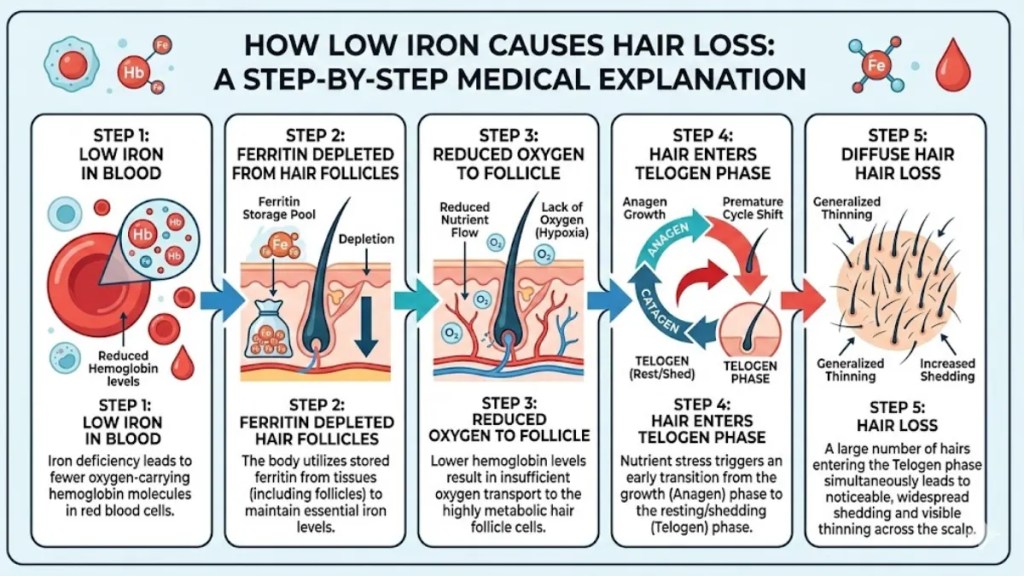
Your hair grows in cycles — anagen (growth), catagen (transition), and telogen (shedding). Under healthy conditions, about 85–90% of your hair stays in the growth phase at any given time.
When ferritin drops below a critical threshold, the body pulls iron reserves directly from hair follicle cells. This throws follicles into early telogen — the shedding phase. This condition is called telogen effluvium, and it produces exactly the kind of diffuse, all-over hair thinning that iron-deficient patients experience.
The Ferritin Theft Your Body Does in Secret
Here is something most articles will not tell you: ferritin is actually stored inside hair follicle cells. When the body is low on iron, it borrows this stored ferritin from the follicles before pulling from other tissues.
This is why hair loss often begins 2–3 months before any other symptoms of iron deficiency appear. Your scalp is the early warning system — your hair is falling before your energy crashes or your nails turn brittle.
Scientific basis: A 2006 review published in the Journal of the American Academy of Dermatology (Trost, Bergfeld & Calogeras) established the link between low serum ferritin and telogen effluvium, recommending ferritin as the primary diagnostic marker for iron-related hair loss.
Iron deficiency weakens hair at the follicle level — and hard water mineral deposits worsen the damage by physically blocking those already-compromised follicles. When iron stores are low and scalp mineral buildup is high, hair fall accelerates beyond what either cause produces independently. Hard water hair fall and iron deficiency are the two most commonly missed diagnoses in chronic hair loss cases.
Symptoms: Is Iron Deficiency Behind Your Hair Fall?
Iron deficiency hair loss has a specific pattern. It is not patches. It is not a receding hairline. It is a general, all-over thinning — you lose volume everywhere, your parting looks wider, and you shed significantly more than the normal 50–100 hairs per day.
🔎 Hair-Specific Signs
- More hair than usual in the shower drain or on your pillow
- Wider parting or visible scalp under normal lighting
- Hair that snaps easily and feels thinner in a ponytail
- Shedding that started 2–3 months after a stressful event, illness, or pregnancy
🩺 Body Signs That Confirm the Diagnosis
- Persistent fatigue even after full sleep
- Cold hands and feet — even in warm weather
- Pale inner eyelids or pale skin tone
- Brittle nails or spoon-shaped nails (koilonychia)
- Brain fog, poor concentration, frequent headaches
- Restless legs at night
⚠️ See a doctor immediately if: You notice significant hair thinning combined with extreme fatigue, shortness of breath, or a rapid heartbeat. These signal severe iron deficiency anemia requiring urgent treatment.
Iron deficiency is just one of many possible root causes. To understand the full picture of what triggers hair loss, read our complete guide to treating hair fall.
Ferritin Levels and Hair Loss Risk — Know Your Number
This is the table your doctor should have shown you.
| Ferritin Level | Hair Loss Risk | What You Should Do |
|---|---|---|
| Below 30 ng/mL | 🔴 Severe — Active heavy shedding | Immediate iron supplementation under doctor supervision |
| 30–70 ng/mL | 🟠 Moderate — Thinning in progress | Iron supplements + diet changes + retest in 3 months |
| 70–100 ng/mL | 🟡 Borderline — Recovery zone | Optimize diet, monitor closely, light supplementation |
| Above 100 ng/mL | 🟢 Optimal for hair growth | Maintain with consistent iron-rich diet |
Based on clinical findings from Trost et al., Journal of the American Academy of Dermatology, 2006.
The Blood Tests You Must Demand From Your Doctor
A standard blood test at most clinics checks only hemoglobin or a basic CBC (complete blood count). This is not enough. To properly diagnose iron deficiency hair loss, you need four specific tests.

🧪 The 4 Tests That Actually Matter
- Serum Ferritin — The most important test. Measures iron storage protein. Target: 70–100 ng/mL for hair health. This single test reveals more than others combined.
- Serum Iron — Measures circulating iron in blood. Normal range: 60–170 mcg/dL.
- TIBC (Total Iron Binding Capacity) — Shows how much iron blood can carry. High TIBC + low serum iron confirms deficiency. Normal: 240–450 mcg/dL.
- Transferrin Saturation — Calculated from serum iron & TIBC. Below 20% confirms deficiency. Normal: 20–50%.
In India: A complete iron panel (all 4 tests) costs approximately ₹400–₹800 at labs like Dr. Lal PathLabs, Thyrocare, or SRL Diagnostics. It is one of the most cost-effective diagnostic tests available.
How to Read Your Results
Do not just look at whether each value is ‘in range.’ Context matters. You can have ferritin at 35 ng/mL — technically within the lab’s normal range — but still experience significant iron deficiency hair loss. The hair-optimized target for ferritin is 70–100 ng/mL, not the lab’s minimum normal value.
Treatment: The Right Way to Fix Iron Deficiency Hair Loss
Treatment has three layers: fix your diet, supplement correctly, and support your scalp during recovery. All three matter. Doing only one will slow your results.
🥗 Iron-Rich Foods That Actually Work
Not all iron is absorbed equally. Heme iron — from animal sources — absorbs at 15–35% efficiency. Non-heme iron — from plant sources — absorbs at only 2–20%. This gap matters enormously for vegetarians and vegans.
- Red meat, chicken liver, beef, tuna, oysters, eggs
- Lentils (dal), spinach, tofu, kidney beans (rajma), pumpkin seeds, quinoa, dark chocolate
- Eat Vitamin C with every iron-rich meal — amla, lemon, orange, guava
- Tea, coffee, calcium supplements — avoid 1 hour before and after iron-rich meals
Nutrition does more for hair than any shampoo ever will. Iron deficiency often pairs with protein deficiency in people with hair loss — read how protein deficiency also triggers hair loss to address both simultaneously.
💊 Iron Supplements — Type, Dose, and Timing
If diet alone is not enough — and for most people with moderate to severe deficiency, it is not — supplementation is necessary.
- Ferrous Sulfate: Most prescribed, highly effective, and affordable. May cause constipation in some individuals.
- Ferrous Gluconate: Gentler on the stomach, but provides slightly lower elemental iron per dose.
- Ferric Forms (Ferric Ammonium Citrate, etc.): Better absorbed by some people, especially those with digestive sensitivity.
- Typical Dose: 100–200 mg elemental iron per day — always under a doctor’s guidance.
- Best Time to Take: On an empty stomach with lemon water (Vitamin C can boost absorption by up to 67%).
- Side Effects: Dark stools are normal. If severe stomach pain or vomiting occurs, switch to a gentler form.
While correcting your iron levels, also consider naturally blocking DHT — because DHT sensitivity can accelerate hair loss even as your iron recovers.
Iron Infusion — When Is It Needed?
For patients with serum ferritin below 15 ng/mL, severe absorption issues (celiac disease, Crohn’s), or those who cannot tolerate oral iron, an intravenous iron infusion may be recommended. This is a hospital procedure that raises ferritin levels significantly faster than oral supplements — results begin within 2–4 weeks.
Iron Deficiency Hair Loss vs Other Types — How to Tell the Difference
Before committing to any treatment, confirm which type of hair loss you are actually dealing with. The treatments are different, and treating the wrong cause wastes time and money.
| Feature | Iron Deficiency | Thyroid-Related | Pattern Baldness |
|---|---|---|---|
| Pattern | All-over diffuse thinning | Diffuse + eyebrows thinning | Temples and crown |
| Reversible? | ✅ Yes, fully | ✅ With treatment | Partial only |
| Key Blood Test | Serum Ferritin | TSH, T3, T4 | No blood test — physical exam |
| Main Treatment | Iron + diet | Thyroid medication | Minoxidil / Finasteride |
| Affects | Women, vegans, athletes | Women 30–60 | Men + genetic predisposition |
| Timeline to Improve | 6–12 months | 3–6 months | Ongoing management |
If you identify with multiple columns, consult a dermatologist for comprehensive testing. Multiple deficiencies frequently occur together.
How Long Before Your Hair Grows Back?
This is the question everyone wants answered — and the answer requires honesty, not false hope.
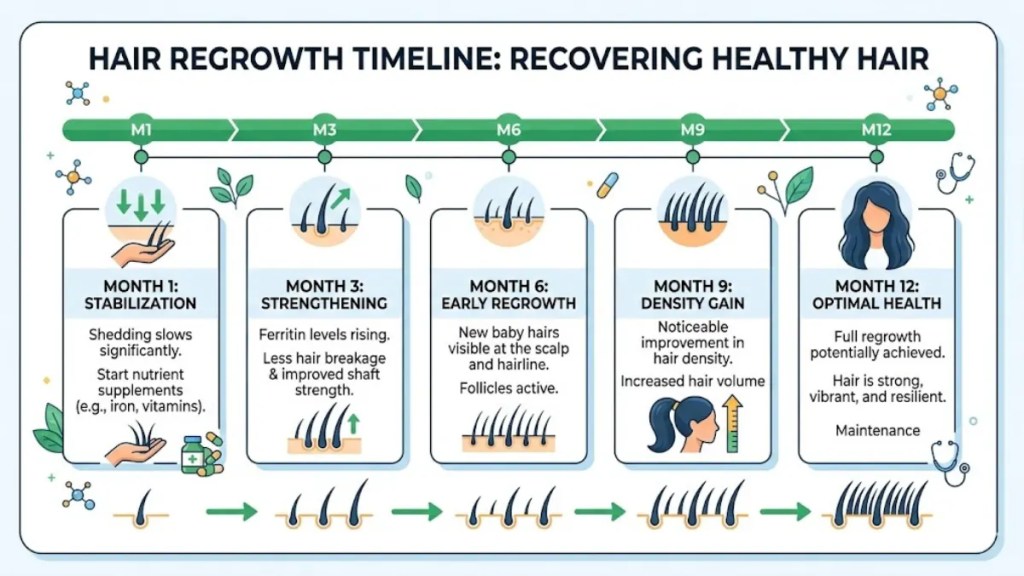
- Month 1–2: Shedding begins to slow. Ferritin is rising but hair hasn’t responded yet. Stay consistent.
- Month 3: Noticeably less breakage. Less hair in the shower. Ferritin approaching 50–70 ng/mL.
- Month 6: Baby hairs become visible along the hairline and scalp — the first real proof it is working.
- Month 9: Visible density improvement. Ponytail feels thicker. Parting narrows.
- Month 12: Full recovery possible for most people with consistent treatment and optimized ferritin.
Hair grows approximately 1.25 cm (half an inch) per month. There is no shortcut to this timeline. Anyone promising faster results is selling you something.
Retest your ferritin at the 3-month mark. If levels are not improving, talk to your doctor about adjusting dosage or switching supplement types.
Does iron deficiency cause hair loss without anemia?
Yes. You can experience iron deficiency hair loss even with completely normal hemoglobin levels. The real marker is serum ferritin — when it drops below 70 ng/mL, hair follicles lose their oxygen supply and shift into the shedding phase. A normal CBC or hemoglobin test does not rule this out. Always ask specifically for a serum ferritin test.
What ferritin level causes hair loss?
Ferritin below 30 ng/mL causes active, heavy shedding. Between 30–70 ng/mL, thinning continues at a slower pace. The optimal target for healthy hair growth is 70–100 ng/mL — this is based on clinical dermatological research, not standard lab reference ranges which are often set too low for hair health.
Is iron deficiency hair loss permanent?
No. Iron deficiency hair loss is one of the most reversible types of hair loss. The follicles are not destroyed — they are dormant due to lack of oxygen. Once ferritin levels are restored and maintained above 70 ng/mL, follicles recover and new hair growth begins. Most people see visible regrowth within 6–12 months of consistent treatment.
Which blood tests should I ask for if I suspect iron deficiency hair loss?
Ask your doctor for four specific tests: 1) Serum Ferritin — the most important marker for hair loss, 2) Serum Iron, 3) TIBC (Total Iron Binding Capacity), and 4) Transferrin Saturation. A hemoglobin test or basic CBC alone is not enough to diagnose iron-related hair loss. In India, this full panel costs approximately ₹400–₹800 at labs like Dr. Lal PathLabs or Thyrocare.
How long does it take for hair to grow back after treating iron deficiency?
Month 1–2: Shedding begins to slow. Month 3: Less breakage, ferritin rising. Month 6: New baby hairs become visible along the scalp. Month 9: Noticeable density improvement. Month 12: Full regrowth possible with consistent treatment. Hair grows only about 1.25 cm per month — patience is non-negotiable.
Can men get iron deficiency hair loss?
Yes. While iron deficiency is more common in women due to menstrual blood loss, men with poor diets, digestive disorders like celiac disease or Crohn’s, heavy physical training, or strict vegetarian and vegan lifestyles face significant risk. The mechanism, symptoms, and treatment are identical regardless of gender.
The Bottom Line
Iron deficiency hair loss is not a mystery. It is not bad luck. It is a fixable, well-understood medical condition with a clear diagnostic path and a proven treatment protocol.
The frustrating truth is that millions of people are spending money on expensive shampoos, serums, and supplements without ever checking the one number that matters most — their serum ferritin. One blood test can explain months, sometimes years, of hair loss.
Know your ferritin. Fix your iron. Give your body the time it needs to rebuild.
Hair loss from iron deficiency is reversible. The follicles are not gone — they are waiting.
For a complete, root-cause approach to stopping hair fall, read our complete guide to treating hair fall — covering every nutritional, hormonal, and lifestyle factor that drives hair loss.
References & Scientific Sources
This article is based on peer-reviewed research and clinical evidence from trusted medical sources.
- 1
The diagnosis and treatment of iron deficiency and its potential relationship to hair loss.
- 2
Iron: Fact Sheet for Health Professionals — recommended intakes, functions, and deficiency symptoms.
- 3
Nutritional factors and hair loss — role of iron stores (serum ferritin) in diffuse hair loss among women.
- 4
Iron deficiency anaemia: assessment, prevention and control — a guide for programme managers.
This article is for informational and educational purposes only. It does not constitute medical advice, diagnosis, or treatment. Always consult a qualified healthcare professional before starting any supplement, medication, or treatment protocol for hair loss or iron deficiency. Self-diagnosis based on this article is not a substitute for professional medical evaluation.


2 thoughts on “Why Is Your Hair Falling Out? Iron Deficiency Hair Loss — The Truth Doctors Rarely Explain”