
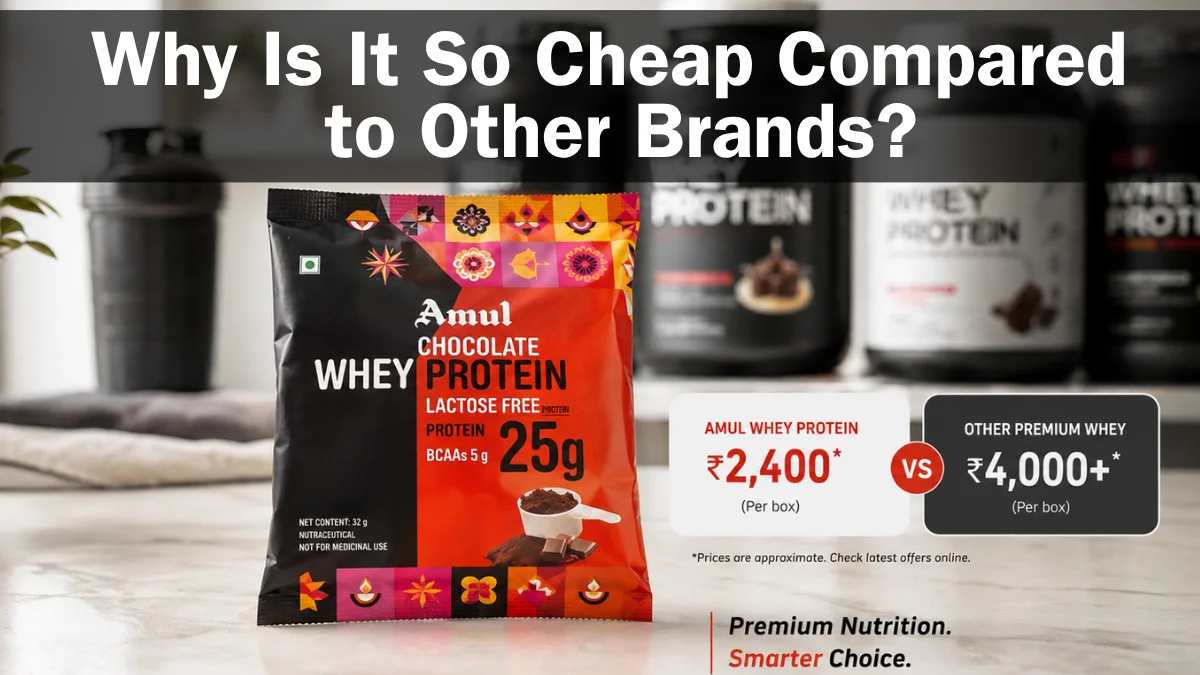
At ₹2,400, Amul Whey Protein looks almost too good to be true when other popular whey products can cost considerably more.
So why is Amul selling whey protein at such an aggressive price—and is there a catch behind it?
In this Amul Whey Protein Review, we break down the ingredients, protein content, lactose-free claim, taste, mixability, lab-testing question and pricing to find out what you are actually getting for your money.
What Is Amul Whey Protein?
The first thing to understand is what Amul is actually selling.
Amul’s plain whey protein is built around whey protein concentrate, not whey protein isolate. The official product page says one 32 g sachet provides 25 g of whey protein and 5 g of BCAA, while also describing the product as lactose free.
The packaging is different from the traditional large whey tubs you see from most supplement brands. Amul sells the product in individual sachets, which makes it easy to carry during travel or keep in a gym bag without taking an entire container with you.
The current official listing puts the plain 30-sachet pack at ₹2,400, with the 60-sachet pack listed at ₹4,200. The chocolate version is listed at ₹2,500 for 30 sachets and ₹4,500 for 60.
That price immediately raises the obvious question:
Why is Amul Whey Protein so cheap compared to other brands?
The answer starts with the type of company Amul actually is.
Why Is Amul Whey Protein So Cheap Compared to Other Brands?

Most people look at whey protein as a sports supplement.
Amul comes at it from a completely different direction: dairy.
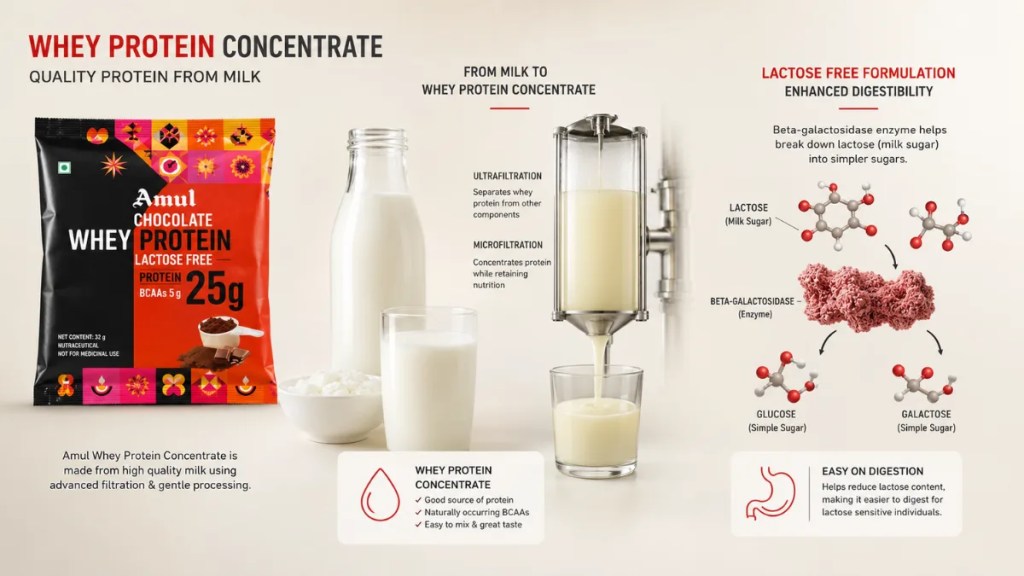
Whey is the liquid fraction separated during dairy processing such as cheese production. That whey can then be processed and filtered to produce whey ingredients, including whey protein concentrate.
This matters because Amul operates at enormous scale in the dairy industry. It already has a massive milk-processing ecosystem, established procurement, processing infrastructure and distribution network.
That does not mean whey protein has zero manufacturing cost. It still requires filtration, drying, quality control, packaging, flavouring where applicable, testing and transportation.
But scale can change the economics dramatically.
A supplement-first company may need to source its whey ingredient, manufacture the finished product, package it, distribute it, market it and then sell it through multiple channels.
Amul already operates inside the dairy ecosystem from which whey originates.
That is why the most logical answer to why Amul whey protein is cheaper is not simply “because it is low quality.”
It is a combination of scale, dairy integration, product formulation and distribution economics.
And there is another important point: Amul’s plain whey formulation is relatively straightforward. The official ingredient list contains whey protein concentrate and beta-galactosidase, while Amul states that there are no added sweeteners, colours or flavours in the plain version.
Is Amul Whey Protein Concentrate or Isolate?
This is where many buyers get confused.
Amul Whey Protein is a whey protein concentrate.
That is clearly stated in the official ingredient list.
Concentrate and isolate are both legitimate whey protein forms, but they are processed differently.
Whey concentrate retains more of the naturally occurring components present in whey. Whey isolate undergoes additional filtration to produce a product with a higher proportion of protein and generally fewer non-protein components.
So if you are expecting Amul to behave exactly like a premium whey isolate, you are starting with the wrong comparison.
The better question is whether Amul Whey Protein Concentrate gives you enough protein and a good overall value for daily use.
For many people, the answer is yes.
A concentrate is not automatically inferior. It is simply a different product category.
How Much Protein Is Actually in Amul Whey Protein?
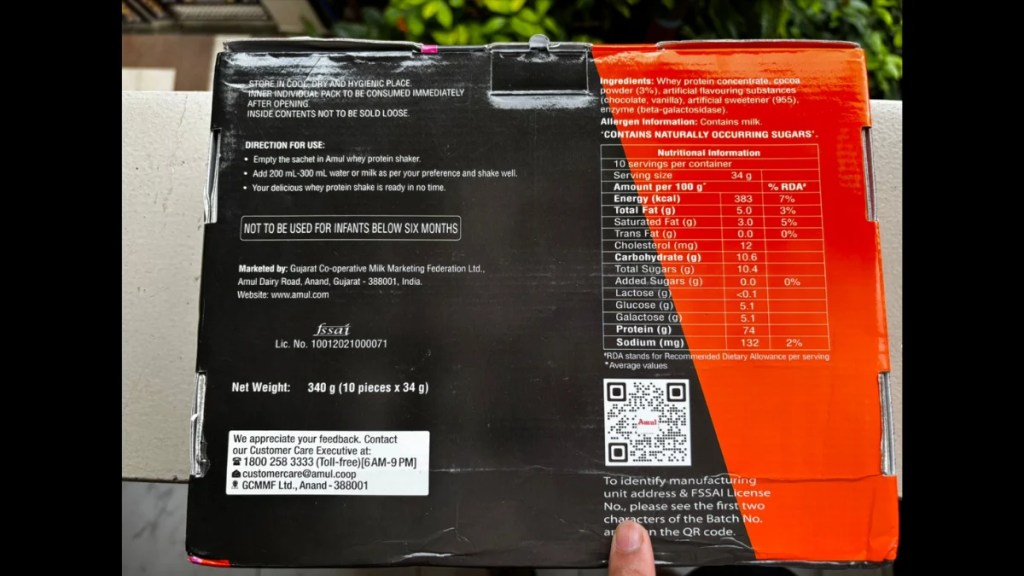
The official Amul specification is straightforward: one 32 g plain whey sachet provides 25 g protein and 5 g BCAA.
That works out to roughly 78% protein by serving weight.
This is an important distinction because phrases such as “100% whey” can easily confuse consumers.
When a label says 100% whey, it refers to the source of the protein, not the idea that the entire sachet is 100% protein.
In other words, a 32 g serving containing 25 g protein is completely different from saying the sachet contains 32 g of pure protein.
The rest of the serving can include other components naturally present in the formulation.
So when judging Amul Whey Protein, look at the nutrition panel first—not just the big claim on the front.
What Makes Amul Whey Protein Different?
There are several details that make this product stand out.
The first is the single-serve sachet format.
The second is the use of whey protein concentrate.
The third is the product’s lactose-free positioning and the inclusion of beta-galactosidase.
And the fourth is the price.
Put those together and you get a product that is positioned very differently from premium whey tubs marketed heavily through gyms, influencers and sports-supplement channels.
Is Amul Whey Protein Really Lactose Free?
Amul officially markets the plain product as lactose free and lists beta-galactosidase in the ingredients.
Beta-galactosidase is an enzyme that breaks lactose down into simpler sugars.
This is relevant because whey concentrate can contain more lactose than highly filtered whey isolate.
So the lactose-free claim is not just about putting the words “lactose free” on the front. There is an enzyme in the formulation that supports this approach.
That is one of the more interesting technical aspects of Amul Whey Protein Ingredients.
However, lactose intolerance and a milk-protein allergy are not the same thing. Someone who reacts to dairy proteins should not assume that a lactose-free product is automatically suitable.
Amul Whey Protein Price: Where Does It Stand?
This is the point where the product becomes especially interesting.
Amul’s official store currently lists the plain 30-sachet pack at ₹2,400 and the 60-sachet pack at ₹4,200. The chocolate versions are listed at ₹2,500 and ₹4,500 respectively.
At 25 g protein per serving, the plain 30-pack gives you 750 g of protein across the complete pack.
That means the price per serving is about ₹80 for the 30-sachet pack.
The larger 60-sachet pack works out to about ₹70 per serving.
| Factor | Amul Whey Protein | What It Means |
|---|---|---|
| Protein source | Whey Protein Concentrate | Straightforward everyday whey |
| Protein per serving | 25 g | High-protein serving |
| BCAA | 5 g | Naturally occurring amino acids from whey |
| Serving format | Individual sachet | Convenient for travel |
| Lactose positioning | Lactose free | Beta-galactosidase included |
| Plain 30-pack | ₹2,400 | About ₹80 per serving |
| Plain 60-pack | ₹4,200 | About ₹70 per serving |
| Main attraction | Price + convenience | Strong budget proposition |
The numbers explain a lot.
Amul is not necessarily cheap because it contains “cheap protein.” It is cheap because the product sits inside a much larger dairy business and is sold in a relatively simple format.
That is an important difference.
Amul Whey Protein Taste and Mixability
Price and nutrition tell only half the story.
You also have to drink the product.
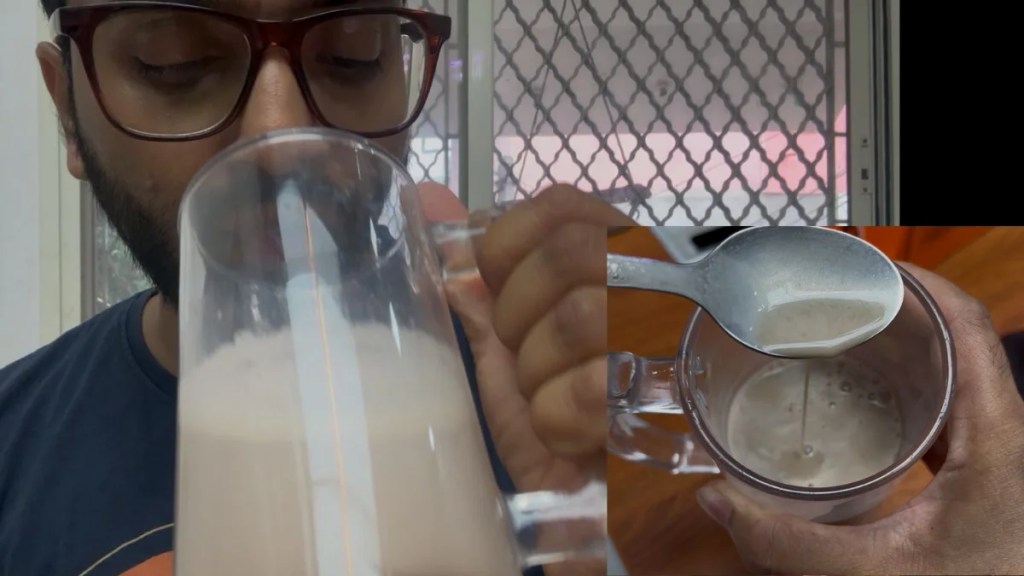
I tested the whey with roughly 200–250 ml of water. It mixed quickly, but one thing was noticeable almost immediately: the shake produced a fair amount of foam.
After sitting for a short time, the foam settled down.
I also noticed that the powder dissolved quickly enough for regular use without turning into a thick, difficult-to-drink shake.
The taste is more subjective.
With the flavoured version, the artificial sweetener and flavour profile are noticeable. It does not taste like a premium milkshake, and anyone expecting a dessert-style whey may find it underwhelming.
But that is not necessarily a deal-breaker.
For a protein supplement, taste is important only up to a point. If the product is affordable, delivers a useful amount of protein and is easy enough to drink every day, it already covers the fundamentals.
In my experience, the Amul Whey Protein Taste is acceptable rather than exceptional.
What About the Amul Whey Protein Lab Test?

This is the section where you need to separate facts from assumptions.
There is a widely viewed third-party Amul Whey Protein Lab Test from Trustified, published in December 2023. The video has accumulated more than 500,000 views, showing just how much interest there is in the question of whether Amul’s whey actually delivers what the label promises.
But an older third-party test should not be treated as a permanent certificate for every batch sold today.
That distinction is important.
A product can be tested at one point in time, while another batch may be manufactured later. The right way to interpret a lab report is to look at what product and batch were tested, which parameters were tested and when the testing happened.
Amul also has its own quality-control system, but that is different from a publicly available independent third-party report.
So if someone asks:
“Does Amul Whey Protein pass the lab test?”
the responsible answer is to refer to the specific independent test rather than making a blanket statement about every current batch.
That is also why I would not use one old lab report as a reason to blindly trust every supplement from the market.
Is Amul Whey Protein Worth Buying?
This is where the entire review comes together.
If you want a simple whey protein concentrate, 25 g protein per serving, single-serve packaging and an aggressive price, Amul has a very strong proposition.
If you want a premium whey isolate with a more elaborate formulation, a huge flavour range or a more luxurious taste experience, there are better options.
The biggest strength of Amul is not one magic ingredient.
It is the combination.
Dairy-scale economics + whey concentrate + 25 g protein per serving + lactose-free positioning + simple sachet packaging + low cost.
That combination is difficult to ignore.
There is one practical problem, though: availability.
Amul’s online store currently shows multiple whey products with changing stock status, so availability can vary by product and time.
That matters if you are planning to depend on the same protein every day.
Amul Whey Protein vs Other Budget Protein Options
The biggest mistake is assuming that the cheapest whey automatically wins.
Your diet matters.
Your protein requirement matters.
Your tolerance matters.
And your budget matters.
For example, we have also reviewed Jan Aushadhi Whey Protein in detail, including its ingredients, price and independent testing. That makes it a useful comparison when looking at budget-focused whey products.
And if whey does not suit you, our guide to the best plant protein in India covers alternative protein sources and compares different plant-based options.
The point is simple: buy according to your needs, not just the lowest number on the price tag.
Who Should Buy Amul Whey Protein?
It Makes Sense If You Want:
A reasonably priced daily protein source.
A whey protein concentrate rather than an isolate.
A simple ingredient profile in the plain version.
Convenient individual sachets for travel.
A product from a major dairy brand.
A protein powder that provides 25 g protein per serving.
It May Not Be the Best Choice If You Want:
A premium whey isolate.
A wide variety of highly developed flavours.
A luxury taste experience.
Consistently available stock without checking.
A product selected primarily on the basis of extensive recent third-party testing.
The Real Answer: Why Is Amul Whey Protein So Cheap?
Now we can finally answer the question from the title.
Amul Whey Protein is cheap because Amul is not operating like a typical supplement-only company.
Its enormous dairy ecosystem gives it a fundamentally different relationship with the raw material and processing infrastructure.
Add a relatively simple whey concentrate formula, single-serve packaging and direct online selling, and the economics become easier to understand.
That does not prove that Amul is the “best whey protein in India.”
It does something more useful.
It explains why a product can be inexpensive without the price itself proving that the product is poor quality.
And that is the real lesson here.
Frequently Asked Questions
Is Amul Whey Protein Good?
Yes, Amul Whey Protein is a strong budget option for people who want a straightforward whey protein concentrate. It provides 25 g protein per serving and is officially marketed as lactose free in the plain version.
Why Is Amul Whey Protein So Cheap Compared to Other Brands?
The biggest reason is its position inside Amul’s large dairy ecosystem. Scale, existing processing infrastructure, a simple formulation and direct distribution can all reduce the overall economics of the product.
Is Amul Whey Protein Concentrate or Isolate?
Amul’s plain whey product uses whey protein concentrate. It is not being sold as a whey protein isolate.
Is Amul Whey Protein Really Lactose Free?
Amul officially describes the plain product as lactose free and lists beta-galactosidase in the ingredients.
Does Amul Whey Protein Cause Bloating?
Individual tolerance varies. Whey concentrate can be harder for some people to tolerate than isolate, but Amul’s plain product includes beta-galactosidase and is marketed as lactose free. Persistent digestive symptoms should not simply be blamed on the product without considering other dietary factors.
Is Amul Whey Protein Worth Buying?
For someone focused on value for money, 25 g protein per serving and a simple whey concentrate, it is worth considering. The final decision should also account for taste, availability, tolerance and whether concentrate fits your needs.
Final Verdict
Amul Whey Protein is one of the more interesting budget whey products in the Indian market because the price makes you question the product before you even open the sachet.
Once you look past the ₹2,400 price tag, the picture becomes clearer.
It is a whey protein concentrate, provides 25 g protein per serving, uses beta-galactosidase in the plain formulation, comes in convenient sachets and is priced aggressively through Amul’s large dairy ecosystem.
It is not perfect.
The taste is not extraordinary. Foaming can be noticeable. Availability can fluctuate. And one older independent lab test should not be treated as a lifetime guarantee for every future batch.
But none of those points change the central conclusion.
If your priority is getting a straightforward daily whey protein without paying a premium simply for branding, Amul Whey Protein deserves serious consideration.
The smartest way to buy protein is not to chase the most expensive tub or the loudest marketing.
Read the label. Understand the protein source. Check the price per serving. Look at the evidence. Then decide.
Disclaimer
This article is for general informational and educational purposes only. Product prices, availability, formulations and testing results can change over time. Independent laboratory results apply to the specific product or batch tested and should not automatically be treated as certification of every current batch. Anyone with a milk-protein allergy, significant digestive condition or other medical concern should consult a qualified healthcare professional before using a protein supplement.


