
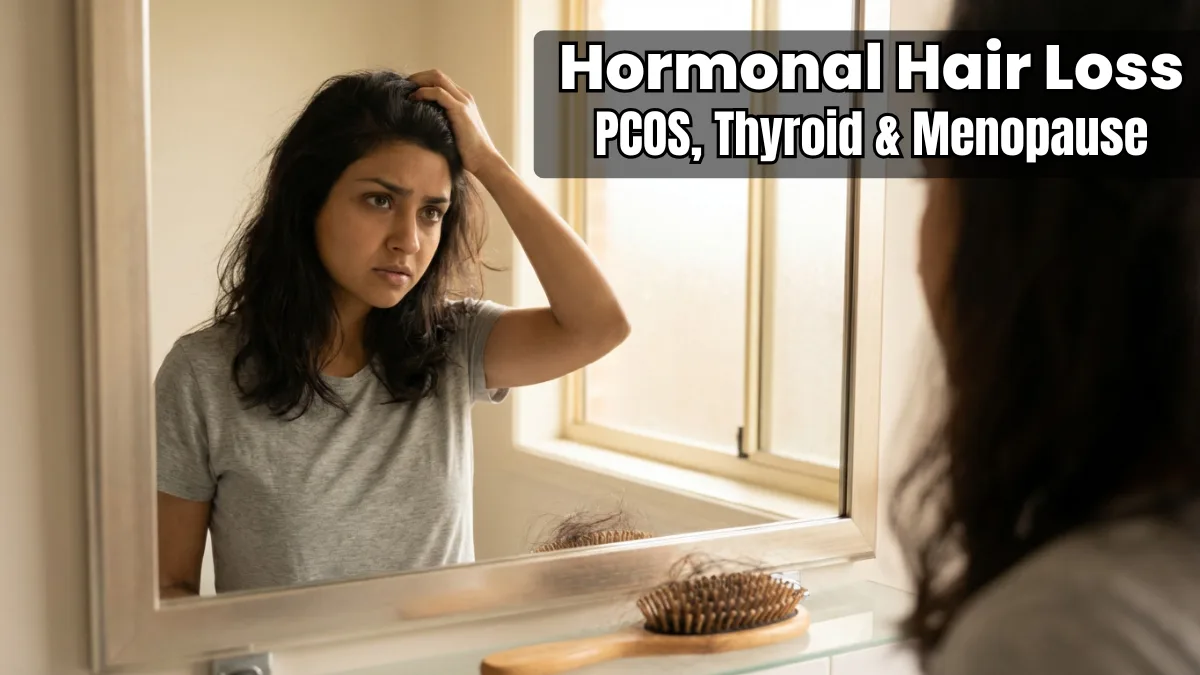
When your hair starts falling — it is not just hair you lose. You lose confidence. You lose peace. You lose a part of yourself every single day.
But here is what most women don’t know — 80% of female hair loss is not caused by shampoo, water, or weather. It is caused by hormones. PCOS, thyroid disorders, and menopause are silently destroying hair from the inside — and most women don’t realize it until the damage is already deep.
This article breaks down every hormonal cause of hair loss in women, the exact signs to look for, and proven natural ways to stop it and regrow your hair.
Table of Contents
What Is Hormonal Hair Loss in Women?
Hormonal hair loss in women happens when the body’s hormone levels go out of balance. Hormones control the hair growth cycle. When they fluctuate — hair follicles shrink, growth slows down, and shedding increases.
This is not regular hair fall. This is internal damage showing up externally.
Which Hormones Are Responsible?
Your hair depends on a delicate balance of multiple hormones. When even one goes off track, the entire hair growth cycle collapses.
Here are the key hormones involved:
- Estrogen & Progesterone — Keep hair in the growth phase. When they drop, hair thins rapidly.
- Testosterone & DHT — High levels shrink hair follicles, especially in women with PCOS.
- Thyroid Hormones (T3, T4, TSH) — Control metabolism and cell regeneration, including hair cells.
- Cortisol — The stress hormone. Chronically high cortisol pushes hair into the shedding phase.
- Insulin — Insulin resistance triggers excess androgen production, which directly causes hair fall.
Every single one of these hormones plays a role in hormonal hair loss in women. The question is — which one is off balance in YOUR body?
If you want a deeper understanding of all types of hair fall and their solutions, read our complete hair fall treatment guide — it covers everything from root cause to regrowth.
PCOS and Hair Loss — The Silent Destroyer

PCOS (Polycystic Ovary Syndrome) is the number one hormonal condition causing hair loss in young women today. It affects women as early as their teenage years — and most don’t even know they have it.
How PCOS Triggers Hair Fall
PCOS causes the ovaries to produce excess androgens (male hormones). These androgens convert into DHT (Dihydrotestosterone) — a hormone that literally poisons hair follicles.
DHT attaches to hair follicles on the scalp, shrinks them, and eventually kills them. The result? Thinning hair at the crown, widening part line, and visible scalp.
Insulin resistance — which is present in 70% of PCOS cases — makes it worse. High insulin signals the ovaries to produce even more testosterone. It becomes a vicious cycle.
Signs That Your Hair Loss Is Due to PCOS
- Hair thinning at the top of the head (not sides or back)
- Irregular or missed periods
- Acne on jawline, chin, or back
- Unwanted facial hair (chin, upper lip)
- Sudden weight gain, especially around the belly
- Darkening of skin around neck and armpits
If you have 3 or more of these signs along with hair fall — PCOS is the most likely cause. No guessing. Get tested.
Thyroid and Hair Loss — The Ignored Culprit
Thyroid disorders are the second biggest hormonal cause of hair loss in women — and the most ignored one. Millions of women live with undiagnosed thyroid problems for years, blaming their hair fall on everything except the real cause.
Hypothyroid vs Hyperthyroid Hair Loss
| Hypothyroidism | Hyperthyroidism | |
|---|---|---|
| Meaning | Underactive thyroid | Overactive thyroid |
| Hair Loss Type | Slow, gradual thinning | Rapid, aggressive shedding |
| Hair Texture | Dry, brittle, rough | Fine, soft, fragile |
| Other Signs | Weight gain, fatigue, cold sensitivity | Weight loss, anxiety, heat sensitivity |
Both conditions disrupt the hair growth cycle. Thyroid hormones directly control how fast your hair cells regenerate. When thyroid levels go off — hair stops growing and starts fallingHow to Identify Thyroid-Related Hair Fall
- Hair falls evenly from all over the scalp (diffuse thinning)
- Eyebrow thinning, especially the outer edges
- Extreme fatigue even after full sleep
- Unexplained weight changes
- Dry skin and brittle nails
- Feeling cold or hot all the time
A simple TSH blood test confirms thyroid issues. It takes 5 minutes. There is no excuse to skip it.
Hormonal imbalance doesn’t just cause hair loss — it also affects your menstrual cycle and vaginal health. Learn more about white discharge and hormonal health in women to understand the full picture.
| Factor | PCOS Hair Loss | Thyroid Hair Loss | Menopause Hair Loss |
|---|---|---|---|
| Main Cause | High Androgens & DHT | TSH Imbalance (T3/T4) | Estrogen & Progesterone Drop |
| Hair Loss Pattern | Crown thinning, wide parting | Diffuse, all-over thinning | Overall thinning, front hairline |
| Common Age | 18–35 years | Any age | 45–55 years |
| Key Symptoms | Acne, irregular periods, facial hair | Fatigue, weight change, dry skin | Hot flashes, mood swings, dryness |
| Reversible? | Yes — with lifestyle & treatment | Yes — once thyroid is controlled | Partially — with HRT & nutrition |
| Best Treatment | Anti-androgen therapy, diet, exercise | Thyroid medication, nutrition | HRT, supplements, scalp care |
One thing is clear from this table — all three conditions are different, but the solution moves in one direction: fix your lifestyle first, and your hormones start following..
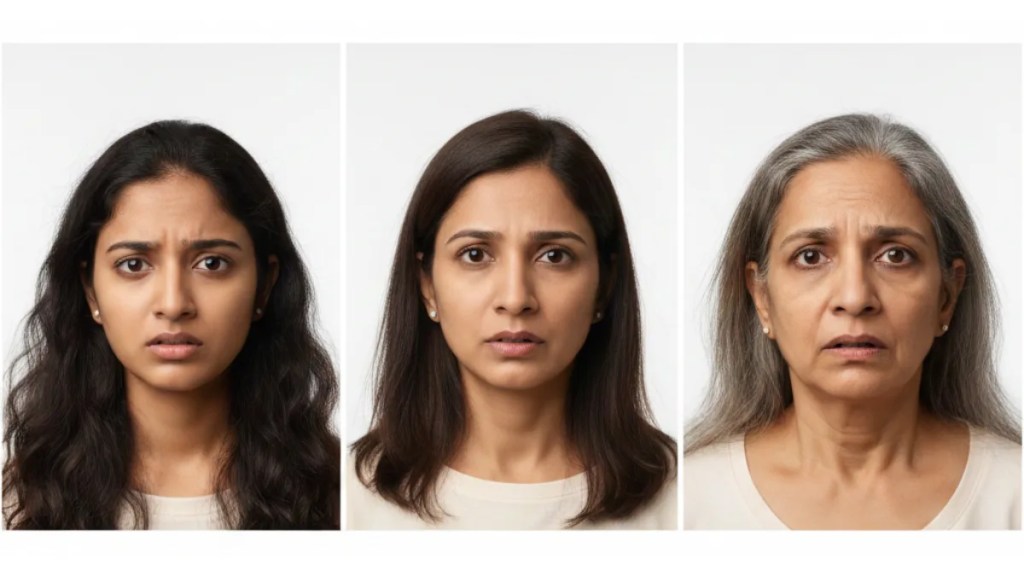
Menopause and Hair Loss — The Unavoidable Phase
Menopause is a natural transition — but it hits hair hard. When estrogen and progesterone levels crash during menopause, the body’s protective shield for hair disappears.
Why Hair Thins After Menopause
During the reproductive years, estrogen keeps hair in its growth phase (anagen) for longer. It promotes thick, strong hair.
After menopause:
- Estrogen drops sharply — hair growth slows down
- Progesterone declines — hair becomes thinner and weaker
- Relative androgen levels increase — even though total testosterone doesn’t rise, the ratio shifts because estrogen is gone
- Collagen production decreases — scalp loses elasticity, follicles weaken
The result is diffuse thinning across the entire scalp, especially at the front and top. Hair becomes finer, drier, and more fragile.
Menopause hair loss is partially reversible. Complete regrowth is difficult, but significant improvement is absolutely possible with the right nutrition, supplements, and medical support.
When to See a Doctor
Lifestyle changes are powerful — but they have limits. See a doctor immediately if:
- Hair loss is sudden and severe (clumps falling out)
- You have been making lifestyle changes for 3-4 months with no improvement
- You notice bald patches (not just thinning)
- Hair loss comes with extreme fatigue, chest pain, or depression
Tests your doctor will recommend:
- Complete Hormone Panel (Estrogen, Progesterone, Testosterone, DHEA-S)
- Thyroid Profile (TSH, T3, T4)
- Insulin and Blood Sugar levels
- Iron, Ferritin, Vitamin D, Vitamin B12
Medical treatments include Minoxidil (topical), Spironolactone (anti-androgen), thyroid medication, or Hormone Replacement Therapy (HRT) for menopausal women. Always take these under medical supervision.

How to Stop Hormonal Hair Loss in Women Naturally
Here is the truth — hormonal hair loss in women is not a life sentence. It is a signal from your body that something is wrong inside. Fix the inside, and the outside repairs itself.
Get Your Hormones Tested
Visit a doctor and get blood tests for TSH, testosterone, estrogen, DHEA-S, and insulin levels. This identifies whether PCOS, thyroid, or menopause is causing your hair loss.
Fix Your Diet
Eat anti-inflammatory foods rich in protein, iron, zinc, biotin and omega-3. Cut sugar, processed food and dairy. A hormone-friendly diet is the foundation of hair regrowth.
Exercise Daily for 30 Minute
Physical activity balances insulin, reduces cortisol, and improves blood circulation to hair follicles. Walking, yoga, or strength training — pick any and stay consistent.
Manage Stress and Fix Sleep
High cortisol from stress directly triggers hair fall. Practice meditation, deep breathing, or journaling. Sleep 7-8 hours every night without compromise.
Consult a Dermatologist if Needed
If lifestyle changes don’t show results in 3-4 months, consult a dermatologist. Treatments like minoxidil, spironolactone, or hormone therapy may be recommended based on your condition.
Frequently Asked Questions — Hormonal Hair Loss in Women
Is hormonal hair loss in women reversible?
Yes. Hormonal hair loss in women is reversible in most cases. Once you identify the root cause — PCOS, thyroid, or menopause — and take corrective action through lifestyle changes and medical treatment, hair regrowth begins within 3 to 6 months.
Which hormone causes the most hair loss in females?
DHT (Dihydrotestosterone) is the primary hormone responsible for female hair loss. It is linked to PCOS and high androgen levels. DHT shrinks hair follicles, makes hair thinner, and eventually stops new growth completely.
How do I know if my hair loss is hormonal?
If your hair loss comes with irregular periods, sudden weight changes, fatigue, acne, or mood swings — it is hormonal. A blood test for TSH, testosterone, estrogen, and DHEA-S confirms the exact hormonal issue within minutes.
Can PCOS hair loss grow back?
Yes. PCOS hair loss grows back once androgen levels are controlled. This requires a combination of a clean diet, regular exercise, stress management, and in some cases, anti-androgen medication. Consistency is everything.
Hormonal hair loss in women is rarely caused by a single factor. PCOS, thyroid dysfunction, and menopause all weaken follicles — and hard water mineral deposits compound this damage directly. Women dealing with hormonal hair loss who live in hard water cities face an accelerated timeline because hard water hair fall and hormonal triggers attack the follicle simultaneously.
CONCLUSION
Hormonal hair loss in women is real, common, and deeply painful — but it is NOT the end of the story.
PCOS, thyroid disorders, and menopause are the three biggest hormonal triggers. Each one damages hair differently — but the foundation of the solution remains the same: fix your lifestyle, fix your hormones, fix your hair.
No magic oil. No miracle shampoo. No overnight cure. Just real science, real discipline, and real results.
Your hormones went out of balance because your lifestyle changed. Bring the lifestyle back — and your hormones will follow. That is not a promise. That is biology.
Start today. Not tomorrow. Not Monday. Today.


4 thoughts on “Hormonal Hair Loss in Women: Why It Happens & How to Stop It Naturally”
Comments are closed.